


RPA Development Services That Actually Make Daily Work Easier
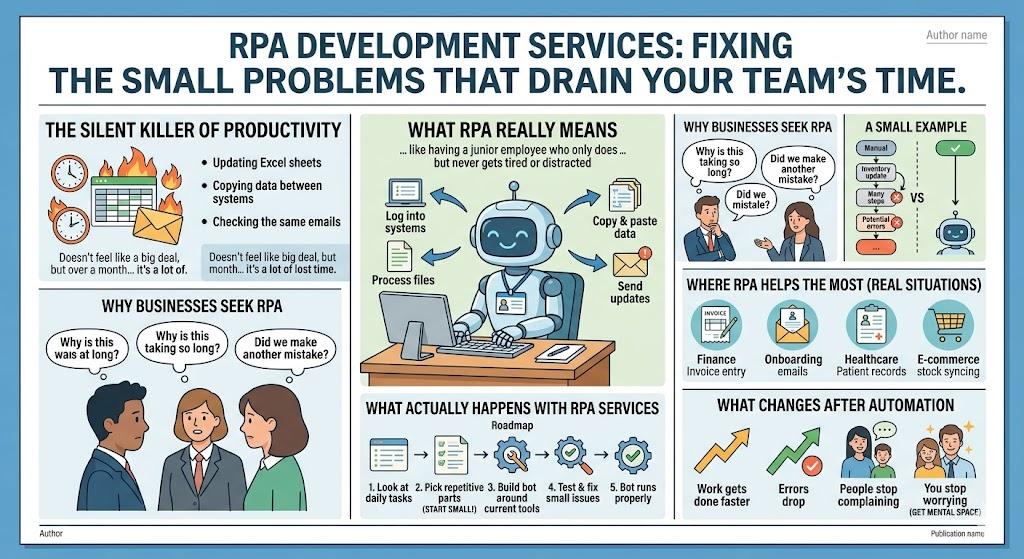
Let me start with something simple.
Most businesses do not struggle because of big problems.
It is usually the small, repetitive tasks that slowly eat up time.
I've seen teams spend 3-4 hours a day just updating Excel sheets, copying data between systems, or checking the same emails again and again. It doesn’t feel like a big deal at first… but over a month, that’s a lot of lost time.
That is usually the point where people start looking into RPA development services not because they want fancy tech, but because they’re just tired of doing the same work every day.
What RPA Really Means (No Complicated Words)
If I explain RPA the way I usually do to clients it is like having a junior employee who only does repetitive work… but never gets tired or distracted.
It can:
-
Log into systems
-
Copy and paste data
-
Process files
-
Send updates
I remember one client (a small finance team) who had one person just handling invoice entries the whole day. After we set up a simple bot, that same work was done in under an hour.
Not perfect on day one we had to tweak a few things but it worked.
That’s what RPA development services are really about. Not replacing people, just removing the boring part of their job.
Why Businesses Usually Come for RPA (From What I’ve Seen)
Honestly, no one wakes up and says, “Let’s implement RPA today.”
It usually starts like this:
Why is this taking so long?
Did we make another mistake in the report?
Why are we still doing this manually?
That’s when the conversation begins.
A small example
One retail client had someone updating inventory manually across two systems. Every evening. It took about 2 hours.
Sometimes they missed items. Sometimes numbers didn’t match.
We automated it. Not a huge project, just a simple bot.
First week? There were small issues. Happens.
Second week? Stable.
After that? They didn’t even think about it anymore.
That’s when you know it’s working.
What Actually Happens When You Go for RPA Development Services
A lot of people think it’s some big, complex setup. It’s really not (at least, it shouldn’t be).
Usually, it goes step by step.
First, we look at what you’re doing daily. Not everything, just the repetitive parts.
Then we pick one or two processes to automate. Starting small always works better.
Then the bot is built around your current system. No need to change your tools.
We test it. Fix small issues (there are always a few).
And once it runs properly, it just… keeps going.
I always tell clients not to try to automate everything at once. That’s where things get messy.
Where RPA Helps the Most (Real Situations)
You’ll see RPA working best in places where work feels repetitive.
Like in finance:
Someone downloading invoices, entering data, matching numbers.
In HR:
Collecting employee details, updating records, sending onboarding emails.
In healthcare:
Managing patient records or appointment entries.
In e-commerce:
Order updates, stock syncing, handling basic customer queries.
One time, we worked with a team that was copying data from emails into a CRM system. Every single day. That’s it.
We automated just that.
It wasn’t a big transformation project… but it saved them a few hours daily. And honestly, that’s enough sometimes.
What Changes After Automation? (Not Overnight, But Gradually)
Let me be honest, it is not magic.
The first few days, you’ll watch the bot closely. You’ll double-check things. You might even feel like doing it manually again “just to be safe.”
Totally normal.
But after a couple of weeks, you’ll notice:
Work gets done faster
Errors drop
People stop complaining about repetitive tasks
And the biggest one?
You stop worrying about those tasks completely.
That mental space matters more than people realize.
Choosing the Right RPA Team (This Part Is Important)
I’ve seen projects fail not because of RPA… but because of overcomplication.
Some teams try to make everything too advanced.
But good RPA development services should feel simple.
They should:
-
Understand what you actually need (not oversell)
-
Start small and build gradually
-
Be okay fixing things after launch
-
Talk in simple terms, not technical jargon
If it sounds confusing from day one, that’s usually not a good sign.
Where RPA Is Heading
Now, yes.. AI is getting added into RPA. Bots are becoming smarter.
But honestly? Most businesses don’t even need that level yet.
What they need is simple automation that works properly.
Even today, just automating basic tasks can save hours every week.
And that’s already a big win.
Conclusion
If your team is spending hours on repetitive work, you don’t need a big transformation plan.
You just need to fix one or two things first.
That’s where RPA development services help the most small improvements that actually make daily work easier.
Not everything has to change overnight.
Sometimes, removing just one frustrating task from your day…
is more valuable than anything else.

 English
 Arabic
 French
 Spanish
 Portuguese
 Turkish
 Dutch
Dutch
 Italiano
 Russian
 Romaian
 Portuguese (Brazil)
 Greek
Greek