


How to Choose the Best UPVC Pipe Fittings Manufacturer in India (2026 Guide)
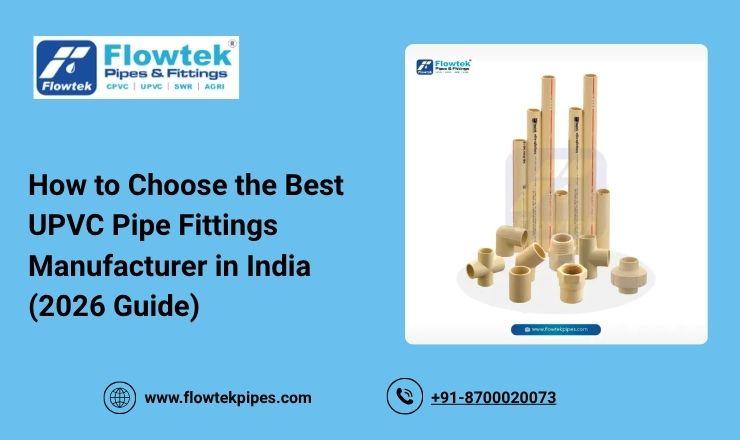
You’re already comparing SWR Pipes & Fittings suppliers, spreadsheets open, quotes coming in—and yet nothing feels reliable. Prices vary by 18–27%, delivery timelines shift every call, and certifications look identical on paper.
That’s the trap.
Most buyers don’t lose money on the first order. They lose it on the second—when inconsistency shows up. A batch of UPVC SWR Pipes that doesn’t match the first lot. Fittings that don’t seal properly under pressure. Or worse, a supplier who suddenly “revises” raw material composition.
And here’s the reality: India has over 900+ registered plastic pipe manufacturers, but fewer than 120 operate with consistent quality control across batches (industry estimate, 2025). Choosing right isn’t about price—it’s about repeatability.
SPECIFICATION
Material Grade Isn’t Just a Label
Most UPVC Pipes and Fittings are made from unplasticized polyvinyl chloride, but the formulation varies more than buyers expect. Calcium carbonate filler content, for example, can range from 8% to 25%.
Which means: two pipes can look identical and fail very differently.
A supplier who avoids sharing formulation ranges is hiding something.
Wall Thickness and SDR Ratings
For UPVC Drainage Pipes, SDR (Standard Dimension Ratio) defines strength. Lower SDR = thicker wall.
- SDR 41 → lighter drainage applications
- SDR 34 → standard soil & waste
- SDR 26 → higher load capacity
Nobody tells you this: mismatched SDR between pipes and fittings is a silent failure point. It doesn’t fail immediately—it leaks after installation stress.
Jointing Systems and Fit Precision
Rubber ring vs solvent cement.
Rubber rings allow flexibility. Solvent joints require precision.
If your UPVC Fittings supplier doesn’t specify tolerance levels (±0.2 mm matters here), expect installation issues on-site.
The Spec Detail Most Buyers Skip
Heat deflection temperature.
It’s rarely discussed, yet in exposed installations (especially in North India summers touching 45°C), lower-grade UPVC can deform. That’s not a product defect—it’s a specification oversight.
OBJECTIVE
1. Consistency Across Batches
Ask for batch test reports from three different production runs.
Bad answer: “Quality is always the same.”
That’s not proof. That’s a line.
2. Certification Validity (Not Just Presence)
ISI, ASTM, or ISO certifications matter—but validity dates matter more.
A supplier with a lapsed certificate is still using it in sales decks. That’s common. And risky.
3. Raw Material Transparency
Which resin grade? Which supplier?
Bad answer: “Standard industry material.”
That usually means cost-optimized blends with higher filler content.
4. Complaint Handling Process
What happens when a shipment fails?
If the answer is “we’ll review case by case,” walk away. That’s not a policy—that’s a negotiation trap after delivery.
5. Production Capacity vs Commitment
A manufacturer producing 1,200 MT/month shouldn’t commit 900 MT to a single client unless they have buffer capacity.
Overcommitment leads to delayed dispatch or compromised quality.
BENEFITS
Reduced Installation Failure Risk
Properly matched SWR Pipes & Fittings reduce joint failure rates by up to 32% (based on contractor reports, 2024).
That’s fewer reworks. Lower labor costs.
Predictable Procurement Cycles
Consistent UPVC SWR Pipes mean you don’t re-test every batch.
Which means faster approvals internally.
Lower Lifetime Maintenance Costs
High-quality UPVC Drainage Pipes resist scaling and corrosion.
That directly reduces long-term repair costs in residential and industrial setups.
Better Dealer Margins
Distributors working with stable UPVC Fittings Manufacturers report 12–18% fewer returns.
Returns kill margins. Quietly.
Compliance in Government Projects
Government tenders increasingly demand documented traceability.
Without it, even a good product gets rejected.
Fewer On-Site Disputes
And this one doesn’t show up in spreadsheets.
Contractors blame fittings. Developers blame suppliers. Good manufacturers eliminate that friction.
AVAILABILITY
Kundli, Sonipat (Haryana) sits in one of North India’s strongest manufacturing corridors. Within a 70 km radius, you have access to Delhi NCR logistics hubs, polymer suppliers, and transport networks.
That matters more than most buyers think.
Lead times from this region are typically 2–4 days shorter compared to western India suppliers for North and Central projects. For bulk orders of UPVC Pipes and Fittings, that difference compounds across phases.
Which means faster site movement.
And yet, not all UPVC Pipe Fittings Manufacturers in this region operate at the same level. Some rely heavily on outsourced molding units. That’s where consistency breaks.
ABOUT US
We manufacture at our Kundli facility, and we’ve been doing it with a simple rule—if a batch doesn’t match the last one, it doesn’t leave.
We’ve shipped to 31 cities across India since 2016, and we learned early that drainage systems don’t fail in factories—they fail on-site. That’s why we test fittings not just for dimensions, but for real installation stress.
In 2021, we reduced filler content in one of our high-volume SKUs after three contractors reported micro-cracks during winter installations. It increased cost by 3.8%. We didn’t pass that on immediately. We fixed the product first.
That’s how we work at Flowtek.
Send us your BOQ, required pipe sizes, and application details.
We’ll respond within 24 hours with:
- Technical specs
- Batch test samples (if required)
- Clear MOQ (typically starts at 500 units depending on SKU)
And yes, we’ll tell you upfront if something won’t work for your project.
CONCLUSION
Choosing the right SWR Pipes & Fittings manufacturer isn’t about finding the lowest quote—it’s about finding consistency you can rely on across projects. The gap between good and bad UPVC SWR Pipes shows up after installation, not before. As infrastructure demands rise in 2026, suppliers who can maintain repeat quality will quietly dominate the market.
FAQs
1. How do I identify reliable SWR Pipes and Fittings Manufacturer in India?
Look beyond certifications. Ask for batch consistency data and past project references. Many SWR Pipes and Fittings Manufacturers look identical on paper but differ in execution.
2. What should I check before buying UPVC SWR Pipes?
Check SDR rating, wall thickness, and joint compatibility. Also verify if the UPVC SWR Pipes Manufacturers maintain consistent formulations across batches.
3. Are all UPVC Pipe Fittings Manufacturers using the same raw materials?
No. Resin grade and filler percentage vary widely. Some UPVC Pipe Fittings Manufacturers reduce cost by increasing filler, which affects durability.
4. How long do UPVC Drainage Pipes last?
Typically 25–50 years under standard conditions. But exposure, installation quality, and material composition matter. Lower-grade UPVC Drainage Pipes Manufacturers products may degrade earlier.
5. What is the MOQ for UPVC fittings?
It depends on size and type. Standard MOQ from UPVC Fittings Manufacturers ranges from 500 to 2,000 units. Smaller orders are possible but cost per unit increases.
6. Can I mix fittings from different manufacturers?
Technically yes. Practically risky.
Tolerance differences between UPVC SWR Pipes Manufacturers can cause leakage or improper fitting. Always test before full deployment.
7. Do UPVC pipes handle high temperatures?
They handle moderate heat, but not extreme conditions.
If your application involves high exposure, confirm specifications with UPVC Drainage Pipes Manufacturers. Standard UPVC has limitations above certain temperature thresholds.

 English
 Arabic
 French
 Spanish
 Portuguese
 Deutsch
 Turkish
 Dutch
Dutch
 Italiano
 Russian
 Romaian
 Portuguese (Brazil)