


How RS-485 to Ethernet Converters Enable Load Balancing Across EV Charging Stations
Electric vehicle (EV) adoption is growing fast. Reports show global EV sales hit 14 million units in 2023. This growth puts a heavy strain on the electrical grid. Most commercial buildings cannot support 20 chargers running at full power. If every car draws maximum current, the circuit breaker trips.
Load balancing solves this problem. It distributes available power across all active chargers. To do this, chargers must talk to a central controller. This is where an RS-485 to Ethernet Converter becomes essential. It allows the charging network to manage power in real-time.
The Role of RS-485 in Charging Hardware
Most EV chargers use the RS-485 protocol for internal communication. Manufacturers choose RS-485 because it is reliable and cheap. It works well in noisy electrical environments. Large power cables create electromagnetic interference (EMI). RS-485 resists this noise using differential signaling.
However, RS-485 is a local protocol. It only sends data over short distances between devices. It cannot connect to the internet or a cloud-based management system. A standalone RS-485 charger is "blind" to the rest of the network. It does not know if another charger is drawing too much power.
What is an RS-485 to Ethernet Converter?
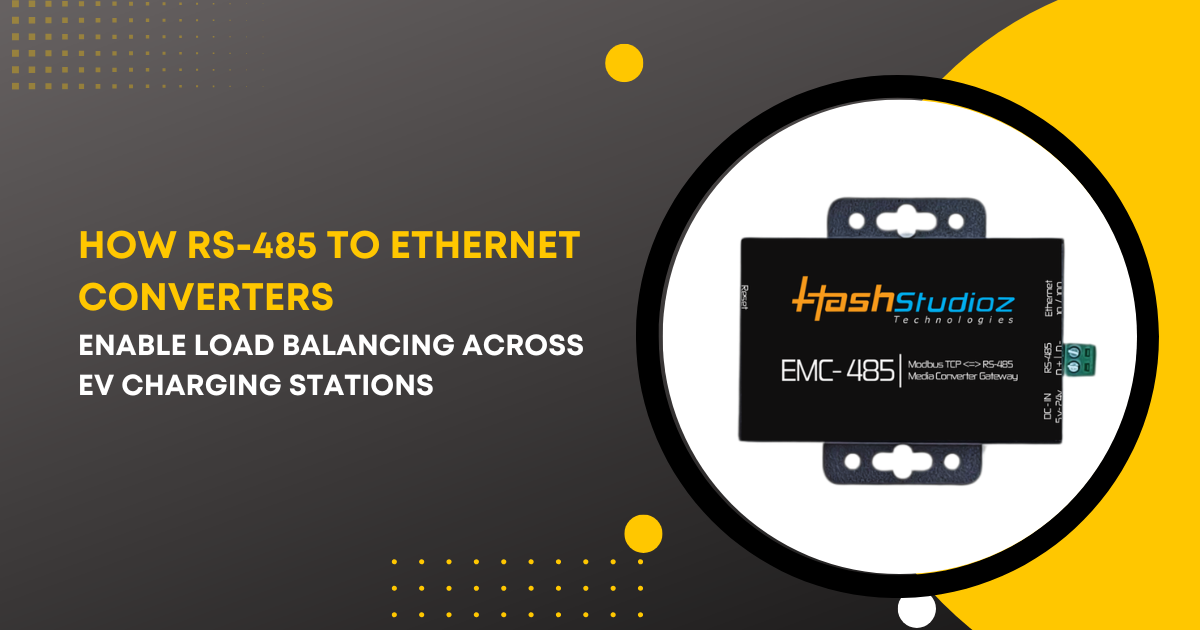
An RS-485 to Ethernet Converter serves as a digital bridge. It takes the serial data from the charger and converts it into IP packets. These packets travel over a standard Local Area Network (LAN).
This device is often called an RS-485 to Lan Converter. It allows the charging station to join the building's IT network. Once on the network, the charger can send data to a central server. This server makes decisions about power distribution.
How Converters Enable Static Load Balancing
Static load balancing sets a fixed limit for a group of chargers. Suppose a parking garage has a 100kW limit. It has 10 chargers that can each draw 22kW. Without management, five cars would blow the fuse.
The RS-485 to Ethernet Converter connects all 10 chargers to a local controller. The controller monitors the total draw.
-
Data Collection: The converter pulls amperage data from each charger via RS-485.
-
Network Transmission: It sends this data to the controller over Ethernet.
-
Command Delivery: If the total hits 100kW, the controller sends commands back.
-
Power Capping: The converter delivers the command to the chargers to drop to 10kW each.
Dynamic Load Balancing and Real-Time Data
Dynamic load balancing is more advanced. It looks at the total building load, not just the chargers. If the building's air conditioning turns off, more power becomes available for cars.
The RS-485 to Lan Converter plays a vital role here. It provides the high-speed data path needed for rapid adjustments.
-
Frequency: Converters can relay data every few milliseconds.
-
Accuracy: Digital transmission prevents the signal loss found in long analog wires.
-
Integration: The converter allows the charging system to talk to the Building Management System (BMS).
Statistics show that dynamic load balancing can increase charging capacity by 60% without upgrading the grid. This saves property owners thousands of dollars in infrastructure costs.
Technical Advantages of Ethernet Over Serial
Using an RS-485 to Ethernet Converter offers several technical benefits for EV sites.
1. Long Distance Connectivity
RS-485 has a limit of about 1,200 meters. Ethernet can span entire cities via fiber optics and switches. In a large mall parking lot, chargers may be far from the server room. The converter allows data to travel across the existing fiber backbone.
2. Reduced Cabling Complexity
Running individual RS-485 wires to a central point is difficult. With a converter, you can use existing network wall jacks. This lowers installation labor costs by up to 30%.
3. Remote Configuration
Most RS-485 to Lan Converter models have a web interface. Technicians can change settings from their office. They do not need to open the charger housing to troubleshoot serial connections.
Real-World Examples
1. Office Park Charging
An office park installed 30 EV chargers for employees. The local utility could only provide 150kW of extra power. Each charger required 11kW at peak. This created a potential 330kW demand.
The park used an RS-485 to Ethernet Converter on each charging cluster.
The results were immediate:
-
Grid Stability: The total load never crossed the 150kW threshold.
-
Uptime: The system reported zero tripped breakers over six months.
-
User Satisfaction: The system prioritized cars with low battery levels. It gave them more power while slowing down cars that were nearly full.
2. Multi-Unit Apartment Complex
An apartment building had limited electrical capacity in its basement. They wanted to offer charging to 12 residents. They installed an RS-485 to Lan Converter to link the chargers to a cloud-based billing and balancing system.
The results were immediate:
-
Cost Savings: The owner avoided a $50,000 transformer upgrade.
-
Revenue Tracking: The converter sent precise energy usage data to the billing software.
-
Scalability: The building added four more chargers later by simply plugging them into the network switch.
3. Public Fast Charging Hub
A highway rest stop installed four DC fast chargers and six Level 2 chargers. Fast chargers draw massive amounts of power instantly. This can cause voltage drops that damage other equipment.
The hub used an RS-485 to Ethernet Converter to sync the chargers with a large battery storage system.
The results were immediate:
-
Peak Shaving: When a fast charger started, the converters signaled the Level 2 units to slow down.
-
Response Time: The network latency stayed below 50ms, ensuring smooth transitions.
-
Data Logging: The hub owners kept 99.9% accurate records of every charging session for tax credits.
3. Fleet Depot Management
A delivery company switched 50 vans to electric. All vans charge at night. The company needed to ensure all vans were full by 6:00 AM without paying "peak demand" charges from the utility.
They implemented an RS-485 to Lan Converter solution for the entire warehouse.
The results were immediate:
-
Energy Bill Reduction: The company lowered its monthly utility bill by 18% through scheduled charging.
-
Operational Readiness: Every van reached 100% charge before the morning shift began.
-
Remote Monitoring: The fleet manager tracked the health of all 50 chargers from a single dashboard.
Critical Features for EV Converters
Not every RS-485 to Ethernet Converter is suitable for EV charging. You must choose industrial-grade hardware.
-
Modbus Support: Most chargers speak Modbus RTU. The converter must translate this to Modbus TCP.
-
Electrical Isolation: Charging stations have high voltages. Isolation protects the network from surges. Look for 1.5KV or higher.
-
Mounting: DIN-rail mounts allow the converter to fit inside the charger or a nearby control box.
-
Wide Temperature Range: Charging stations sit outside. The device must work from -40°C to 75°C.
Improving Network Security
Connecting chargers to a LAN introduces security risks. Hackers could try to disable load balancing to crash the grid.
Proper setup of the RS-485 to Lan Converter prevents this.
-
VLAN Tagging: Put all charging traffic on a private network.
-
Encryption: Use converters that support SSL/TLS for data transmission.
-
Access Control: Disable unused ports and change all default passwords.
The Economics of Data Conversion
Adding an RS-485 to Ethernet Converter adds a small cost per charger. Typically, this is between $50 and $150. However, the savings are much larger.
Upgrading a building's main electrical panel can cost $20,000 to $100,000. Load balancing removes the need for this upgrade. The converter is the tool that makes this saving possible. It turns a "dumb" charger into a "smart" node.
Future Trends in EV Infrastructure
The future of charging is bidirectional. This is "Vehicle-to-Grid" (V2G) technology. Cars will not just take power; they will give it back during peak times.
This requires even more data exchange. The RS-485 to Ethernet Converter will handle these complex data flows. It will allow the grid to treat a parking lot like a giant battery. High-speed LAN connectivity is the only way to manage these thousands of data points safely.
Final Thoughts
Load balancing is the secret to mass EV adoption. It allows us to use our existing grid more efficiently. The RS-485 to Ethernet Converter is the unsung hero of this process. It bridges the gap between old serial hardware and modern high-speed networks.
By using an RS-485 to Lan Converter, operators gain total control over their power. They save money on construction and electricity. Most importantly, they provide a reliable charging experience for drivers. As the world moves to electric transport, these small converters will be in every parking lot and garage. They ensure that the lights stay on while the cars charge up.

 English
 Arabic
 French
 Spanish
 Portuguese
 Deutsch
 Dutch
Dutch
 Italiano
 Russian
 Romaian
 Portuguese (Brazil)
 Greek
Greek