


Vietnam Exports 2025: Growth, Top Products & Trade Partners
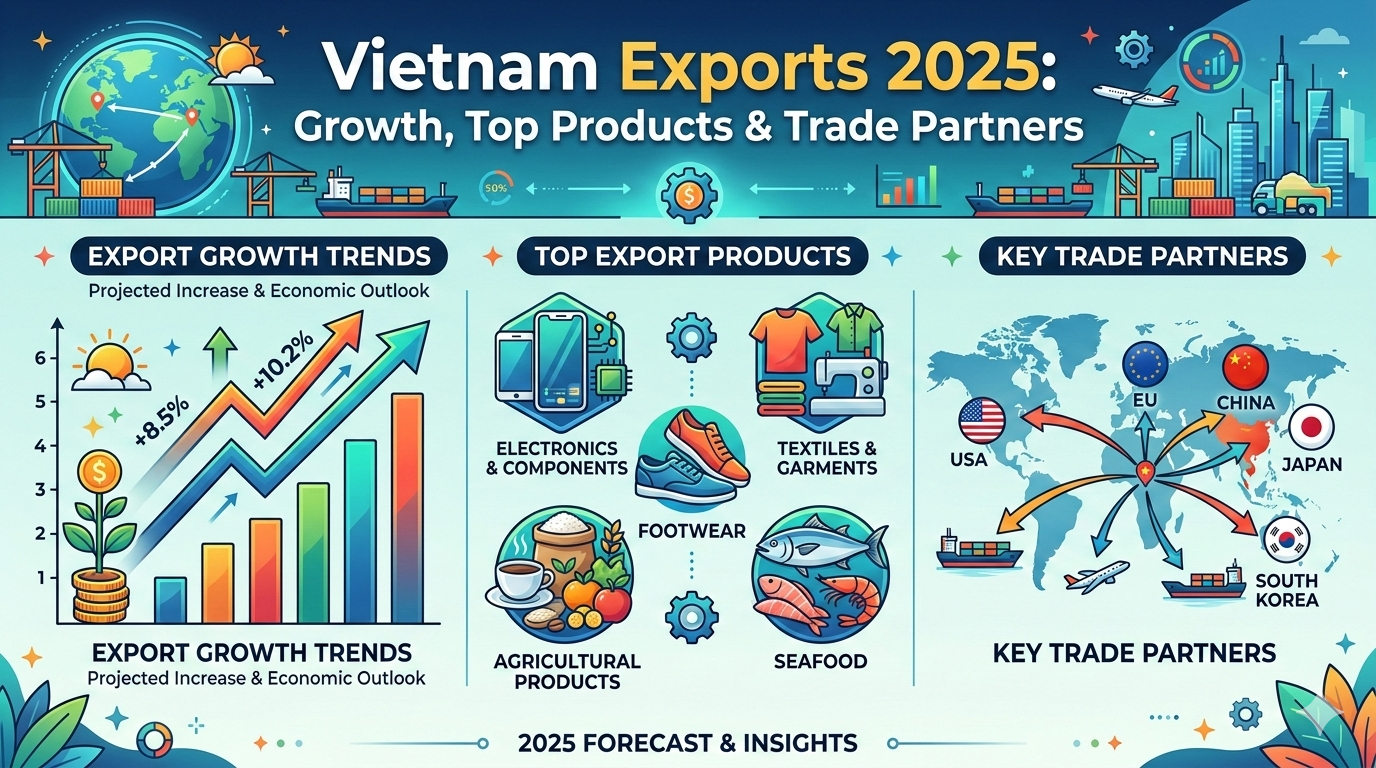
In recent years, Vietnam has emerged as one of the fastest-growing export-driven economies in Asia. With its strategic geographic location in Southeast Asia, competitive labor costs, expanding manufacturing base, and strong participation in global trade agreements, the country has positioned itself as a critical link in global supply chains. The steady rise of vietnam exports reflects not only production growth but also deepening integration into international markets.
According to recent vietnam export data, the country’s total exports reached approximately $403.2 billion in 2024, marking a 6.4% increase compared to the previous year. In the first quarter of 2025 alone, exports totaled $102.8 billion, up 10.6% year-on-year. Total trade turnover in Q1 2025 stood at $202.5 billion, reflecting a 13.7% annual increase. These figures from official vietnam customs data and trade reports confirm Vietnam’s growing prominence as the world’s 21st largest exporter.
As global supply chains diversify away from over-concentration in single markets, vietnam exports continue to benefit from geopolitical shifts, free trade agreements, and foreign direct investment (FDI). Let’s explore Vietnam’s main export sectors, its leading trade partners, top exporters, historical trends, and the outlook for 2025 and beyond.
Vietnam Main Exports: Top 10 Export Products by HS Code
Vietnam has built a diverse export portfolio spanning electronics, machinery, textiles, agriculture, and wood products. Based on official vietnam trade data and export statistics for 2024–25, the following sectors dominate:
1. Electrical Machinery & Equipment (HS Code 85) – $121.7 Billion
Electrical machinery leads all categories, accounting for nearly 29.5% of total exports. This sector includes smartphones, computers, integrated circuits, and electronic components. Global tech giants have established major manufacturing operations in Vietnam, turning it into a global electronics hub.
2. Footwear (HS Code 64) – $25.4 Billion
Vietnam is one of the world’s largest footwear exporters. With 6.1% of total exports, the country supplies athletic shoes, leather footwear, and sportswear to major global brands.
3. Machinery & Mechanical Appliances (HS Code 84) – $23.5 Billion
Mechanical equipment, engines, and industrial machinery form a strong pillar of vietnam main exports, representing 5.7% of total export value.
4. Articles of Apparel (Knit) (HS Code 61) – $21.2 Billion
Vietnam is the second-largest textile exporter globally. Knit garments such as T-shirts, sweaters, and sportswear remain in high demand.
5. Articles of Apparel (Not Knit) (HS Code 62) – $19.7 Billion
Non-knit apparel like jackets, formal suits, and uniforms contribute significantly to vietnam exports.
6. Furniture & Bedding (HS Code 94) – $14.2 Billion
Vietnam has become a key global furniture supplier. The sector benefits from strong demand in the U.S. and Europe.
7. Fish & Seafood (HS Code 03) – $9.8 Billion
Shrimp, pangasius fish, and squid are leading seafood exports.
8. Wood & Wood Articles (HS Code 44) – $6.5 Billion
Wood panels, plywood, and finished wooden goods are major export earners.
9. Coffee, Tea & Spices (HS Code 09) – $5.6 Billion
Vietnam is the world’s second-largest coffee exporter and a leading pepper supplier.
10. Rubber & Articles (HS Code 40) – $4.3 Billion
Rubber tires and industrial rubber products round out the top ten categories.
Together, these categories form the backbone of vietnam main exports, with manufacturing accounting for nearly 88.7% of total export output.
Vietnam Exports by Country: Top Trade Partners
A strong network of global trade relationships supports Vietnam’s export momentum. The structure of vietnam exports by country highlights its reliance on major developed economies and regional partners.
1. United States – $113.9 Billion (27.5%)
The U.S. is Vietnam’s largest export market. Electronics, textiles, footwear, and furniture dominate shipments. The trade surplus with the U.S. reached $12.2 billion in May 2025 alone, reflecting strong American demand.
2. China – $60.7 Billion (14.7%)
China imports agricultural goods, electronics, and machinery from Vietnam. Bilateral trade continues expanding despite global tensions.
3. South Korea – $28.2 Billion (6.8%)
South Korea is both a major investor and export destination.
4. Japan – $26.8 Billion (6.5%)
Japan imports seafood, machinery, and electronics.
5. Hong Kong – $20.1 Billion (4.9%)
A key re-export and trading hub.
6. Germany – $14.7 Billion (3.6%)
Strong demand for machinery and electronics.
7. Netherlands – $10.3 Billion (2.5%)
Agriculture and textiles dominate trade.
8. United Kingdom – $9.2 Billion (2.2%)
9. Thailand – $8.8 Billion (2.1%)
10. India – $7.5 Billion (1.8%)
The structure of vietnam exports by country demonstrates diversification across North America, Europe, and Asia, reducing overdependence on a single region.
Top Vietnam Exporters Driving Growth
Foreign direct investment plays a critical role in shaping vietnam exports. Approximately 72% of exports come from FDI-backed firms, while domestic companies contribute 27.9%.
Leading exporters include:
-
Samsung Group (Vietnam) – $65 Billion
-
Intel Products Vietnam – $12.9 Billion
-
LG Group – $8.2 Billion
-
Foxconn Vietnam – $4.5 Billion
-
NatSteelVina – $8 Billion
-
VINATEX – $800 Million
-
Vinamilk – $180 Million
Electronics and semiconductors dominate the list, underscoring Vietnam’s role in global technology supply chains. At the same time, domestic firms in agriculture and textiles continue strengthening their global presence.
Historical Growth of Vietnam Exports
Vietnam’s export journey over the past decade reveals consistent upward momentum:
-
2014: $150.21 Billion
-
2017: $215.11 Billion
-
2020: $281.44 Billion
-
2021: $335.79 Billion
-
2022: $370.90 Billion
-
2023: $353.07 Billion
-
2024: $403.20 Billion
-
Q1 2025: $102.80 Billion
Despite temporary slowdowns during global economic disruptions, vietnam exports have nearly tripled in ten years. This long-term growth trend is supported by strategic trade agreements such as CPTPP, EVFTA, and RCEP.
Tariff Risks & Policy Impacts in 2025
While growth remains strong, tariff risks present challenges. U.S. Section 232 tariffs impose 25% duties on steel and aluminum. A proposed 46% reciprocal tariff on Vietnamese goods remains under negotiation.
In anticipation of possible tariff increases, May 2025 saw exports surge 17% year-over-year, as businesses accelerated shipments. This highlights how policy changes directly influence vietnam trade data patterns.
Exporters must monitor regulatory updates closely and strengthen compliance documentation to address origin scrutiny.
Opportunities for Buyers & Suppliers
For Importers:
-
Lock in long-term contracts for textiles and furniture.
-
Monitor fluctuations in agricultural commodities.
-
Utilize preferential tariff treatment under FTAs.
For Exporters:
-
Diversify markets beyond the U.S.
-
Enhance value-added manufacturing.
-
Invest in raw material localization.
-
Ensure compliance using updated vietnam customs data procedures.
Strategic diversification will help stabilize vietnam exports by country, especially amid global trade volatility.
2025 Outlook: Can Vietnam Surpass $450 Billion?
Export growth is projected to remain between 10–15% in 2025. If sustained, annual export value could exceed $450 billion.
Key growth drivers include:
-
Continued electronics manufacturing expansion
-
Supply chain diversification from China
-
Strong U.S. consumer demand
-
Regional trade agreements
-
Expanding middle-tech manufacturing
However, risks remain from global tariff volatility, environmental regulations in the EU, and geopolitical tensions.
Conclusion
Vietnam has transformed into a global export powerhouse within a decade. With strong electronics manufacturing, competitive textile production, and a growing agricultural sector, vietnam exports continue to expand despite global uncertainty. The diversification seen in vietnam exports by country ensures resilience, while manufacturing strength reinforces its strategic supply chain position.
Official vietnam export data, vietnam trade data, and vietnam customs data indicate sustained momentum heading into 2025. As the country balances tariff risks and new trade opportunities, both buyers and suppliers must stay informed and adaptable.
Looking ahead, Vietnam’s ability to leverage trade agreements, strengthen domestic manufacturing capacity, and expand into emerging markets will determine the next chapter of its export success story.

 English
 Arabic
 French
 Spanish
 Portuguese
 Deutsch
 Dutch
Dutch
 Italiano
 Russian
 Romaian
 Portuguese (Brazil)
 Greek
Greek