


Smart Agriculture Solutions: Deploying RS-485 IoT Gateways for Soil and Environment Sensors in Remote Fields
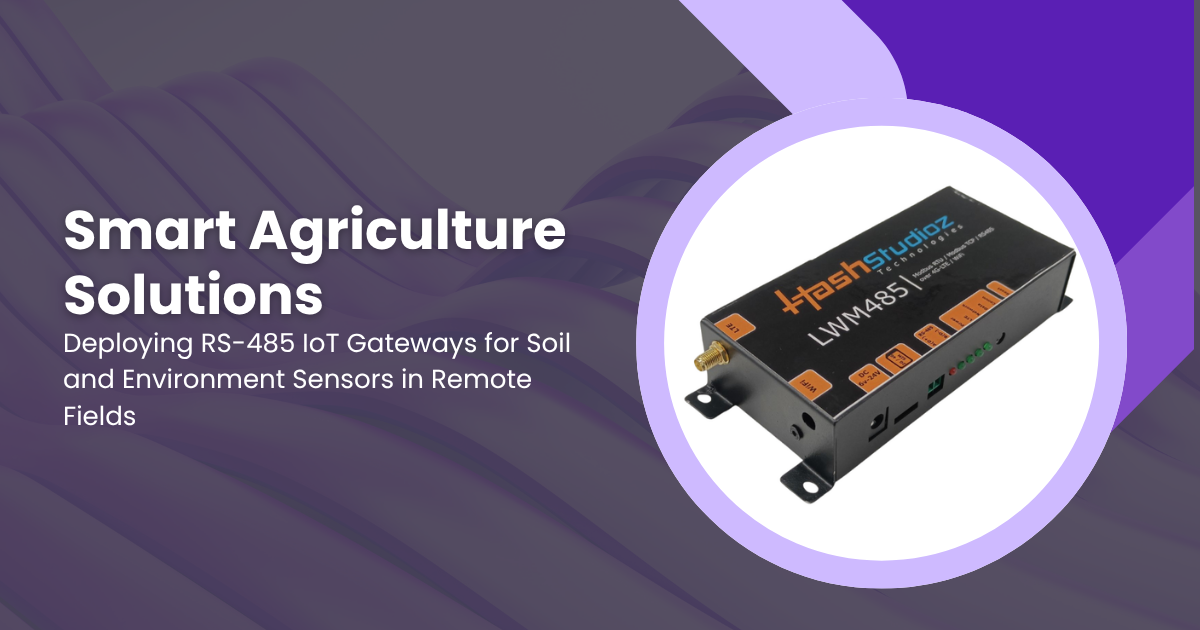
The global smart agriculture industry depends heavily on precise field data. Modern farming operations require constant tracking of environmental factors to maximize crop yields. Farmers must monitor soil moisture, temperature, and nutrient levels across vast geographical areas. Remote fields present harsh environmental conditions and long physical distances. Standard wireless sensors often fail over long ranges because dense crop canopies block wireless signals.
Industrial wired standards solve these remote communication challenges effectively. The RS-485 serial communication standard provides excellent reliability in agricultural setups. This technology withstands electrical interference and spans long distances without signal degradation.
Building a reliable field monitoring network requires a centralized data collection hub. An RS-485 IoT Gateway serves as this central hub by collecting local sensor data. The IoT Gateway translates serial data packets into internet protocols and transmits them to cloud platforms. This architecture ensures continuous data flow from the underground root zone directly to farm management software.
Understanding RS-485 in Modern Agriculture
The RS-485 standard defines a physical layer communication protocol that uses differential signaling. It utilizes a twisted pair of insulated wires to transmit digital information. Electrical noise from irrigation pumps, tractors, and overhead power lines often disrupts field electronics. RS-485 resists this electrical noise by measuring the voltage difference between two signaling lines.
The protocol supports total cable lengths up to 1,200 meters, which allows coverage across massive farm plots. It utilizes a multi-drop network design, meaning users can connect multiple sensors to one continuous cable run. A single network bus line easily supports up to 32 standard field devices. The simple wiring layout uses two main lines, labeled A and B, which lowers installation costs in long trenches.
Wired configurations eliminate the risk of wireless signal drops caused by physical obstructions. Crops, trees, and rolling terrain do not block or weaken physical serial signals. This makes the standard ideal for permanent installations in orchards, vineyards, and dense grain fields.
The Role of the RS-485 IoT Gateway
An RS-485 IoT Gateway bridges local field networks and the global internet. Field sensors collect raw data using serial protocols like Modbus RTU, which cannot travel directly over the internet. The gateway device receives these serial packages and translates them into internet-friendly communication protocols.
The hardware handles several data processing tasks locally at the edge of the field network. It converts Modbus data registers into lightweight MQTT or HTTPS protocols for cloud transmission. It features built-in flash memory or SD card slots to save data locally during cellular network outages. This local logging prevents data loss when remote network towers experience downtime.
The gateway also manages power delivery to the connected field sensors. It switches sensor power lines off between reading cycles to conserve system energy. Once the reading cycle finishes, the device utilizes cellular networks or long-range radio to upload the information.
Essential Agricultural Sensors for Field Deployment
Different types of sensors monitor specific variables across the agricultural landscape. These devices use internal microcontrollers to convert analog physical properties into digital RS-485 signals.
1. Soil Attribute Sensors
Soil quality dictates crop production rates and structural root health. These specialized instruments stay buried in the active root zone throughout the growing season.
-
Moisture and Temperature Sensors: These tools track volumetric water content within the soil particles. The data helps managers calculate precise irrigation schedules and avoid overwatering.
-
Electrical Conductivity Sensors: These units measure soil salinity levels by checking electrical resistance. High salinity harms root systems and restricts natural water uptake by plants.
-
Soil NPK Sensors: These instruments estimate Nitrogen, Phosphorus, and Potassium concentrations. Farmers use this specific data to adjust fertilizer application schedules and save input costs.
-
Soil pH Probes: These devices track the acidity or alkalinity of the field soil. Most commercial crops require a stable pH range between 6.0 and 7.5 for optimal nutrient absorption.
2. Environmental Sensors
Weather conditions alter crop growth patterns and influence disease development. Above-ground sensors help track these rapid environmental changes in real time.
-
Ambient Air Temperature and Humidity Probes: These instruments monitor the immediate microclimate around the crop leaves. The data predicts immediate frost risks and potential pest outbreaks.
-
Solar Radiation Sensors: These pyranometers calculate total sunlight exposure hitting the field canopy. The information helps agronomy software estimate local crop photosynthesis rates.
-
Barometric Pressure Sensors: These components track local atmospheric pressure shifts over time. They assist farm managers in short-term rain prediction and storm tracking.
Designing the Field Network Architecture
A proper field network layout ensures stable data transfer over several years of operation. Engineers must plan the physical cable topology and electrical characteristics carefully before digging trenches.
Outdoor environments destroy standard commercial wires due to moisture, temperature swings, and wildlife. Field installations require industrial-grade cabling with shielded twisted-pair wires to stop external electromagnetic interference. Technicians select cables with Polyethylene or Polyurethane jackets to resist ultraviolet radiation from sunlight. They choose water-resistant, direct-burial cables for underground runs to prevent moisture absorption.
Modbus RTU operates as the primary software protocol over the physical RS-485 lines. It uses a master-slave configuration model where the RS-485 IoT Gateway acts as the network master. Each underground soil sensor acts as a slave device with a unique address from 1 to 247. The gateway queries each address sequentially to gather measurements without data collisions.
Deploying the IoT Gateway in Remote Environments
Remote agricultural fields lack stable AC power lines and traditional wired internet infrastructure. The gateway deployment strategy must address these physical limitations with specialized field hardware.
An IoT Gateway requires a reliable power source to run continuously through changing seasons. Solar power systems provide the most practical solution for remote fields. A 20-watt to 50-watt solar panel generates sufficient energy during daylight hours.
The system stores this energy in lithium iron phosphate batteries due to their excellent outdoor temperature tolerance. Software engineers program the gateway to enter low-power sleep modes between active sensor reading cycles. This reduction in power usage saves battery life during cloudy winter weeks.
Benefits of Wired RS-485 Sensors Over Wireless Nodes
Many system integrators debate between deploying wired sensors or individual wireless sensor nodes. Wired RS-485 setups offer specific operational advantages in heavy commercial farming environments.
Wireless sensor nodes require individual batteries spread across hundreds of acres of land. Changing hundreds of separate field batteries increases annual maintenance labor costs significantly. An RS-485 network provides power directly through the central bus cable. The gateway powers all connected field sensors from one centralized solar battery source, which simplifies battery maintenance.
Dense crop canopies block wireless radio frequencies and absorb signal energy. Wet leaves from corn or fruit trees absorb 2.4 GHz wireless signals quickly. Wired networks eliminate this signal attenuation completely because data travels safely through buried cables. The communication line remains unaffected by crop growth stages, heavy foliage, or rainy weather.
Data Security and Cloud Integration
Field data remains valuable for agricultural corporations, supply chain managers, and commodity traders. Protecting the data stream prevents data manipulation, falsified yield reports, and malicious network intrusion.
The IoT Gateway must protect data before transmitting it over public cellular networks. Modern industrial gateways include dedicated hardware security modules to handle encryption tasks. The system encrypts all outgoing data packets using TLS 1.3 encryption standards.
The cloud platform receives the encrypted data stream from the RS-485 IoT Gateway via an MQTT broker. It decrypts the incoming messages and stores the raw parameters inside time-series databases.
Advanced data visualization software transforms these raw data numbers into clean graphical dashboards for farm managers. The system triggers automated alerts when soil moisture drops below 20%. This automated notification allows smart irrigation controllers to turn on water valves immediately without human intervention.
Future Trends in Smart Field Telemetry
Smart farming technologies continue to evolve rapidly as hardware components become more efficient. New communication standards complement existing RS-485 field networks rather than replacing them.
The integration of artificial intelligence edge processing inside gateways is rising across the industry. Future gateways will analyze soil trends locally without relying on continuous cloud connectivity. This edge processing reduces cellular data usage costs by only transmitting critical anomalies or daily summaries.
The market value for smart agricultural software expands as data modeling improves. Predictive irrigation algorithms use historical sensor data to save up to 30% more water annually compared to manual schedules.
The industry is also adopting hybrid network topologies. These systems use RS-485 buses for local sensor clusters and LoRaWAN for long-distance wireless links back to the main office. This combination merges the reliability of wired sensors with the flexible deployment options of long-range radio.
Conclusion
Deploying an RS-485 IoT Gateway creates a dependable hardware foundation for precision agriculture operations. The industrial serial standard overcomes the physical transmission limits of standard wireless options. It delivers clean sensor data through dense crop canopies and over long field distances.
Integrating robust soil sensors with a central IoT Gateway allows farmers to track real-time field conditions accurately. This technology eliminates guesswork in resource management, fertilizer application, and irrigation timing.
Wired sensor networks lower overall maintenance demands and reduce battery replacement expenses over time. These networks keep working through severe weather events and harsh seasonal shifts. Adopting these rugged hardware solutions prepares modern farms for shifting climate conditions, improves total crop yields, and protects valuable water supplies.

 English
 Arabic
 French
 Spanish
 Deutsch
 Turkish
 Dutch
Dutch
 Italiano
 Russian
 Romaian
 Portuguese (Brazil)
 Greek
Greek