


The Complete Boat Service and Repair Checklist for Fort Myers Boat Owners
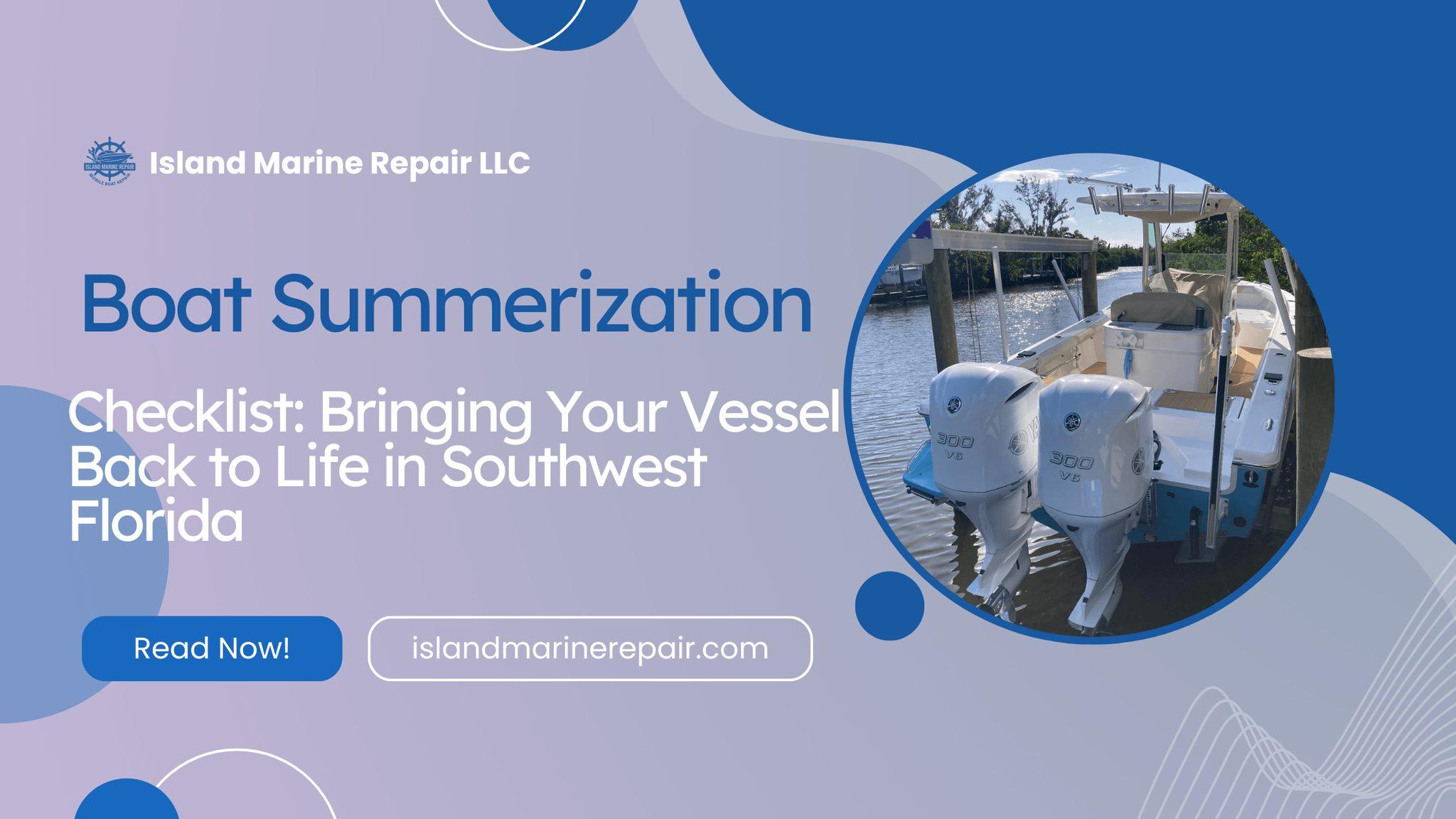
A comprehensive annual service and inspection routine for a Fort Myers boat covers more ground than most owners initially realize. The combination of the vessel itself, the propulsion system, the electrical system, the safety equipment, and the trailer (for trailered boats) creates a maintenance matrix with interdependent components — a failure in one system often creates problems in others, and catching issues in one area during an inspection frequently reveals related issues in adjacent systems.
This checklist is organized as a practical, sequential annual service guide for a typical Fort Myers-area recreational boat with an outboard engine. Diesel-powered vessels have additional service requirements covered in the diesel service guide; sterndrive-powered boats have additional requirements covered in the Volvo Penta guide. The core inspection categories apply broadly.
Engine System Checklist
**Lubrication:** ☐ Engine oil and filter changed (four-stroke engines, annual or every 100 hours) ☐ Lower unit gear oil drained and refilled — inspect drained oil for milkiness indicating water intrusion ☐ Gear oil seal condition confirmed — no water in oil, no external leakage ☐ Trim cylinder hydraulic fluid level checked
**Cooling System:** ☐ Water pump impeller inspected — replace if any degradation, cracking, or wear ☐ Thermostat inspected and replaced if in doubt — low cost, high consequence if fails ☐ Cooling water passages flushed thoroughly ☐ Telltale stream verified steady and consistent at normal operating RPMs ☐ Temperature gauge or sender function confirmed against known normal
**Fuel System:** ☐ Fuel-water separator filter replaced ☐ Fuel line and primer bulb inspected for cracks, softness, or fuel weeping ☐ Carburetor or VST fuel filter inspected and replaced as needed ☐ Fuel tank inspected for water contamination — shake-and-check or fuel polishing if boat has sat ☐ Fuel system connections secure with no fuel odor at rest or after startup
**Ignition and Electrical:** ☐ Spark plugs removed and inspected — replace per condition (tan-gray normal; black or white abnormal) ☐ Spark plug wire condition inspected for cracking or corrosion at boot connections ☐ Battery voltage tested at rest (12.6V full charge) ☐ Battery load tested for capacity under cranking demand ☐ Battery terminal connections cleaned and treated with anti-corrosion grease ☐ Engine wiring harness connector inspected and treated with dielectric grease ☐ All warning indicators and gauges tested for function
**Corrosion Protection:** ☐ Anodes (zinc or aluminum) inspected — replace if less than 50% remaining ☐ External engine surfaces treated with corrosion inhibitor spray ☐ Shift linkage, throttle body connections, and trim motor lubricated ☐ Propeller shaft inspected for fishing line and line cuts to seal
The outboard boat service checklist provides specific service documentation templates and interval tracking for all of these engine service items.
Hull and Deck Inspection Checklist
**Below the Waterline (for boats kept in water):** ☐ Bottom paint condition inspected — areas of paint loss or heavy fouling identified ☐ Through-hull fittings inspected for corrosion and seacock operation (turn and back) ☐ Transducer and depth finder thru-hull inspected for damage ☐ Hull bottom inspected for impact damage, osmotic blistering, or delamination
**Deck and Cockpit:** ☐ Deck hardware — cleats, rod holders, hatches — inspected for loose fasteners and sealant condition ☐ Hatch seals inspected for cracking or compression loss ☐ Bilge inspected for water accumulation beyond normal — source identified if water is excessive ☐ Bilge pump function tested via manual switch ☐ Bilge pump float switch tested by raising float manually
**Structural:** ☐ Transom condition inspected for softness indicating water intrusion (stern-drive boats specifically) ☐ Jack plate or engine mounting bracket inspected for corrosion and fastener condition ☐ Livewells and baitwells operational — pump function, drain function, no leaks
Electrical System Checklist
☐ All navigation lights tested and operational ☐ Bilge blower operational ☐ VHF radio operational — channel 16 confirmed, battery indicator normal ☐ Chart plotter and fish finder powered up, GPS acquiring, transducer function verified ☐ Bilge pump automatic and manual operation tested ☐ Shore power system inspected — cord condition, inlet seal, galvanic isolator function
Boat electrical wiring inspection covers the specific electrical inspection items in more detail, including the shore power safety checks that are particularly important for boats regularly on marina power.
Safety Equipment Checklist
☐ Life jackets inspected — sufficient number and sizes for crew, no mold, inflation mechanisms functional for inflatable types ☐ Throwable flotation device (Type IV) in accessible position, no UV damage ☐ Fire extinguisher(s) inspected — pressure indicator in green zone, not expired ☐ Visual distress signals inspected — flares not expired, orange smoke in date ☐ Horn or whistle accessible and functional ☐ First aid kit contents reviewed — expired items replaced ☐ EPIRB or PLB inspected — battery not expired, registration current ☐ Float plan procedure reviewed with regular crew members
Trailer Checklist (for trailered boats)
☐ Wheel bearings inspected and repacked with marine grease — races and bearings for pitting or wear ☐ Bearing seals inspected for water intrusion evidence ☐ Tire condition inspected — sidewall cracks, tread depth, date code within acceptable age ☐ Tire pressure checked when cold ☐ All trailer lights operational — tail, brake, turn, reverse ☐ Light connector cleaned and treated with dielectric grease ☐ Safety chains in good condition, rated hooks secure ☐ Coupler latch function confirmed — closes positively, does not release without manual operation ☐ Winch strap or cable in good condition — no fraying, full wrap on drum ☐ Frame and cross members inspected for structural rust or damage ☐ Bunks or rollers inspected for wear that could damage hull

Boat trailer maintenance safety checks provides more detailed protocols for each trailer inspection item.
Documentation and Administrative Checklist
☐ Vessel registration current and accessible on board ☐ Insurance current — policy renewed and card or documentation accessible ☐ If applicable: documented inspection by USCG Auxiliary or state auxiliary program ☐ Marina slip agreement or dry storage agreement current ☐ Service history log updated with all work performed
Using the Checklist: Owner Items vs. Professional Items
Not all items on this checklist are appropriate for owner self-service. The engine service items — oil change, impeller replacement, lower unit service — require appropriate tools and mechanical knowledge. The bearing inspection requires disassembly and bearing evaluation skills. The shore power electrical inspection requires specific testing equipment and ABYC-relevant knowledge.
A practical approach is to divide the checklist: items that are clearly accessible (light function tests, bilge pump tests, fire extinguisher inspection, tire condition visual check) are performed by the owner at the beginning of each season. Items requiring disassembly, specific tools, or professional judgment are performed as part of an annual professional service visit.
Boat service and repair professionals Fort Myers who conduct annual service appointments benefit from an owner who has pre-completed the accessibility and basic function checks — this allows the professional service time to focus on the higher-skill items rather than basic operational checks.
Boat accessories and upgrades to consider can be evaluated during the annual service context — the end of the annual service inspection is a natural time to discuss upgrade priorities and improvements with a technician who has just seen the vessel's current condition comprehensively.
Frequently Asked Questions
Q: How long does a complete annual boat service take?
A: A comprehensive annual service covering engine, basic electrical check, and corrosion treatment for a single outboard boat typically takes three to five hours. Adding trailer service adds one to two hours. Adding thorough electrical inspection adds one to two hours.
Q: Should I do the annual service at the beginning or end of the season?
A: In Fort Myers's year-round boating environment, "beginning of season" is less meaningful than in northern climates. Annual service timed before peak usage periods — October before the dry season, or April before the summer heat — ensures the boat enters its most active period in optimal condition.
Q: What's the cost of a complete annual service in Fort Myers?
A: A comprehensive annual service for a single four-stroke outboard — covering all engine system items — typically runs $400 to $800 depending on engine size and what's found during inspection. Adding trailer service and electrical inspection adds $200 to $400.
Q: What happens if I skip annual service for one year?
A: The risk is cumulative degradation in the items that annual service catches and prevents. Impeller wear, gear oil contamination, anode depletion, and fuel system deposits don't necessarily fail in the year service is skipped — they fail when they reach their threshold, which may be the year service was skipped or the year after. The unpredictability of deferred maintenance is its primary risk.
Conclusion
The annual service and inspection checklist for a Fort Myers boat represents a systematic approach to the maintenance obligations that the marine environment creates continuously. Working through this checklist annually — with professional service for the items requiring skill and tools, and owner inspection for the accessible items — is the most reliable path to a vessel that performs when you want it to and doesn't deliver expensive surprises when you can least afford them.
Service Log as a Financial Planning Tool
Beyond its value as a maintenance reference, the boat service log functions as a financial planning tool for Fort Myers boat owners who want to budget realistically for annual marine service costs. A log with three or more years of service records provides the baseline data for projecting what upcoming service years will require.
An engine approaching the end of its typical impeller replacement interval, a battery bank that load-tested at 70 percent capacity last season, trailer tires that are approaching the six-year replacement recommendation: these are all upcoming expenditures that a service log makes visible months in advance rather than as surprises. The owner who can see these approaching service requirements six months out can budget for them, schedule them during less-expensive off-peak service windows, and avoid the higher-urgency costs of addressing them reactively.
For boats approaching resale, a complete service log demonstrating consistent professional maintenance represents a tangible financial asset. In Fort Myers's active used boat market, documentation of annual service history and the absence of deferred maintenance genuinely affects transaction value. Buyers who can verify through a detailed log that an engine has been properly maintained are more confident paying the asking price than buyers presented with an undocumented vessel of unknown service history. The time invested in maintaining a detailed service log over years of ownership typically returns its investment many times over at the point of eventual sale. Maintaining a consistent service log from the day a boat enters service is one of the simplest and highest-value habits an active Fort Myers boat owner can develop. It costs nothing but a few minutes after each service event and pays dividends in every subsequent service interaction, every resale transaction, and every diagnostic conversation with a professional marine mechanic.

 English
 Arabic
 French
 Spanish
 Portuguese
 Deutsch
 Turkish
 Italiano
 Russian
 Romaian
 Portuguese (Brazil)
 Greek
Greek