


The Boat Repair Industry Is Quietly Changing — Most Owners Haven't Noticed Yet
For most of the history of recreational boating, getting a boat repaired meant one thing: hauling it to a shop, leaving it there, and waiting — sometimes for days, sometimes for weeks — until the work was done and you could go pick it up. That model has been the default for so long that most boat owners never questioned it, even as it created real friction: trailering hassles for boats not already on a trailer, haul-out and launch fees at marinas, lost time, and a boat sitting idle in a shop's queue rather than in the water where its owner actually wants it. Anyone who's experienced this firsthand knows the particular frustration of a boat sitting untouched in a shop's lot for a week longer than promised, simply because it's queued behind other jobs rather than because the actual repair itself takes that long — a frustration that, multiplied across an entire customer base, eventually creates real market pressure for an alternative model to emerge and gain traction.
Over the past several years, a quieter shift has been happening alongside that traditional model: mobile marine repair, where technicians travel to the boat — at a dock, a private lift, or wherever it's stored — rather than requiring the boat to come to them. This isn't a brand-new concept, but it's grown from a niche offering into a genuinely significant part of how marine repair gets done in many coastal markets, and the reasons behind that growth say something interesting about both the industry itself and how boat ownership has changed for a broad cross-section of owners over a relatively compressed period of time.
Why the Traditional Shop Model Created So Much Friction
The traditional repair shop model makes sense for certain kinds of work — major engine rebuilds, extensive fiberglass repair, or anything requiring specialized equipment and a controlled indoor environment genuinely benefits from shop facilities. But a large percentage of routine marine maintenance and repair work doesn't actually require that kind of facility: oil changes, anode replacement, electrical diagnostics, water pump service, and plenty of other common repairs can be done perfectly well at a dock or driveway with the right tools and a technician who knows what they're doing.
For that category of work, the traditional shop model imposed cost and inconvenience that didn't match the actual complexity of the job, treating a quick oil change with the same logistical overhead as a genuinely complex engine rebuild requiring specialized facilities and equipment that only a proper shop could reasonably provide. A boat owner needing a routine service item handled would still face the same trailering hassle, haul-out fee, and multi-day wait as someone needing a major repair, simply because the shop-based model didn't distinguish between the two in terms of how the boat had to get to the work in the first place.
What Changed to Make Mobile Service Viable at Scale
A few things converged to make mobile marine repair practical as more than a niche offering. Diagnostic technology improved significantly — modern marine engines, particularly outboards, increasingly include onboard computer systems that a technician with the right equipment can interface with directly at the boat, reducing the need for shop-based diagnostic equipment that previously required bringing the boat in just to figure out what was wrong in the first place. This single shift alone removed one of the biggest practical barriers that had kept comprehensive diagnostic work tied almost exclusively to shop facilities for so long.
Parts availability and supply chains have also improved enough that a well-prepared mobile technician can carry or quickly source the components needed for the most common repairs without requiring shop inventory on the scale that used to justify keeping everything centralized in one location. And simply, demand caught up — as more of daily life shifted toward on-demand and at-location services across other industries, boat owners increasingly expected that same convenience to be available for marine repair, creating real market pressure for the service model to evolve.
A Brief History of How This Trend Actually Started
Mobile marine repair didn't emerge from a single innovation moment — it grew gradually out of a combination of independent technicians who'd always offered some at-the-dock service as a convenience for regular customers, and the broader recognition across many service industries that customers increasingly valued having work done at their location rather than having to bring an item to a central facility. For decades, this remained a relatively informal, word-of-mouth arrangement in many markets — a mechanic willing to come to your dock for an established client, rather than a structured, marketed business model in its own right.
The shift toward mobile marine repair becoming a deliberately structured, primary business model rather than an informal accommodation tracked alongside broader changes in how service businesses operate generally — better scheduling and dispatch technology, improved ability to carry a comprehensive set of tools and parts in a properly equipped service vehicle, and a growing customer base that had already become accustomed to at-location service in other parts of their lives and increasingly expected similar convenience for boat maintenance as well.
Customer Expectations Have Shifted Across Every Service Industry
It's worth viewing the mobile marine repair trend within this larger context rather than as an isolated development unique to boating. Across numerous service categories — auto repair, home maintenance, even some categories of healthcare — there's been a broad, sustained shift toward at-location service becoming an expected option rather than a premium add-on. Customers who've grown accustomed to a mechanic coming to fix their car in a driveway, or a technician servicing home appliances on-site, naturally extend that same expectation to boat maintenance, especially once they realize the option genuinely exists in their market.
This broader cultural shift in service expectations has probably done as much to drive mobile marine repair's growth as any boating-specific factor, since it created a customer base already primed to value and seek out this kind of convenience rather than needing to be convinced that at-location service for a complex mechanical item was even a reasonable thing to expect.
What to Actually Look for When Choosing a Mobile Provider
For boat owners considering a mobile marine repair relationship for the first time, a few practical evaluation criteria help separate genuinely capable providers from those offering a narrower scope than initially advertised. Asking directly what diagnostic equipment a technician actually brings to a job — rather than assuming all mobile providers carry equivalent capability — reveals a lot about whether a given provider can actually handle complex diagnostic work at the dock or whether their practical capability is limited mostly to basic maintenance tasks.
Checking for proper licensing, insurance, and manufacturer certifications relevant to your specific engine brand also matters, since mobile operation doesn't exempt a business from the same basic professional standards that would apply to a traditional shop. References or reviews specifically mentioning the kind of work you need done — not just general positive sentiment, but actual examples of similar repairs handled successfully — give a more reliable signal of genuine capability than overall star ratings alone.
It's also reasonable to ask how a provider handles situations that do require shop facilities or specialized equipment beyond what can be reasonably brought to a dock. A transparent, established mobile provider should be upfront about the boundaries of what they can handle at your location versus what would need to go to a partner shop or specialized facility, rather than either overstating their capability or being vague about it when asked directly. This kind of caution costs nothing beyond a small amount of upfront diligence, and it consistently separates owners who build a genuinely reliable, long-term mobile service relationship from owners who end up disappointed by a provider whose actual capability didn't match their initial marketing impression.
The Service Coverage Question
One legitimate concern about mobile marine repair is scope — can a mobile technician actually handle the full range of repairs a boat might need, or only a narrow band of simpler maintenance work? In practice, this varies considerably by provider, and it's worth understanding what a given mobile service actually covers before assuming it can replace a shop relationship entirely.
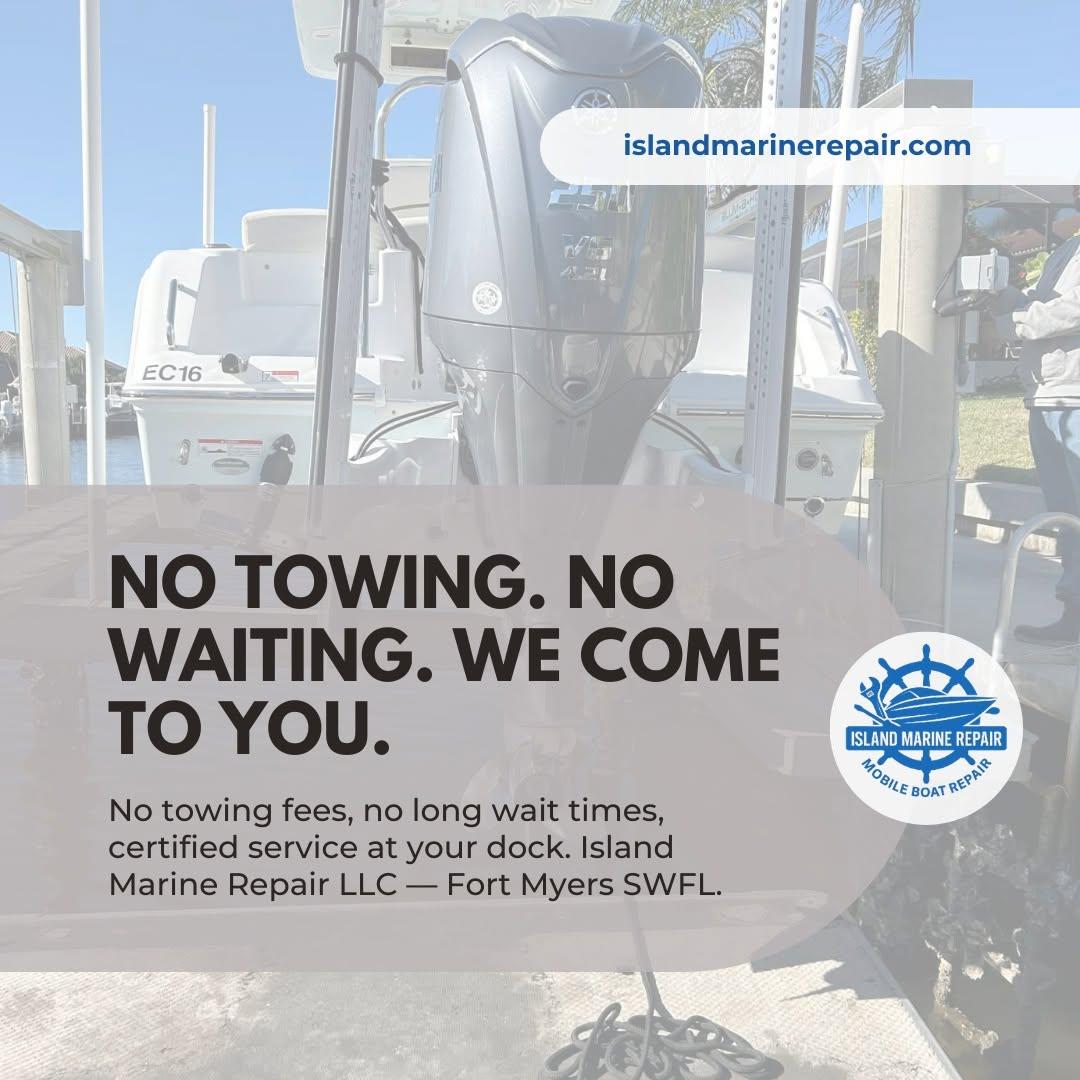
Established mobile marine repair operations — the kind that have grown into serious businesses rather than remaining a side hustle — frequently cover a genuinely broad range: outboard and inboard engine service, electrical diagnostics and repair, fiberglass work, trolling motor and accessory installation, and seasonal services like winterization, often rivaling or exceeding the scope a customer would expect from a well-established traditional shop. Island Marine Repair, operating in the Fort Myers and Southwest Florida market, is a representative example of how far this model has expanded — covering everything from routine outboard maintenance to fiberglass repair and brand-specific service across multiple engine manufacturers, all without requiring the boat to leave its slip or driveway. That breadth of coverage is part of what's allowed mobile service to shift from "convenient for small jobs" to a genuine primary repair relationship for a growing number of boat owners, rather than just a backup option for emergencies.

What Mobile Service Changes About the Ownership Experience
Beyond the obvious convenience factor, mobile marine repair has changed something less obvious about the relationship between boat owners and maintenance: it's made consistent, proactive maintenance considerably easier to actually follow through on. A boat owner who has to plan a haul-out, arrange transport, and lose access to the boat for several days is much more likely to defer routine maintenance until something actually breaks, simply because of the friction involved in addressing it proactively. A boat owner whose mechanic can show up at the dock for a scheduled seasonal check is far more likely to actually stick to that schedule, because the friction that previously discouraged proactive maintenance has been largely removed.
This matters more than it might initially seem, because so much of marine maintenance is genuinely preventive in nature — anode replacement, fluid changes, electrical inspections — work that's cheap and easy when done on schedule but considerably more expensive once neglect turns a minor item into an actual failure. A service model that makes proactive maintenance more convenient, rather than less, has real downstream effects on how well-maintained boats in that market tend to be over time.
Pricing Transparency Has Improved Alongside the Service Model
A related shift worth noting is how pricing transparency has evolved alongside the mobile service model itself. Traditional shop-based repair has historically involved a degree of pricing opacity that frustrated many customers — an estimate given verbally, work performed, and a final bill that sometimes diverged meaningfully from the initial estimate once "additional issues were discovered" during the repair process. This pattern, whether the additional charges were always fully justified or not, contributed to a fair amount of customer distrust toward the marine repair industry broadly.
Many mobile providers, building their business model around customer convenience and trust from the outset, have leaned into more transparent, itemized pricing as a competitive differentiator — clear diagnostic fees, itemized parts and labor breakdowns, and more communication before additional work is authorized rather than after the fact. This isn't universal across every mobile provider, and traditional shops certainly aren't uniformly opaque either, but the competitive pressure of an industry built partly around customer trust and convenience has pushed pricing practices in a generally more transparent direction across the broader market, benefiting customers regardless of which specific service model they ultimately choose for a given repair.
Geographic Variation in Mobile Service Availability
It's worth acknowledging that mobile marine repair's growth hasn't been uniform across all markets. Dense coastal areas with high boat ownership concentration — places with extensive marinas, private docks, and a large enough customer base to support multiple specialized mobile providers — have seen this model mature considerably faster than more rural or less boating-dense regions, where the customer density may not yet support the kind of specialized, comprehensive mobile operations available in busier coastal markets.
Boat owners in less densely boated regions may still find mobile service available, but potentially with a narrower range of specializations represented locally, or longer scheduling lead times simply due to fewer providers serving a wider geographic area. This is a practical consideration worth factoring in when evaluating how much to rely on mobile service as a primary maintenance strategy versus maintaining some relationship with a traditional shop as well, depending on what's actually realistic and available in your specific area.
Where the Traditional Shop Model Still Wins
None of this means traditional repair shops are becoming obsolete — they remain essential for the categories of work that genuinely benefit from a controlled facility and specialized heavy equipment: major engine rebuilds, extensive structural fiberglass work, and anything requiring equipment that simply isn't practical to bring to a dock. The more accurate way to think about the shift isn't "mobile replacing shops" but rather a more sensible division of labor, where routine and moderate-complexity work increasingly happens at the boat's location, while the subset of repairs that genuinely require shop facilities continues to flow toward traditional shops as it always has.
The Future of the Model
Looking forward, there's little indication this trend is plateauing. As diagnostic technology continues advancing — more onboard computer systems on engines, more sophisticated handheld diagnostic tools available to technicians — the practical capability gap between what a mobile technician can accomplish at a dock versus what previously required a shop visit will likely continue narrowing further. Combined with continued evolution in customer expectations toward convenience-oriented service generally, the trajectory points toward mobile marine repair continuing to capture a growing share of the routine and moderate-complexity repair market, while traditional shops remain essential for the genuinely facility-dependent work that will likely always require their specialized capabilities.
For an industry that operated on essentially the same basic model for decades, this represents a genuinely significant structural shift — not a passing trend, but an evolution in how a substantial portion of marine maintenance and repair work actually gets done, with real, lasting implications for how boat owners interact with the maintenance side of ownership going forward. Owners entering the boating world today, without decades of prior experience anchoring their expectations to the old shop-only model, increasingly treat mobile availability as simply one of the baseline factors they weigh when choosing where to keep a boat and who to trust with maintaining it — a meaningfully different starting assumption than boat owners would have brought to the same decision a generation ago.
What This Means for Boat Owners Going Forward
For boat owners evaluating their own maintenance and repair relationships, the practical takeaway is worth considering: a meaningful share of what used to require a shop trip can now likely be handled at the dock, and that shift in convenience has made consistent maintenance schedules considerably easier to actually follow through on for owners who take advantage of it. The industry's quiet evolution toward mobile service isn't just a convenience trend — it's changing, in a measurable way, how well boats in markets with strong mobile service options tend to be maintained over their lifespan, simply because the friction that used to discourage proactive care has been substantially reduced.

 English
 Arabic
 French
 Spanish
 Portuguese
 Deutsch
 Turkish
 Dutch
Dutch
 Italiano
 Russian
 Romaian
 Greek
Greek