Mental health services have become more important than ever across the USA. As more people seek therapy, counseling, psychiatric care, and behavioral health treatment, providers face growing administrative responsibilities. One of the biggest challenges is billing for mental health accurately while staying compliant with payer requirements and changing regulations.
Unlike many other specialties, mental health billing often involves unique documentation rules, session-based coding, telehealth guidelines, authorization requirements, and varying insurance policies. Even small mistakes can result in denied claims, delayed payments, or unnecessary administrative work.
Whether you are an independent therapist, psychologist, psychiatrist, counselor, or behavioral health practice, understanding the billing process can help improve cash flow and reduce claim denials.
Why Mental Health Billing Requires Special Attention
Mental health billing is not simply about submitting claims after each patient visit. Every claim must accurately reflect the services provided, the medical necessity of treatment, and the payer's specific requirements.
Several factors make behavioral health billing more complex than general medical billing:
- Time-based psychotherapy sessions
- Different CPT and diagnosis code combinations
- Prior authorization requirements
- Telehealth billing regulations
- Documentation supporting medical necessity
- Coordination between primary and secondary insurance
- Frequent payer-specific policy updates
Because of these complexities, many providers rely on experienced medical billing services to improve claim accuracy and reduce administrative workload.
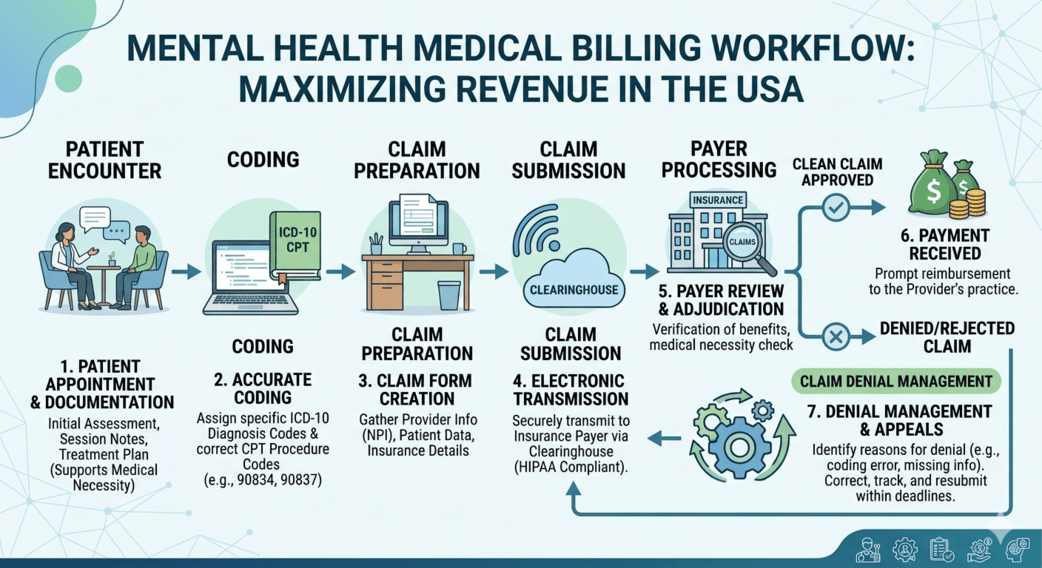
The Basic Mental Health Billing Process
A successful billing workflow begins long before a patient attends their appointment.
Patient Registration
Accurate patient information is the foundation of successful billing. This includes:
- Personal details
- Insurance information
- Policy verification
- Referral information if required
- Consent forms
Incorrect patient information is one of the easiest mistakes to avoid but remains a common reason for claim rejection.
Insurance Verification
Before providing services, practices should verify:
- Active insurance coverage
- Mental health benefits
- Copayment requirements
- Deductibles
- Visit limitations
- Authorization requirements
Completing this step early prevents unexpected billing issues later.
Clinical Documentation
Documentation should clearly explain:
- Patient symptoms
- Diagnosis
- Treatment plan
- Progress notes
- Length of each session
- Medical necessity
Incomplete documentation often leads to denied or delayed claims during payer review.
Choosing the Correct CPT Codes
Mental health providers commonly bill using psychotherapy, psychiatric evaluation, and medication management codes.
The selected CPT code should accurately reflect:
- Type of service
- Session duration
- Provider credentials
- Complexity of treatment
Using an incorrect code—even if the treatment itself was appropriate—can trigger audits or claim denials.
This is where professional medical coding services play an important role by ensuring coding accuracy and compliance with current coding guidelines.
Common Billing Challenges for Mental Health Providers
Even experienced practices encounter billing difficulties.
Insurance Policy Differences
Each insurance company may have different rules regarding:
- Covered services
- Session limits
- Authorization requirements
- Telehealth coverage
- Documentation expectations
Billing staff must stay updated to avoid preventable denials.
Claim Denials
Common reasons include:
- Incorrect diagnosis codes
- Missing modifiers
- Incomplete documentation
- Expired authorizations
- Eligibility issues
- Duplicate submissions
- Incorrect provider information
Regular claim reviews help identify recurring problems before they become larger revenue issues.
Changing Regulations
Mental health reimbursement policies continue to evolve, especially regarding telehealth services and behavioral health coverage.
Keeping up with these updates requires continuous staff education and regular billing audits.
The Role of Documentation in Successful Billing
Good documentation protects both the provider and the patient.
A complete record should include:
- Date of service
- Session duration
- Treatment goals
- Clinical observations
- Progress since previous visits
- Future treatment recommendations
Documentation should accurately reflect the care delivered without unnecessary or repetitive information.
Strong documentation also supports medical necessity if an insurance company requests additional records.
Telehealth Billing for Mental Health
Telehealth has become an essential part of behavioral healthcare across the USA.
Many patients now prefer virtual therapy sessions because they offer:
- Greater convenience
- Reduced travel time
- Better appointment attendance
- Improved access in rural communities
However, telehealth billing comes with additional requirements.
Providers should verify:
- Eligible telehealth services
- Appropriate modifiers
- Place of service codes
- State-specific regulations
- Insurance payer policies
Following updated payer guidance helps reduce reimbursement delays.
How Credentialing Affects Mental Health Billing
Many providers overlook the connection between billing success and credentialing.
If a provider is not properly enrolled with an insurance payer, claims may be rejected even when services are medically necessary.
Maintaining current provider enrollment helps ensure:
- Faster reimbursements
- Accurate payer records
- Reduced claim rejections
- Expanded insurance participation
Regular monitoring of enrollment status prevents avoidable payment interruptions.
Tips to Improve Mental Health Billing Performance
Small improvements in daily workflows can produce significant financial benefits over time.
Consider these best practices:
- Verify insurance before every visit.
- Obtain prior authorization when required.
- Submit claims promptly.
- Review documentation before claim submission.
- Monitor denied claims regularly.
- Track payer payment trends.
- Stay current with coding updates.
- Conduct periodic internal billing audits.
Consistent attention to these areas helps improve reimbursement rates while reducing administrative stress.
Why Revenue Cycle Management Matters
Effective revenue cycle management extends beyond claim submission.
It includes every financial step from patient scheduling through final payment collection.
An efficient revenue cycle helps practices:
- Reduce denied claims
- Improve payment turnaround
- Increase financial transparency
- Identify billing trends
- Strengthen cash flow
- Improve operational efficiency
Practices that actively monitor key billing metrics are often better prepared to respond to changing payer requirements.
When Should a Practice Consider Outsourcing?
As practices grow, billing responsibilities often become more demanding.
Outsourcing may be beneficial when:
- Claim denials continue to increase.
- Staff spend excessive time on billing.
- Accounts receivable continue growing.
- Coding updates become difficult to manage.
- Provider productivity declines due to administrative tasks.
Experienced billing professionals can help streamline operations while allowing providers to focus more on patient care.
Many behavioral health practices choose specialized medical billing services that also provide medical coding services, credentialing, and comprehensive revenue cycle management support to improve financial performance.
Organizations such as 247 Medical Billing Services assist healthcare providers with these administrative processes while helping practices maintain billing accuracy and operational efficiency.
Building a Strong Billing Process for Long-Term Success
Mental health practices operate in an increasingly complex reimbursement environment. Insurance policies, coding updates, documentation standards, and compliance requirements continue to evolve.
Success in billing for mental health depends on creating consistent workflows, maintaining accurate documentation, verifying insurance before treatment, and ensuring claims are submitted correctly the first time.
Whether a practice manages billing internally or works with experienced professionals, investing in accurate billing processes supports financial stability while allowing providers to dedicate more time to delivering quality behavioral healthcare.
Frequently Asked Questions
1. What is billing for mental health?
Billing for mental health is the process of submitting insurance claims for behavioral health services such as therapy, counseling, psychiatric evaluations, medication management, and other mental health treatments.
2. Why are mental health claims often denied?
Claims may be denied because of incorrect coding, missing documentation, expired authorizations, insurance eligibility issues, missing modifiers, or provider enrollment problems.
3. How important is documentation in mental health billing?
Documentation is essential because it demonstrates medical necessity, supports the services billed, and helps providers respond to insurance audits or record requests.
4. Does telehealth require different billing procedures?
Yes. Telehealth services often require specific modifiers, place of service codes, and compliance with payer-specific billing policies and state regulations.
5. What role does credentialing play in reimbursement?
Proper credentialing ensures providers are enrolled with insurance companies, allowing claims to be processed and reimbursed correctly.
6. How can practices reduce claim denials?
Practices can lower denial rates by verifying insurance, using accurate coding, maintaining complete documentation, submitting claims promptly, and reviewing denial trends regularly.
7. Should small behavioral health practices outsource billing?
Outsourcing can be a practical option for practices experiencing frequent claim denials, staffing limitations, growing administrative workloads, or challenges managing billing compliance.




 English
 Arabic
 Spanish
 Portuguese
 Deutsch
 Turkish
 Dutch
Dutch
 Italiano
 Russian
 Romaian
 Portuguese (Brazil)
 Greek
Greek