


Online Grocery Market Size, Trends & Forecast 2035
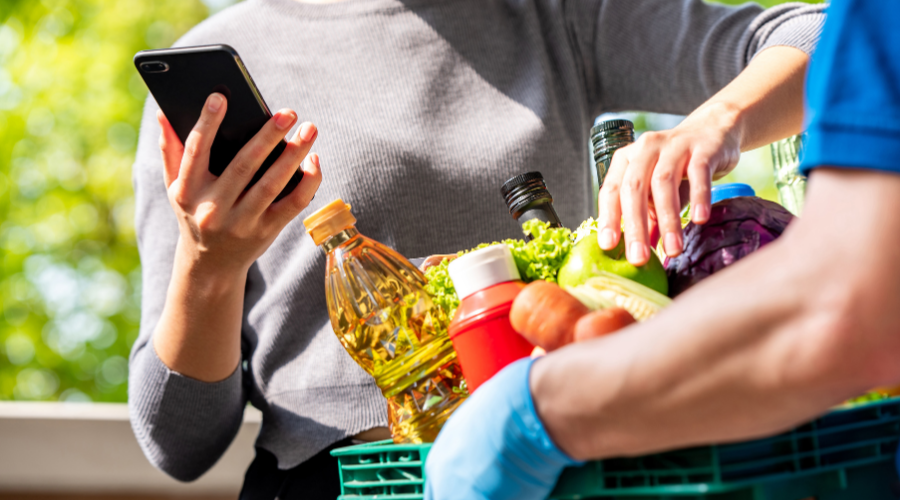
The online grocery market has evolved from a convenience-oriented retail channel into a core component of modern food distribution. Consumers can now browse fresh produce, dairy, meat, beverages, packaged foods and household essentials through websites and mobile applications, then choose home delivery or store pickup. For retailers, the shift is equally significant because digital grocery requires new approaches to inventory, fulfillment, pricing, customer loyalty and last-mile logistics.
The global online grocery market reached USD 718.69 billion in 2025 and is projected to reach approximately USD 3,036.42 billion by 2035, expanding at a compound annual growth rate (CAGR) of 15.50% between 2026 and 2035. The forecast reflects continuing consumer adoption, wider smartphone penetration, improved digital payments, expansion of delivery infrastructure and retailers' increasing investment in omnichannel capabilities.
The market is no longer defined simply by the ability to place an order online. The competitive question has become whether a retailer can provide an experience that combines accurate inventory, competitive prices, convenient fulfillment, reliable delivery and strong product quality. Grocery is particularly demanding because many products are perishable, bulky, temperature-sensitive or purchased frequently.
Major retailers are consequently integrating digital ordering with physical stores rather than treating e-commerce as a completely separate business. Walmart's latest annual filing, for example, describes an omnichannel model in which substantially all U.S. stores provide same-day pickup and delivery, with e-commerce sales growth driven primarily by store-fulfilled pickup and delivery.
What is driving the online grocery market?
The online grocery market is growing because consumers increasingly value convenience, time savings and flexible fulfillment. Better mobile apps, digital payments, personalized recommendations, wider product availability and faster delivery are making online grocery shopping suitable for both planned weekly purchases and smaller top-up orders.
Grocery purchasing differs from many other forms of e-commerce because it is repetitive. A customer may buy the same milk, cereal, vegetables, snacks and household products every week or month. This creates an opportunity for digital platforms to use previous purchase history to simplify repeat orders.
Convenience is particularly valuable for households with limited time. Instead of traveling to a store, finding parking, navigating aisles and waiting at checkout, shoppers can create a basket from home or while commuting. Scheduled delivery also allows consumers to fit grocery purchasing around work and family responsibilities.
The market has also benefited from the development of omnichannel retail. Consumers do not necessarily choose between online and offline shopping permanently. They may use an app for a weekly stock-up, visit a store for fresh products, and place an urgent delivery order when they need a missing ingredient.
McKinsey's research has similarly found that online grocery has evolved into a complementary shopping channel, with consumers using e-commerce for stock-up and top-up missions while continuing to visit physical stores.
Inflation and value-conscious shopping are also shaping demand. Online platforms make it easier for consumers to compare prices, search promotions and switch between brands. Recent results from Instacart illustrate that grocery delivery demand can remain resilient even when consumers are cautious about spending; the company reported strong second-quarter 2026 transaction value and attributed continued demand partly to consumers seeking affordability and convenience.
For retailers, however, growth in order volume does not automatically translate into higher profitability. Picking, packing, substitutions, delivery and returns can create additional costs. Successful online grocery operators therefore need to improve both customer adoption and the economics of fulfillment.
How are product categories changing online grocery shopping?
Fresh produce, breakfast and dairy products, snacks and beverages, meat and seafood, and staples remain important online grocery categories, but the willingness to purchase fresh and perishable products online is becoming one of the market's most important developments.
Early online grocery adoption was concentrated heavily in packaged and shelf-stable products because consumers were more comfortable purchasing items whose quality could be assessed easily from a product page. Fresh produce and meat presented a different challenge because shoppers could not physically inspect the products before purchase.
That behavior has changed as retailers have improved quality controls, substitution policies, cold-chain logistics and product information. Consumers increasingly expect online grocery services to deliver acceptable freshness, accurate weights and appropriate temperature control.
McKinsey research found that fresh and frozen categories experienced strong growth in online demand, alongside traditionally stronger e-commerce categories such as packaged foods, household care and snacks.
Breakfast and dairy products also benefit from their recurring nature. Items such as milk, eggs, yogurt and breakfast cereals can become part of predictable replenishment routines. Online platforms can use purchase history to remind customers when commonly purchased products are likely to run low.
Snacks and beverages are another attractive category because they can generate frequent purchases and support impulse buying through recommendations. Search algorithms can connect complementary products, such as suggesting coffee filters alongside coffee or sparkling water alongside snacks.
Meat and seafood remain operationally more complex because freshness and temperature management are critical. Retailers must coordinate picking, packaging and delivery windows carefully, especially in warmer climates.
Staples and cooking essentials are well suited to online ordering because many households purchase rice, flour, pasta, cooking oils, spices and canned products repeatedly. These products can also contribute to larger basket sizes because consumers can stock up without carrying heavy items home from a physical store.
The category opportunity is therefore expanding beyond basic grocery delivery. Retailers are attempting to recreate the breadth and convenience of a supermarket while using digital tools to make shopping faster and more personalized.
Why are app-based and web-based platforms competing differently?
App-based and web-based platforms both provide online grocery access, but mobile applications are increasingly important for frequent shopping, personalization, loyalty programs and real-time delivery tracking. Websites remain valuable for discovery, larger-screen shopping and customers who prefer browser-based purchasing.
Mobile apps have a natural advantage for repeat purchases because they remain accessible on a customer's device. Notifications can remind shoppers about promotions, delivery windows or abandoned carts, while stored payment information makes repeat checkout faster.
Apps also enable location-based experiences. A platform can identify nearby stores, show available delivery slots, provide real-time order tracking and adjust product availability based on local inventory.
Web-based platforms remain important because grocery shopping can involve substantial basket-building. Consumers purchasing a large weekly order may prefer a larger screen for comparing products, reviewing nutrition information and managing quantities.
Leading retailers increasingly treat the two channels as parts of a single customer ecosystem rather than separate businesses. The objective is to allow customers to move between website, app, physical store, pickup and delivery without losing their shopping history or loyalty benefits.
Walmart's omnichannel model demonstrates this integration. Its latest filing says its e-commerce growth is primarily supported by store-fulfilled pickup and delivery, illustrating how physical stores can function as fulfillment assets rather than simply competing with digital channels.
This model also changes the economics of online grocery. A retailer does not necessarily need a completely separate warehouse for every online order. Existing stores can act as local inventory hubs, allowing orders to be picked close to customers and reducing delivery distances.
However, store-based fulfillment can become difficult as online order volumes increase. Dedicated automated fulfillment centers can improve picking efficiency, while stores provide geographic proximity and broader local availability. The optimal strategy therefore depends on order density, geography, product mix and customer expectations.
How are one-time purchases and subscriptions shaping demand?
One-time purchases remain important for occasional grocery needs, while subscription models are becoming more valuable for predictable replenishment and customer retention. Subscription purchasing can encourage repeat orders by automating frequently purchased items and reducing the effort required to rebuild a basket.
One-time orders are especially useful for consumers who want flexibility. A shopper may place an order before a party, during a busy week, or when unexpected circumstances make a store visit inconvenient.
Subscriptions work differently. Consumers can arrange recurring purchases of household staples, beverages, baby products or other regularly consumed goods. The value is not simply delivery; it is the removal of repetitive decision-making.
Retailers can benefit from greater demand predictability. If a customer regularly purchases a particular set of products, the platform can forecast future demand and use those signals to improve inventory planning.
However, grocery subscriptions face a natural limitation: households do not always consume products at exactly the same rate. A subscription system that is too rigid can lead to unwanted products, cancellations or customer frustration.
More sophisticated platforms therefore allow customers to modify quantities, skip deliveries or change dates. The goal is to combine the predictability of subscriptions with the flexibility consumers expect from modern digital commerce.
Personalization is becoming increasingly important in this environment. Online grocery platforms can analyze previous purchases and shopping patterns to make recommendations, reorder frequently purchased items and present relevant promotions.
Emerging AI systems may take this further by allowing consumers to interact with grocery platforms conversationally. In 2026, Albertsons introduced an AI-enabled grocery-shopping experience that allows customers to build and modify carts through conversational interactions, illustrating how grocery search may evolve beyond conventional keywords and product menus.
The long-term opportunity is to make grocery shopping less about manually searching for individual products and more about communicating a shopping intention, such as preparing meals for a family, restocking a household or staying within a particular budget.
Why are logistics and fulfillment critical to online grocery profitability?
Logistics is one of the defining challenges of online grocery because the business must deliver a wide variety of products quickly while protecting freshness and controlling costs. Efficient fulfillment depends on inventory accuracy, picking technology, cold-chain management, delivery density and route optimization.
A traditional grocery store is designed for customers to walk through aisles and select products themselves. In online grocery, the retailer or fulfillment partner performs that work. Every additional step—from locating an item to packing and transporting it—adds cost.
Inventory accuracy is particularly important. If an online platform shows an item as available but the store cannot find it, the retailer must substitute the product, refund the customer or delay the order. Frequent substitutions can reduce customer trust.
Automation can improve the economics. Automated storage and retrieval systems, robotic picking, intelligent routing and demand forecasting can reduce manual effort in high-volume facilities.
However, automation is not appropriate for every product or geography. Fresh produce may require human inspection, while smaller markets may not generate enough order volume to justify a highly automated fulfillment center.
Last-mile delivery is another major cost. Delivering one grocery order to one household can be expensive when orders are geographically dispersed. Higher order density makes each delivery route more efficient because a driver can serve multiple customers within a limited area.
The rapid-delivery segment introduces an additional trade-off. Customers may value delivery within minutes, but extremely short delivery windows can require dense networks of local fulfillment locations and additional delivery capacity.
Research published in 2025 using more than eight million grocery orders in Dubai found that allowing customers just five additional minutes of delivery time could reduce daily delivery mileage by about 30% and life-cycle CO₂ emissions by about 20%.
This illustrates an important point for the industry's future: the fastest possible delivery is not always the most economically or environmentally efficient model. Scheduled and slightly more flexible delivery can sometimes improve route density and reduce unnecessary vehicle movement.
How are AI, automation and data transforming online grocery?
AI and data analytics are transforming online grocery by improving product recommendations, demand forecasting, inventory management, pricing, fraud detection and customer service. Automation is also helping retailers process more orders without increasing operating costs at the same rate.
One of the most valuable applications is demand forecasting. Grocery demand can vary with weather, holidays, local events, promotions and seasonal behavior. Better forecasts can reduce both stockouts and excess inventory.
AI can also personalize the digital storefront. Instead of showing every customer the same products, platforms can prioritize items based on previous purchases, dietary preferences, household behavior and current shopping intent.
Recommendation technology is becoming increasingly sophisticated. Research into grocery e-commerce has demonstrated how contextual and AI-driven recommendations can improve product discovery and add-to-cart behavior, including cross-category recommendations that connect grocery purchases with related products.
Computer vision and automation can also support fulfillment. Cameras and sensors can help verify products, while robotic systems can move inventory through warehouses and automated fulfillment centers.
Data is equally valuable for suppliers and consumer brands. Online grocery platforms can understand which products are searched, viewed, added to carts and purchased. This creates opportunities for retail media, targeted promotions and more effective merchandising.
Instacart's recent results demonstrate the growing importance of this advertising layer. Its advertising business increased 16% year over year to USD 297 million in the second quarter of 2026, showing how grocery platforms can generate revenue beyond transaction fees and product sales.
The challenge is ensuring that personalization remains useful rather than intrusive. Customers want relevant recommendations, but excessive promotion can make grocery interfaces harder to navigate. Trust, privacy and transparent use of customer data will therefore remain important competitive considerations.
Which regions are shaping the online grocery market?
North America has a mature online grocery ecosystem, Europe combines strong supermarket networks with established click-and-collect and delivery models, while Asia Pacific is expected to remain a major growth engine because of digital adoption, urbanization and rapidly evolving delivery infrastructure.
North America's market benefits from large retailers, established e-commerce platforms and widespread consumer familiarity with digital ordering. The United States has developed a particularly diverse model involving supermarket-owned platforms, marketplaces, delivery aggregators and technology-enabled fulfillment.
Walmart's scale illustrates the importance of store-based omnichannel infrastructure in North America. Its 2026 annual report describes widespread same-day pickup and delivery across Walmart U.S. stores, while e-commerce contributed positively to comparable sales.
Europe has developed several distinct online grocery models. The United Kingdom has historically emphasized home delivery, while France has had a strong click-and-collect tradition. McKinsey previously identified these differences as evidence that grocery e-commerce economics depend heavily on local consumer behavior and retail infrastructure.
Recent developments also show continuing investment in European grocery technology. In 2026, Asda partnered with Ocado to modernize its online business, including e-commerce systems, fulfillment and delivery capabilities. The deal illustrates how technology partnerships can help established grocers upgrade their digital infrastructure.
Asia Pacific represents a particularly dynamic opportunity. Large urban populations, high smartphone usage, digital payments and dense cities create favorable conditions for app-based grocery and rapid delivery models.
China has developed sophisticated digital grocery ecosystems combining marketplaces, supermarkets, mobile commerce and highly integrated logistics. Other Asian markets are developing their own approaches, often combining traditional neighborhood stores with digital ordering and delivery.
Latin America offers growth potential as consumers increasingly adopt digital payments and e-commerce. Local market conditions, logistics infrastructure and household income levels will influence the pace of adoption.
The Middle East and Africa are also developing rapidly in selected urban markets. High smartphone penetration and concentrated urban populations can support app-based grocery services, although cold-chain infrastructure and delivery economics remain important considerations.
Across all regions, the most successful models are likely to be localized rather than universally standardized. Grocery is deeply connected to local diets, shopping habits, store networks and logistics conditions.
Who are the leading companies in the online grocery market?
The competitive landscape includes global e-commerce companies, supermarket chains, warehouse clubs, online marketplaces and specialized grocery platforms. Competition is increasingly based on ecosystem strength, fulfillment efficiency, customer loyalty, pricing and the ability to integrate digital and physical retail.
The companies covered in the supplied market assessment include Amazon.com Inc., Walmart Inc., The Kroger Co., Costco Wholesale Corporation, Target Corporation, Tesco Plc, JD.com, Inc., FreshDirect, LLC, Albertsons Companies, Inc., and Maplebear Inc. (Instacart), alongside other participants.
Amazon combines e-commerce infrastructure, membership benefits, grocery operations and logistics. Its competitive advantage comes from the ability to connect grocery with a broader digital ecosystem and customer relationship.
Walmart's strength is different. Its enormous physical store network can function as a distributed fulfillment system, enabling pickup and delivery while giving the company proximity to customers. Its latest reporting indicates that store-fulfilled pickup and delivery remain central to e-commerce growth.
Kroger and Albertsons bring established supermarket relationships, local inventory and grocery expertise, while Costco's membership model creates a strong recurring customer relationship and large-basket purchasing behavior.
Tesco demonstrates the importance of grocery specialization in Europe, while JD.com illustrates the role of technology-driven retail and logistics in Asia.
Instacart operates through a different model by connecting consumers, retailers and delivery services. Its recent financial performance shows how the grocery marketplace can expand into advertising and enterprise technology in addition to facilitating transactions.
The competitive landscape is consequently becoming broader than traditional retailer-versus-retailer competition. Technology companies, delivery platforms, supermarkets, marketplaces and fulfillment specialists are increasingly participating in the same customer journey.
What is the outlook for the online grocery market through 2035?
The online grocery market is expected to become an increasingly integrated part of food retail as consumers combine physical stores, mobile applications, websites, pickup and home delivery. Based on the supplied forecast, the market is projected to grow from USD 718.69 billion in 2025 to approximately USD 3.04 trillion by 2035 at a CAGR of 15.50%.
The next phase of growth will likely focus less on simply acquiring online customers and more on improving the economics and quality of digital grocery. Retailers will need accurate inventory, efficient picking, optimized delivery routes, strong private-label offerings and reliable fresh-food quality.
AI is likely to influence nearly every stage of the process. Consumers may increasingly use conversational interfaces to build shopping lists, plan meals and find products, while retailers use AI to forecast demand, optimize inventory and personalize promotions.
Fulfillment will also become more sophisticated. Automated warehouses, store-based micro-fulfillment, robotic systems and dynamic routing can help retailers increase order density and lower operating costs.
At the same time, consumers may become more selective about delivery speed. Ultra-fast delivery will remain attractive for urgent purchases, but scheduled delivery and pickup can provide better economics for larger weekly baskets. The growing importance of sustainability may further encourage retailers to consolidate routes and improve vehicle utilization.
The market's competitive structure will therefore favor companies that can connect technology with physical infrastructure. A strong app alone is not enough. The retailer must also have the inventory, fulfillment network, supplier relationships and logistics capabilities necessary to deliver the promised experience.
Ultimately, online grocery is moving toward an omnichannel model in which digital and physical retail reinforce each other. Stores can become fulfillment centers, apps can become loyalty platforms, and grocery marketplaces can become advertising and data businesses.
The projected growth through 2035 reflects a broader change in how consumers manage everyday food purchasing. The winners will be those that make online grocery not only faster, but also more affordable, reliable, personalized and operationally sustainable.

 Arabic
 French
 Spanish
 Portuguese
 Deutsch
 Turkish
 Dutch
Dutch
 Italiano
 Russian
 Romaian
 Portuguese (Brazil)
 Greek
Greek