


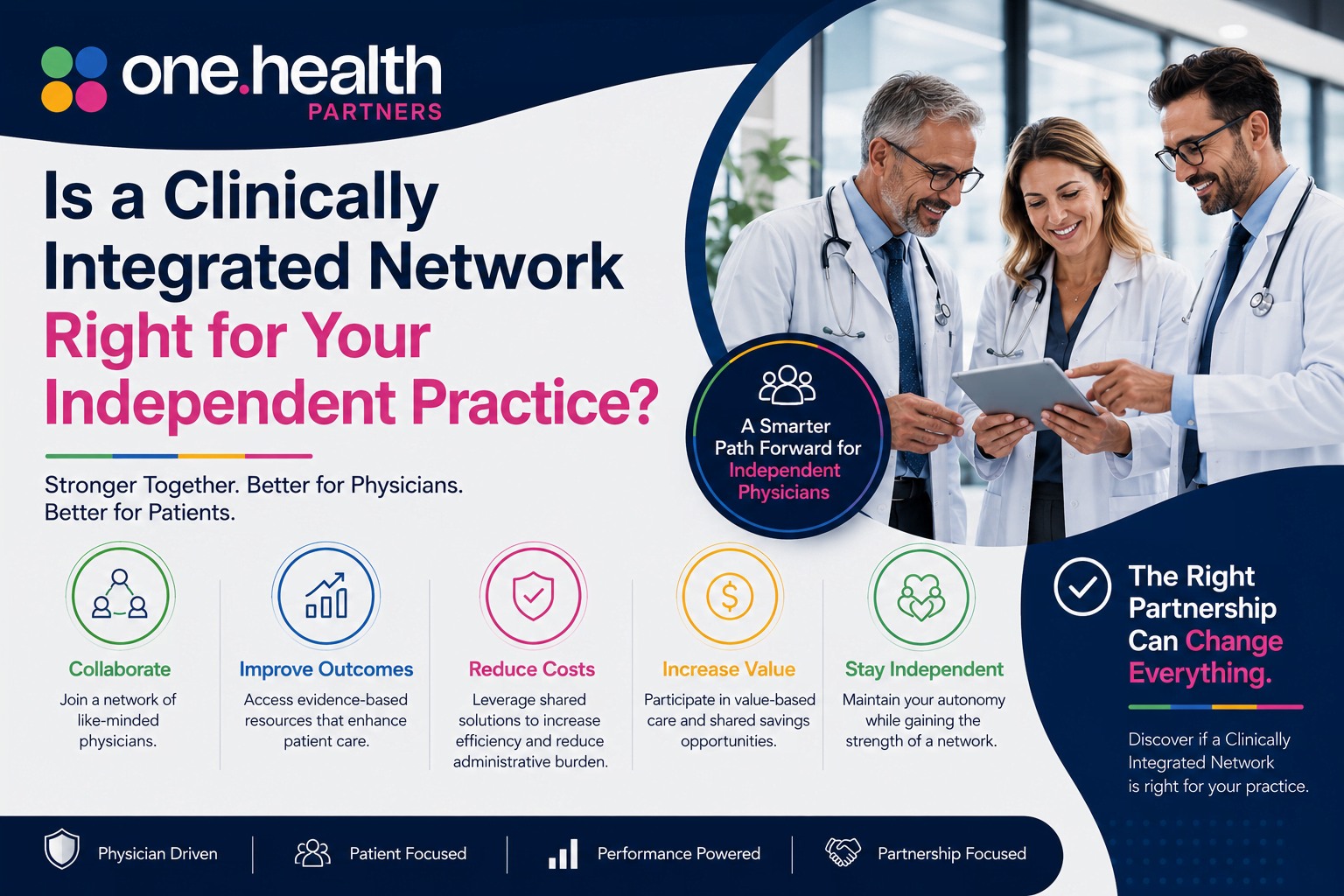
Is A Clinically Integrated Network Right For Your Independent Practice?
Somewhere around 60 percent of physicians say administrative burden is the single biggest reason they have considered leaving independent practice altogether. I did not just read that number once and move on, it actually m ade me stop and think about how many good doctors are quietly burning out behind the scenes while their patients never even notice. If you are running a specialty practice right now and wondering whether a clinically integrated network in Illinois, USA makes sense for you, you are not alone, and you are asking the right question at the right time.
This is not one of those decisions you make on a whim. It touches your staff, your patients, your income, and honestly your sanity. So let us actually walk through it properly, no fluff, no sales pitch dressed up as advice.
What This Decision Really Comes Down To
A clinically integrated network is, at its core, a structure where independent physicians stay independent in how they practice medicine, but share resources, technology, and administrative infrastructure with a larger group. You are not selling your soul to a hospital system. You are not becoming an employee who clocks in and out.
What you are doing is deciding whether the operational weight you have been carrying alone is worth handing off, and to whom.
I think a lot of physicians get stuck here because they frame it as a binary choice. Stay fully independent or give up everything. That framing is honestly outdated. The middle ground exists now in ways it did not a decade ago.
Signs It Might Be Time to Consider This Path
From conversations I have had with specialists across different fields, a few patterns keep coming up. If any of these sound familiar, it is probably worth exploring:
-
You are spending more hours on billing, coding, and prior authorizations than you would like to admit.
-
Recruiting and retaining staff has become a constant, exhausting cycle.
-
You have thought about retirement or slowing down but worry about what happens to your patients and team.
-
Your practice's technology feels outdated compared to larger systems nearby.
-
You want liquidity or a fair valuation for the practice you built, without handing control to shareholders.
If two or three of these hit close to home, that is usually a signal worth paying attention to, not ignoring.
What Independence Actually Looks Like Inside a Network
Here is where people get nervous, and honestly, I get it. "Network" sounds like it might mean losing your identity. In practice, though, a properly structured clinically integrated network works differently.
Clinical decisions stay with you. Your diagnosis, your treatment plan, your relationship with your patients, none of that gets outsourced. What changes sits mostly behind the scenes: billing support, care coordination across settings, access to shared clinical programs, and infrastructure you likely could not build on your own as a solo or small group practice.
I have talked to physicians who described the transition almost like exhaling for the first time in years. Not because their work changed, but because everything around their work finally had support underneath it.
Questions Worth Asking Yourself First
Before you even take a call with any organization, sit with these questions honestly:
-
Do I actually want to keep practicing medicine, or am I looking for a full exit?
-
What matters more to me, maximum payout or long term stability for my staff and patients?
-
Am I comfortable with shared infrastructure, or do I want full control over every operational decision?
-
What would my ideal next five years actually look like, realistically?
Your answers here shape whether a clinically integrated network fits you at all, and honestly, they shape which specific partner would fit too.
Red Flags to Watch For
Not every network is built the same, and this part matters more than most physicians realize going in. A few things I would personally flag as concerning:
-
Deals structured heavily around debt rather than cash.
-
Vague answers about who retains clinical decision making authority.
-
Pressure to sign quickly without time for proper legal and financial review.
-
No clear track record of practices that stayed intact post transaction.
If you are hearing any of these during early conversations, slow down. This is your practice and your patients, not a transaction to rush.
Where One Health Partners Fits Into the Conversation
I think it is worth mentioning One Health Partners here specifically because their model addresses several of the concerns I just listed. OHP operates as a non-profit, operator led organization, not an investor backed roll up chasing shareholder returns. Their acquisitions have been structured as all cash, and the company reportedly carries zero debt on its balance sheet, which is a meaningful difference compared to debt heavy private equity structures common elsewhere in healthcare.
What stood out to me looking into their approach is how much emphasis they place on continuity. Staff, practice name, location, scheduling, clinical autonomy, benefits, all of it is designed to stay intact after a transaction closes. The support layered in, things like billing expertise, care coordination, and shared clinical programs, exists to strengthen what is already working rather than dismantle it.
For physicians exploring partnership opportunities for independent physicians, this kind of structure tends to matter more once you actually sit down and compare it against typical alternatives in the market.
So, Is It Right for You?
Honestly, there is no universal answer here, and anyone who tells you otherwise is probably selling something. Some physicians thrive staying fully independent, especially in smaller markets with lower overhead. Others are drowning under administrative weight that a network could genuinely lift.
What I would say, based on everything I have seen, is this: if your practice is healthy clinically but exhausting operationally, and you want to protect what you built while gaining real support, this path deserves a serious look rather than a dismissal.
Final Thoughts
Running an independent practice was never supposed to mean running a small business empire on top of practicing medicine. Somewhere along the way, that is what it became for a lot of specialists, and honestly, it is exhausting more good physicians than it should.
A clinically integrated network will not fix everything. No structure does. But for the right practice, at the right stage, it can bring back something that has been missing for a while: the ability to actually focus on patients again, without the operational noise drowning everything else out.
So take the questions in this article seriously. Talk to physicians who have already made this move. Ask hard questions, and do not settle for vague answers. Because in the end, the physicians who explore real partnership opportunities for independent physicians now are the ones setting themselves up for a stronger, steadier next chapter, both for their patients and for themselves.
Frequently Asked Questions
1. How do I know if my practice is a good fit for a clinically integrated network?
Generally, practices that are clinically strong but operationally stretched, meaning solid patient volume and outcomes but heavy administrative burden, tend to benefit most from this kind of structure.
2. Will I lose control over my clinical decisions if I join a network?
No, in a properly structured clinically integrated network, physicians retain full authority over diagnosis and treatment. The network typically supports operations, not clinical judgment.
3. What is the difference between joining a network and selling to private equity?
Private equity deals are usually investor driven and often financed with debt, aimed at eventual returns for shareholders. A non-profit, operator led model like One Health Partners focuses on long term practice support rather than an investor exit.
4. How long does the evaluation and transition process usually take?
It varies by practice, but most transitions move through an initial conversation, financial and clinical review, partnership structuring, and closing, often spanning a few months from first contact to completion.
5. What happens to my staff if I join a clinically integrated network?
In well structured partnerships, staff, benefits, and team structure typically remain unchanged. The goal is continuity, not disruption, for the people who have helped build the practice alongside you.

 Arabic
 French
 Spanish
 Portuguese
 Deutsch
 Turkish
 Dutch
Dutch
 Italiano
 Russian
 Romaian
 Portuguese (Brazil)
 Greek
Greek