


How to crack competitive Jharkhand exam 2026 in your first attempt?
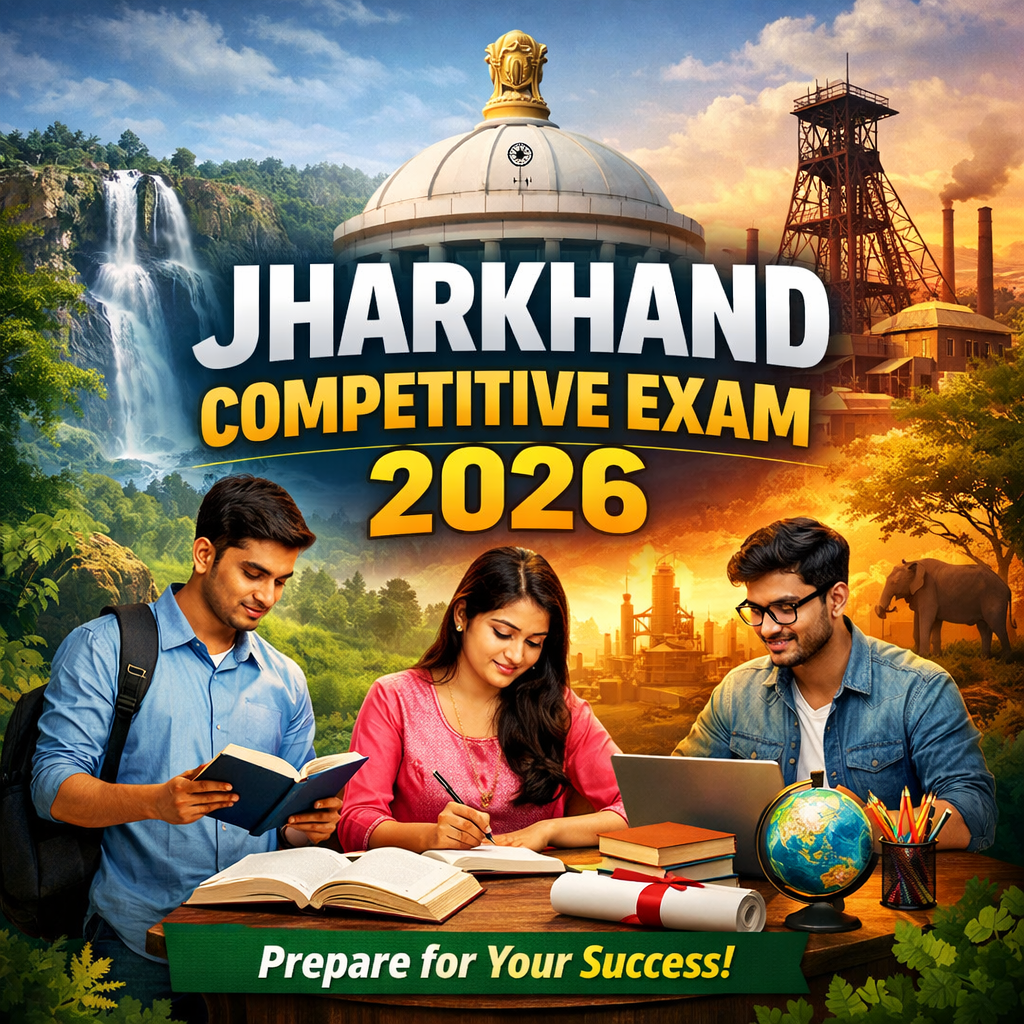
Jharkhand Competitive Exams 2026: Complete Guide to Exam Pattern, Eligibility, and Syllabus
Jharkhand, a rapidly developing state in eastern India, offers numerous opportunities for aspirants preparing for government jobs. Competitive exams conducted in Jharkhand are among the most sought-after career paths due to job security, attractive salary structures, and social prestige.
These exams are conducted by various authorities such as the Jharkhand Public Service Commission JPSC exam 2026, Jharkhand Staff Selection Commission (JSSC), Jharkhand Polytechnic exam, JSSC Excise Constable exam, Jharkhand Police Driver exam and other departmental boards. This comprehensive guide provides a detailed overview of Jharkhand competitive exams, including exam patterns, eligibility criteria, and syllabus, designed to help aspirants prepare effectively and succeed.
Overview of Jharkhand Competitive Exams
Jharkhand conducts a wide range of competitive examinations for recruitment in administrative, police, teaching, engineering, medical, and clerical services. Some of the most popular exams include:
-
Jharkhand Public Service Commission - JPSC Civil Services Exam
-
Jharkhand Staff Selection Commission Teacher Exam (JSSC) Exams (CGL, CGL Tech, Police, etc.)
-
Jharkhand Teacher Eligibility Test (JTET)
Each exam has its own structure, eligibility criteria, and syllabus, but there are common elements that aspirants must understand thoroughly.
Jharkhand Competitive Exams: Eligibility Criteria
Eligibility criteria for Jharkhand exams vary depending on the type of exam, but the general requirements are outlined below:
Educational Qualification
For most Jharkhand government exams, candidates must have a minimum educational qualification depending on the post:
-
For Group A and B posts (JPSC exams): A bachelor’s degree from a recognized university is mandatory.
-
For Group C posts (JSSC exams): Candidates must have completed 10th, 12th, or graduation depending on the specific post.
-
For teaching exams (JTET): Candidates must possess a Diploma in Education (D.El.Ed), B.Ed, or equivalent qualification.
-
For technical posts: Engineering or specialized degrees are required.
Age Limit
Age criteria vary across exams:
-
Minimum age: 18–21 years
-
Maximum age: Typically 35–40 years
Age relaxation is provided as per government norms:
-
SC/ST candidates: 5 years relaxation
-
OBC candidates: 3 years relaxation
-
Female candidates: Additional relaxation in some cases
Nationality
-
The candidate must be an Indian citizen.
-
Preference is often given to domicile candidates of Jharkhand for certain posts.
Physical Eligibility (For Police Exams)
Candidates applying for police or defense-related posts must meet physical standards:
-
Minimum height requirements
-
Chest measurements (for males)
-
Physical efficiency tests (running, long jump, etc.)
Jharkhand Competitive Exams: Exam Pattern
Understanding the exam pattern is crucial for effective preparation. While patterns differ across exams, most follow a multi-stage selection process:
1. Preliminary Examination
The preliminary exam is the first stage and is usually objective in nature.
-
Type: Multiple Choice Questions (MCQs)
-
Subjects: General Studies, General Knowledge, Current Affairs
-
Duration: 2–3 hours
-
Marking: Negative marking may apply
The purpose of this stage is to shortlist candidates for the main examination.
2. Main Examination
The main exam is more detailed and often includes descriptive papers.
-
Type: Descriptive and/or objective
-
Subjects: Advanced topics, optional subjects, language papers
-
Papers: Usually 4–6 papers depending on the exam
This stage tests in-depth knowledge and analytical ability.
3. Interview/Personality Test
Candidates who qualify for the mains are called for an interview.
-
Focus: Personality, communication skills, general awareness
-
Conducted by: Expert panel
4. Skill Test/Physical Test (if applicable)
-
Typing test for clerical posts
-
Physical efficiency test for police jobs
Detailed Exam Pattern for Major Jharkhand Exams
JPSC Civil Services Exam Pattern
The JPSC exam is conducted in three stages:
Preliminary Exam
-
Paper 1: General Studies
-
Total Marks: 200
-
Duration: 2 hours
Main Exam
-
Paper 1: General Hindi and English
-
Paper 2–6: General Studies (4 papers) + Optional Subject
-
Total Marks: 1000
Interview
-
Marks: 100
JSSC Combined Graduate Level (CGL) Exam Pattern
-
Paper 1: Language Knowledge (Hindi/English)
-
Paper 2: Regional/Tribal Language
-
Paper 3: General Knowledge
Each paper is objective and conducted online or offline.
Jharkhand Police Exam Pattern
-
Written Exam: Objective questions from GK, Math, Reasoning
-
Physical Efficiency Test: Running, long jump, etc.
-
Medical Test
Jharkhand Teacher Eligibility Test (JTET)
-
Paper 1: For primary teachers (Classes 1–5)
-
Paper 2: For upper primary teachers (Classes 6–8)
Subjects include:
-
Child Development and Pedagogy
-
Language I and II
-
Mathematics
-
Environmental Studies or Social Science
Jharkhand Competitive Exams: Detailed Syllabus
A thorough understanding of the syllabus is essential for strategic preparation.
General Studies Syllabus
This section is common across most exams and includes:
History
-
Ancient, Medieval, and Modern Indian History
-
Freedom Movement
-
Jharkhand regional history
Geography
-
Physical Geography
-
Indian Geography
-
Jharkhand Geography (minerals, rivers, forests)
Polity
-
Indian Constitution
-
Fundamental Rights and Duties
-
Panchayati Raj system
-
Governance and public policy
Economy
-
Indian Economy basics
-
Budget and Economic Survey
-
Jharkhand economy (agriculture, industries)
Science and Technology
-
Basic Physics, Chemistry, Biology
-
Current developments in science
Current Affairs
-
National and international events
-
Government schemes
-
Sports, awards, and appointments
Mathematics Syllabus
-
Number system
-
Algebra
-
Geometry
-
Trigonometry
-
Mensuration
-
Data interpretation
Reasoning Ability
-
Logical reasoning
-
Analytical reasoning
-
Coding-decoding
-
Blood relations
-
Series and puzzles
Language Syllabus
Hindi
-
Grammar (व्याकरण)
-
Vocabulary
-
Comprehension
English
-
Grammar
-
Vocabulary
-
Reading comprehension
Optional Subjects (JPSC)
Candidates can choose from subjects like:
-
History
-
Geography
-
Political Science
-
Sociology
-
Public Administration
Each optional subject has an extensive syllabus similar to graduation-level studies.
Jharkhand-Specific Topics
A unique aspect of Jharkhand exams is the emphasis on state-specific knowledge:
-
Tribal culture and heritage
-
Local festivals and traditions
-
Important personalities of Jharkhand
-
Natural resources and industries
-
Government schemes specific to Jharkhand
Preparation Strategy for Jharkhand Competitive Exams
Success in Jharkhand exams requires a structured preparation plan.
Understand the Syllabus and Pattern
Start by carefully analyzing the syllabus and exam pattern. This helps in prioritizing topics and managing time effectively.
Create a Study Plan
Divide your preparation into phases:
-
Foundation building
-
Practice and revision
-
Mock tests
Focus on Jharkhand GK
State-specific knowledge plays a crucial role, especially in JPSC and JSSC exams.
Practice Previous Year Papers
Solving past papers helps in understanding question trends and improving speed.
Stay Updated with Current Affairs
Read newspapers and follow reliable sources for daily updates.
Take Mock Tests
Regular mock tests improve time management and accuracy.
Best Books for Jharkhand Competitive Exams
Some recommended books include:
-
NCERT textbooks (Class 6–12)
-
Indian Polity by M. Laxmikanth
-
Spectrum Modern History
-
Lucent’s General Knowledge
-
Jharkhand-specific GK books
Career Opportunities After Jharkhand Exams
Clearing these exams opens doors to prestigious roles such as:
-
Deputy Collector
-
DSP (Deputy Superintendent of Police)
-
Block Development Officer (BDO)
-
शिक्षक (Teacher)
-
Clerical and administrative posts
These jobs offer stability, growth opportunities, and social respect.
Conclusion
Jharkhand competitive exams provide excellent career opportunities for aspirants aiming for government jobs. Understanding the exam pattern, eligibility criteria, and syllabus is the first step toward success. With consistent effort, strategic planning, and focused preparation, candidates can crack these exams and secure a bright future.
Aspirants should stay dedicated, regularly revise concepts, and keep themselves updated with current affairs and Jharkhand-specific knowledge. With the right approach, success in Jharkhand competitive exams is achievable.

 Arabic
 French
 Spanish
 Portuguese
 Deutsch
 Turkish
 Dutch
Dutch
 Italiano
 Russian
 Romaian
 Portuguese (Brazil)
 Greek
Greek