


GDS API Integration for Flight Booking: Everything You Need to Know
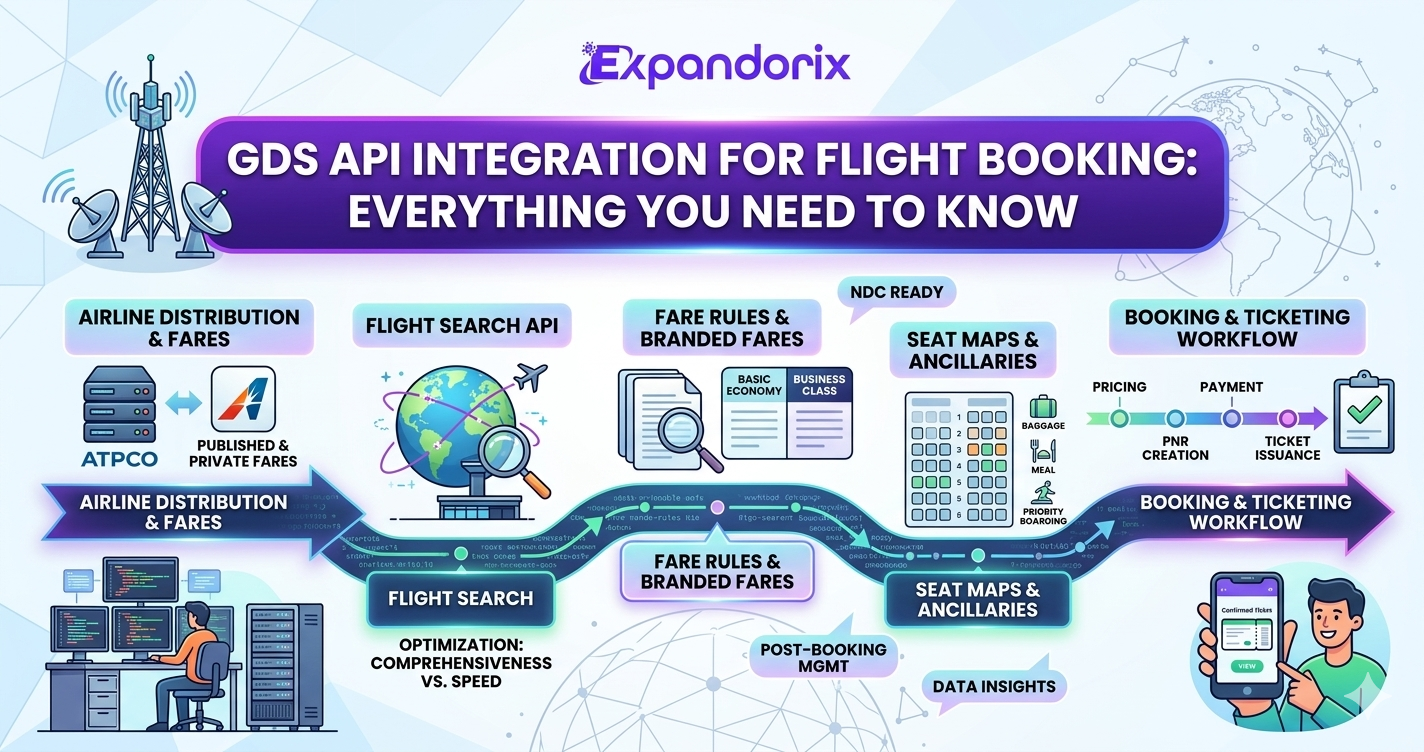
Flight booking represents the most complex and high-stakes component of GDS API integration. Airlines have sophisticated revenue management systems, highly structured fare rules, complex ticketing workflows, and strict distribution compliance requirements. Getting flight booking right in a GDS API integration requires deep understanding of airline distribution, fare management, and booking lifecycle management. This article provides everything you need to know about implementing GDS API integration specifically for flight booking.
We will cover the full technical and commercial landscape of airline GDS distribution — from how airlines file fares and availability to the ticketing process, ancillary selling, and post-booking management. Whether you are building a consumer OTA, a corporate travel tool, or a specialist airfare platform, this guide provides the foundational knowledge for a successful implementation.
How Airlines Use the GDS for Distribution
Airlines distribute their inventory through the GDS using a sophisticated combination of filing systems. Published fare filing is the process by which airlines submit their public fares to the GDS through ATPCO (Airline Tariff Publishing Company), the industry's central fare database. ATPCO processes and distributes fare changes to GDS platforms typically within hours of filing, ensuring that the GDS displays current fares.
Availability — the actual seats available for booking in each fare class on each flight — is managed through the airline's own inventory management system, which sends real-time availability updates to the GDS through a dedicated availability connection. When your platform queries the GDS for flight availability, the GDS combines fare data from ATPCO with real-time availability from the airline's inventory system to return bookable options.
Private fares — negotiated rates between airlines and specific OTAs or corporate buyers — are distributed through a separate channel from public fares. GDS platforms provide the infrastructure for private fare distribution, allowing airlines and buyers to set up private fare agreements that are only visible to authorised selling entities.
The Flight Search API: Architecture and Optimisation
The flight availability search is the entry point for every flight booking workflow, and it is the API call that most directly affects user experience. A well-optimised flight search implementation returns results quickly across a comprehensive range of options, while a poorly implemented search is slow, incomplete, or both.
Flight search APIs accept query parameters including origin and destination airports, travel dates, cabin class preference, number of passengers, and optionally preferred airlines and fare types. The GDS processes this query against its available inventory and returns a set of itinerary options, each with fare information.
One of the key architectural decisions in flight search implementation is how to handle the trade-off between comprehensiveness and speed. A highly comprehensive search that queries all available airlines and all fare classes will return the most complete set of options but will take longer. A targeted search that queries a subset of airlines or prioritises certain fare classes will return faster but may miss some options.
Modern GDS flight search APIs offer several mechanisms for controlling this trade-off, including the ability to specify which airlines to include or exclude, whether to return branded fares, how many alternatives to return, and whether to include connection options. Understanding and tuning these parameters for your specific use case is important for balancing speed and comprehensiveness.
Fare Rules and Conditions: The Detail That Matters
Airline fares are governed by detailed fare rules that specify the conditions under which a fare is valid, the restrictions that apply, and the fees associated with changes and cancellations. Correctly retrieving, interpreting, and displaying fare rules is one of the most important — and challenging — aspects of flight booking GDS API integration.
Fare rules are structured around a set of categories defined by ATPCO. Key categories include advance purchase requirements (how far in advance the fare must be booked), minimum and maximum stay conditions (whether a Saturday night stay is required, for example), transfer and stopover permissions, change fees and conditions, cancellation penalties, and refundability conditions.
Retrieving fare rules through the GDS API requires calling the fare rules retrieval API with the specific fare basis code from the availability or pricing response. The returned rules are structured XML that must be parsed and presented to customers in a clear, human-readable format. Failure to present fare rules clearly and accurately creates customer disputes and regulatory compliance risk.
Branded Fares and Fare Families
Branded fares — the fare family bundles that airlines use to package their products — have become a critical component of airline distribution over the past decade. Virtually every major airline now sells its product in branded tiers: basic economy, standard economy, flexible economy, premium economy, business, and first class. Each tier comes with a defined set of included services and a corresponding price premium.
GDS API integration for modern flight booking must support branded fare retrieval and display. The GDS platforms provide branded fare APIs that return the specific services included in each tier for a given flight and fare combination, enabling your booking platform to present clear side-by-side comparisons that help customers choose the right product for their needs.
Implementing branded fare display well is a significant conversion driver. Research consistently shows that customers who can clearly see what is included in their fare — particularly regarding checked baggage, seat selection, and flexibility — are more likely to book and more likely to upsell to higher tiers. Investing in a high-quality branded fare display is not just technically important, it is commercially valuable.
Seat Maps and Seat Selection
Seat selection has become an expected feature of modern flight booking platforms. Customers want to choose their seat — aisle or window, front of cabin or exit row — as part of the booking process, and many OTAs generate ancillary revenue from selling premium seat options.
GDS platforms provide seat map APIs that return the cabin configuration for specific flights, including which seats are available, which are occupied, and which are premium-priced. The data returned includes seat characteristics — seat pitch, recline, proximity to exits, whether the seat blocks the armrest — enabling rich seat map displays that help customers make informed choices.
Seat assignment through the GDS involves adding a Special Service Request (SSR) for the chosen seat to the PNR before ticketing. Some airlines allow pre-ticketing seat assignment; others only confirm seat selection after ticket issuance. Your implementation needs to handle both scenarios correctly.
Ancillary Selling Through GDS
Beyond seats, airlines sell a range of ancillary products through the GDS — baggage, meal preferences, priority boarding, lounge access, extra legroom, and more. Ancillary selling is a significant revenue opportunity for OTAs, who can earn commissions on ancillary sales and improve customer value by offering a complete booking experience.
GDS ancillary APIs (typically referred to as Offer and Order APIs in the newer NDC context) allow platforms to retrieve the ancillary catalogue for a specific booking, display available options with pricing, and add selected ancillaries to the booking record. Implementing ancillary selling correctly requires handling the specific SSR and OSI codes used by different airlines for different service types, and managing the booking record correctly as ancillaries are added and modified.
The Booking and Ticketing Workflow
Creating a confirmed flight booking through the GDS involves a multi-step workflow that must be implemented precisely. Any error in this workflow can result in a booking that is incomplete, incorrectly priced, or not properly ticketed — all of which create operational and financial problems.
The workflow begins with a confirmed pricing call that locks in the fare for the selected itinerary. This is followed by PNR creation, which sends passenger details, contact information, and ticketing time limit to the GDS. The GDS creates a booking record and returns a PNR locator code. Payment is then processed — either through the GDS's built-in payment processing or through your own payment gateway, with payment confirmation added to the PNR. Finally, ticketing is triggered, causing the GDS to issue the electronic ticket and update the PNR to ticketed status.
Each step in this workflow must include proper error handling and rollback logic. A payment failure after PNR creation, for example, requires cancelling the PNR to release the held inventory. A ticketing failure after payment processing requires immediate operational escalation to avoid a customer paying for a booking that has not been properly ticketed.
Post-Booking Flight Management
After a booking is ticketed, the operational workflow continues. Schedule changes from airlines, voluntary changes requested by passengers, involuntary disruptions, and cancellations all require interaction with the GDS API. Building robust post-booking management capabilities is essential for any serious flight booking platform.
Schedule change management is one of the most complex post-booking scenarios. Airlines frequently adjust flight times, particularly for bookings made well in advance. The GDS notifies platforms of schedule changes through automated notifications or through periodic PNR status checks. Your platform needs to process these changes, notify affected passengers, and in many cases facilitate rebooking or refunds.
Voluntary change and cancellation processing involves calling the GDS API to retrieve the applicable change or cancellation fees from the fare rules, presenting these to the customer for confirmation, and then executing the change or cancellation through the appropriate GDS API calls. Correctly applying fare rules to change requests is technically demanding but commercially important.
NDC and the Future of GDS Flight Booking
The airline distribution landscape is evolving rapidly as NDC (New Distribution Capability) matures and more airlines adopt it as their primary distribution channel. NDC enables richer, more personalised flight offers that the traditional GDS EDIFACT channel cannot fully support. Understanding how GDS API integration for flight booking is evolving in the NDC era is important for building a platform that remains competitive over time.
All three major GDS providers have invested in NDC aggregation capabilities, allowing platforms using GDS API integration to access airline NDC content through the GDS infrastructure rather than through direct NDC connections. This means that well-implemented GDS API integration increasingly gives access to both traditional fare content and richer NDC content through a single technical channel.
Conclusion
Flight booking is the most demanding component of GDS API integration, requiring deep technical precision, thorough understanding of airline distribution rules, and robust operational processes. Platforms that invest in getting flight booking right — from fare rules to branded fares, seat maps to post-booking management — Expandorix build a competitive foundation that supports the full range of customer needs and commercial opportunities in airline distribution.

 English
 Arabic
 French
 Spanish
 Portuguese
 Deutsch
 Turkish
 Dutch
Dutch
 Italiano
 Russian
 Romaian
 Greek
Greek