


How Newton’s Ring Apparatus Demonstrates Interference of Light
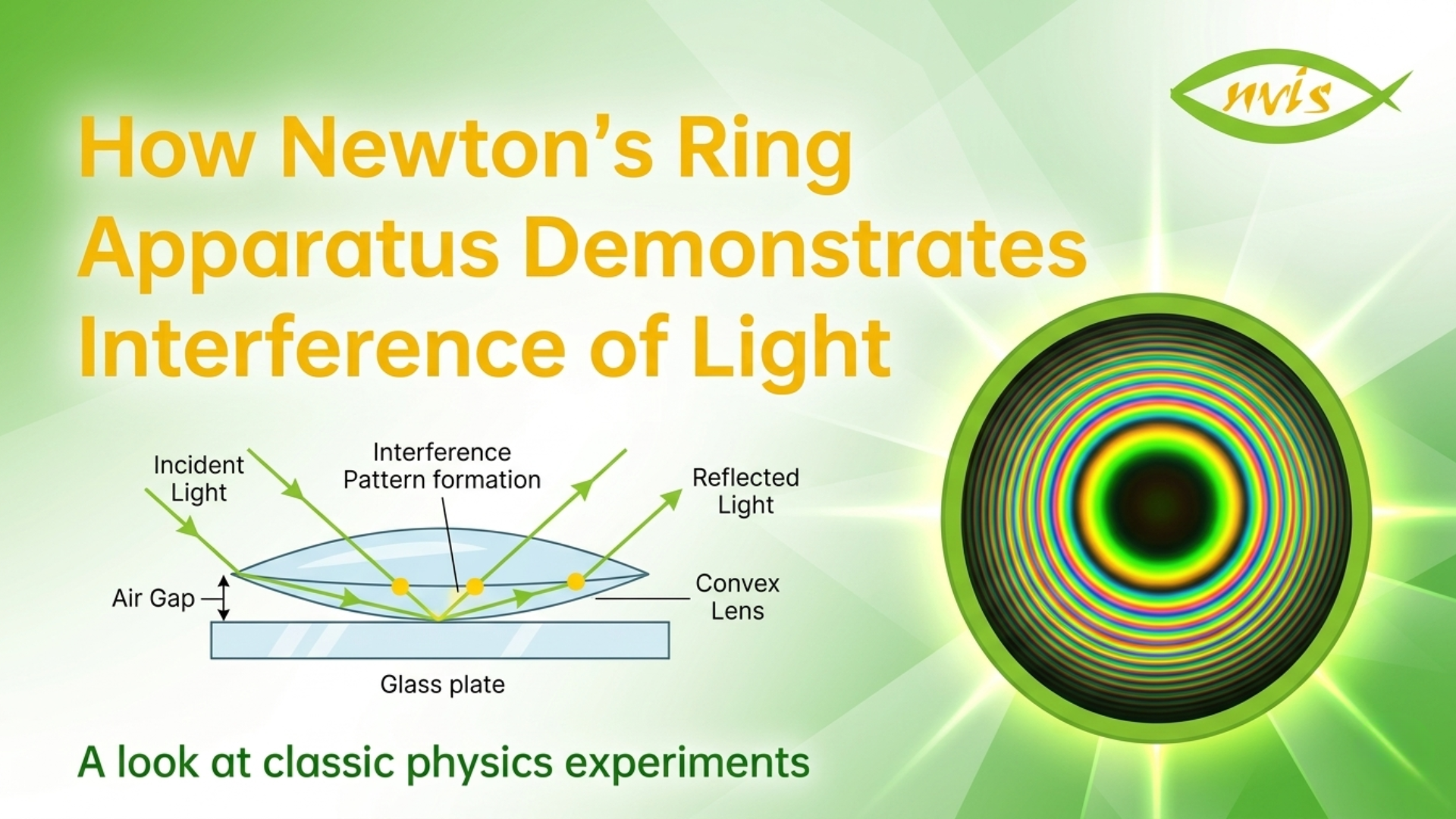
The concept of light behaving as a wave becomes strikingly clear through one of the most elegant experiments in optics, the Newton’s rings experiment. Using a Newton's ring apparatus (also referred to as a Newton's ring experiment apparatus), this setup visually demonstrates the phenomenon of interference of light through the formation of concentric circular fringes. These rings are not just visually appealing; they reveal fundamental properties of light such as wavelength, phase difference, and coherence.
Understanding the Basic Principle
At its core, Newton's ring apparatus works on the principle of interference of light waves. When a plano-convex lens is placed on a flat glass plate, a thin air film is formed between them. When monochromatic light (light of a single wavelength) is directed onto this setup, part of the light reflects from the top surface of the air film while another part reflects from the bottom surface.
These two reflected light waves travel slightly different paths and recombine. Depending on their phase difference, they either reinforce each other (constructive interference) or cancel each other out (destructive interference). This interaction produces a pattern of alternating bright and dark concentric rings known as Newton’s rings.
Structure and Setup of the Apparatus
The Newton's ring experiment apparatus typically consists of a plano-convex lens placed on a flat glass plate, a monochromatic light source (commonly sodium vapor lamp), and a microscope for observing the rings. The arrangement ensures that light falls normally onto the lens and plate system, creating a uniform interference pattern.
The thickness of the air film varies radially from the point of contact, which directly influences the formation of rings. At the center, where the lens touches the plate, the air film thickness is nearly zero, leading to a dark spot due to destructive interference.
How Interference Creates the Ring Pattern
As light reflects from both surfaces of the air film in the newton's ring apparatus, the path difference between the two rays changes gradually with distance from the center. This variation results in alternating constructive and destructive interference at different radial distances.
Bright rings are formed where the path difference satisfies the condition for constructive interference, while dark rings appear where destructive interference occurs. The result is a series of concentric circles centered at the point of contact between the lens and the glass plate.
Key Observations from the Experiment
-
The central spot is dark due to zero thickness of the air film
-
Rings are perfectly circular and concentric
-
The diameter of rings increases with distance from the center
-
The spacing between rings decreases outward
-
The pattern depends on the wavelength of light used
-
Higher wavelength results in wider rings
-
The experiment can be used to calculate the wavelength of light
Why This Experiment Matters
The newton's ring experiment apparatus provides a direct and visual confirmation of the wave nature of light. At a time when understanding light as both a particle and a wave is crucial, this experiment remains one of the simplest yet most powerful demonstrations of wave optics.
By translating abstract theory into observable patterns, it helps students and researchers grasp complex optical phenomena with clarity. Its continued use in modern education highlights its importance and effectiveness in explaining interference.
Conclusion
The Newton's ring apparatus offers a clear and practical demonstration of how light behaves as a wave through interference. By forming distinct concentric rings, Newton's ring experiment apparatus transforms theoretical concepts like constructive and destructive interference into observable reality. This experiment not only strengthens the understanding of wave optics but also enables precise measurement of important properties such as wavelength. Its simplicity, accuracy, and strong visual impact make it an essential experiment in physics education, continuing to bridge the gap between theory and real-world observation.
Learn how Newton's ring apparatus demonstrates light interference, forming concentric rings and helping measure wavelength in optics experiments.

 English
 Arabic
 French
 Spanish
 Portuguese
 Deutsch
 Turkish
 Dutch
Dutch
 Italiano
 Russian
 Romaian
 Greek
Greek