Mental health practices today are facing a quiet but serious challenge. It’s not just about patient care anymore—it’s about navigating a billing ecosystem that’s becoming increasingly complex, time-consuming, and error-prone. From evolving payer requirements to therapy-specific coding nuances, many providers find themselves spending more time chasing payments than supporting patients.
That’s exactly why billing companies for mental health are no longer seen as optional support—they’re becoming essential partners.
Whether you're a solo therapist, a growing group practice, or a multi-location behavioral health organization, the right billing approach can dramatically impact your revenue, compliance, and peace of mind. Let’s break down what’s happening in the industry, why outsourcing is gaining traction, and how to choose the right partner for your practice.
The Reality of Mental Health Billing Today
Mental health billing is fundamentally different from general medical billing. It involves unique CPT codes, frequent prior authorizations, session-based billing models, and payer-specific documentation requirements.
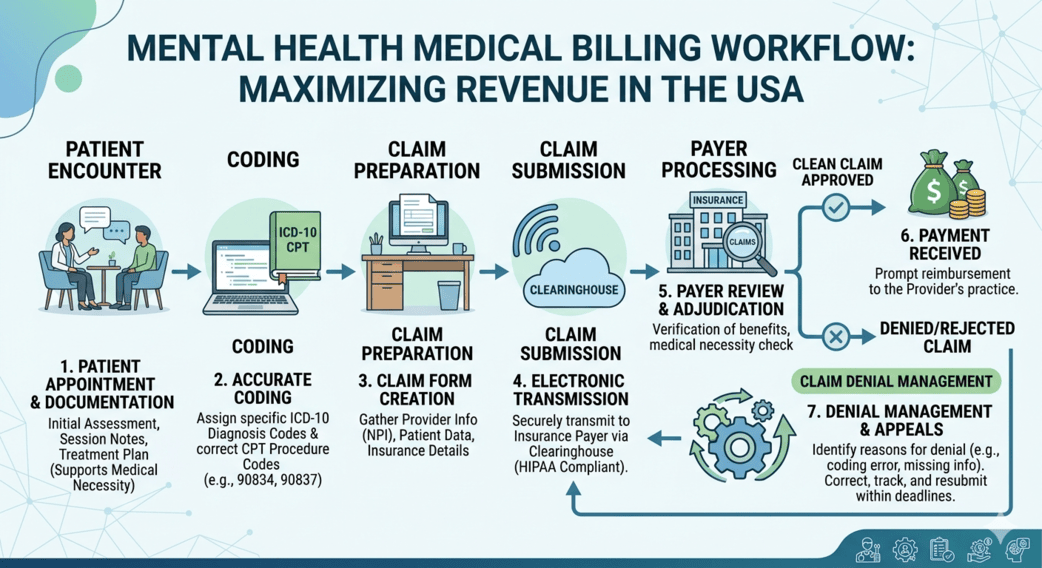
Take a simple example: A licensed therapist conducts a 50-minute psychotherapy session. Sounds straightforward—but billing it correctly requires:
- Selecting the appropriate CPT code (like 90834 vs 90837)
- Verifying coverage and session limits
- Ensuring documentation meets payer standards
- Submitting claims with accurate modifiers if required
- Following up if denied due to medical necessity
Now multiply that across dozens—or hundreds—of patients each week.
This complexity is why many providers seek mental health insurance billing services that specialize in behavioral health workflows instead of relying on general billing teams.
When In-House Billing Starts Holding You Back
Many practices begin with in-house billing, often managed by a front desk team or a single biller. It works—for a while.
But over time, certain red flags start to appear:
- Claims getting denied repeatedly for avoidable reasons
- Payments taking longer than expected
- Staff overwhelmed with administrative tasks
- Lack of visibility into revenue cycle performance
- Compliance risks due to coding errors
At this point, practices start exploring whether to outsource mental health billing services—and for good reason.
Outsourcing doesn’t just shift workload; it introduces expertise, systems, and accountability that are difficult to replicate internally.
What Sets Mental Health Billing Specialists Apart?
A mental health billing specialist isn’t just someone who submits claims. They understand the behavioral health ecosystem deeply.
Here’s what differentiates them:
1. Therapy-Centric Coding Knowledge
They’re fluent in psychotherapy codes, add-on services, telehealth billing, and crisis intervention billing nuances.
2. Payer-Specific Expertise
Mental health claims often vary significantly between insurers. A specialist knows how different payers interpret the same service.
3. Documentation Alignment
They help ensure clinical notes align with billing requirements—reducing audit risks.
4. Denial Pattern Recognition
Instead of reacting to denials, they identify patterns and prevent them proactively.
This level of specialization is why many practices look for a mental health billing and coding company instead of a general provider.
A Closer Look at Outsourced Mental Health Billing
Let’s talk about what actually happens when you choose outsourced mental health billing.
It’s not just about sending your claims to another company. A good partner becomes an extension of your practice.
What They Typically Handle:
- Insurance eligibility verification
- Claim submission and scrubbing
- Payment posting
- Denial management and appeals
- Patient billing and follow-ups
- Reporting and analytics
For example, a mid-sized therapy clinic struggling with 25% claim denials switched to a mental health billing services agency. Within three months, denial rates dropped below 10%, and revenue cycles shortened significantly.
That’s the kind of transformation the right partner can bring.
Choosing the Best Mental Health Billing Agency: What Really Matters
Not all billing providers are created equal. Choosing the best mental health billing agency requires more than comparing pricing.
Here’s what you should evaluate:
Experience in Behavioral Health
Ask directly: How many mental health clients do they serve? Do they understand therapy-specific billing?
Transparency in Reporting
A reliable mental health billing provider will give you clear insights into collections, denials, and outstanding claims.
Technology Integration
Can they work with your EHR system? Do they offer real-time dashboards?
Compliance and Security
HIPAA compliance is non-negotiable, but also look for audit readiness and documentation support.
Communication Style
You don’t want to chase your billing team. A responsive mental health billing consultant should proactively update you.
Real-World Scenario: From Chaos to Control
Consider this: A group of licensed therapists expanded quickly but didn’t scale their billing processes. Within months, they faced:
- Delayed reimbursements
- Confusing financial reports
- Staff burnout
They partnered with a top outsource mental health billing company, which restructured their entire revenue cycle. Within six months:
- Collections increased by 30%
- Administrative workload reduced significantly
- Financial reporting became predictable and actionable
This isn’t an isolated case—it’s becoming the norm.
Why More Therapists Are Outsourcing Billing Services
The demand for billing services for mental health therapists is rising rapidly, and it’s not just about convenience.
Time Reclaimed for Patient Care
Therapists can focus on sessions instead of spreadsheets.
Improved Revenue Accuracy
Specialized billing reduces errors and missed charges.
Scalability Without Stress
As your practice grows, your billing partner grows with you.
Reduced Compliance Risks
Professional handling minimizes audit exposure.
For many providers, working with a professional mental health billing company becomes a long-term strategic decision rather than a temporary fix.
The Role of Technology in Modern Billing Solutions
Today’s mental health medical billing solution goes beyond manual processes. Advanced systems now offer:
- Automated claim scrubbing
- Real-time eligibility checks
- AI-assisted denial prediction
- Integrated reporting dashboards
When combined with expert oversight, these tools significantly enhance efficiency.
That’s why leading mental health medical billing services outsourcing providers invest heavily in both technology and talent.
Is Outsourcing Right for Every Practice?
Not necessarily—but it’s worth considering if:
- You’re experiencing frequent claim denials
- Your staff is overwhelmed with billing tasks
- Revenue cycles are inconsistent
- You’re planning to scale your practice
Even smaller clinics are now exploring billing services for mental health providers because the return on investment is often immediate.
Beyond Billing: The Bigger Picture of Revenue Cycle Management
Billing is just one part of the equation. A strong partner also supports your broader financial ecosystem.
This includes:
- End-to-end revenue cycle management
- Accurate medical coding services aligned with payer rules
- Efficient medical billing services to maximize reimbursements
- Integrated medical billing and coding services for seamless workflows
- Proper credentialing services to ensure providers are enrolled with insurers correctly
When all these elements work together, your practice operates more efficiently—and profitably.
Why the Right Partner Makes All the Difference
Choosing from the many mental health billing companies available can feel overwhelming. But the difference between an average provider and the best outsource mental health billing and coding company often comes down to one thing: alignment with your practice goals.
A strong billing partner doesn’t just process claims—they help you:
- Understand your financial performance
- Identify growth opportunities
- Reduce operational stress
- Build a sustainable practice
Conclusion: Building a Healthier Practice Starts Behind the Scenes
Mental health professionals dedicate their lives to helping others navigate complex emotional and psychological challenges. But behind every successful practice is a well-managed financial system that keeps everything running smoothly.
That’s where specialized billing companies for mental health step in—not as vendors, but as strategic allies.
When billing is handled with precision, insight, and care, it creates space for what truly matters: patient outcomes.
Organizations like 247 Medical Billing Services understand this balance. By combining expertise in medical billing services, medical coding services, and comprehensive revenue cycle management with reliable credentialing services, they help mental health providers streamline operations without losing focus on care delivery.
In a field where every minute matters, having the right billing partner isn’t just helpful—it’s transformative.
FAQs
What do billing companies for mental health typically charge?
Most companies charge a percentage of collections (usually 5%–10%) or a flat fee, depending on services offered and practice size.
How do I know if I should outsource mental health billing?
If you’re facing frequent denials, delayed payments, or administrative overload, outsourcing can improve efficiency and revenue.
Are mental health billing services different from general medical billing?
Yes. Mental health billing involves unique codes, session limits, and payer-specific rules that require specialized expertise.
Can outsourced billing improve revenue?
In many cases, yes. Specialized billing teams reduce errors, speed up reimbursements, and improve claim acceptance rates.
What should I look for in a mental health billing agency?
Focus on experience in behavioral health, transparency, technology integration, and strong communication practices.




 Arabic
 French
 Spanish
 Portuguese
 Deutsch
 Turkish
 Dutch
Dutch
 Italiano
 Russian
 Romaian
 Portuguese (Brazil)
 Greek
Greek