


The Business Case for Qualified Electronic Archiving in Regulated Industries
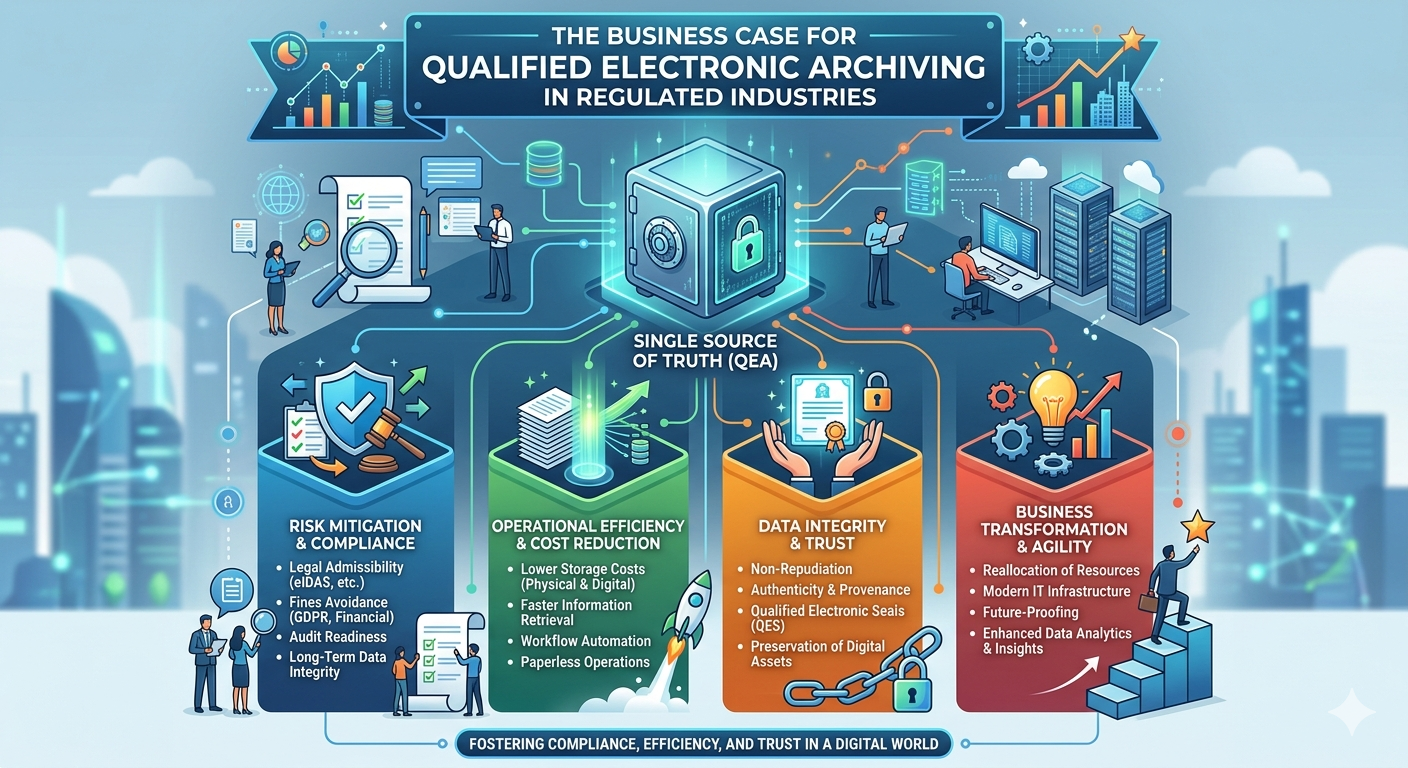
Regulated industries do not have the luxury of treating records like random files in a shared folder. Financial firms, healthcare providers, insurance companies, legal teams, public-sector agencies, and manufacturers all depend on documents that must remain accurate, searchable, protected, and legally reliable for years. That is where Qualified Electronic Archiving becomes more than a technical upgrade. It becomes a business safeguard for companies that cannot afford weak evidence, missing records, or compliance gaps.
Why Regulated Businesses Need Stronger Archiving Standards
Every regulated company has one quiet problem sitting in the background: proof. Proof of what was approved. Proof of what was signed. Proof of what was sent. Proof of what changed. Proof of what happened five years ago when nobody remembers the details anymore.
Traditional document storage often fails this test. A folder can store a file, but it does not always prove that the file stayed unchanged. A cloud drive can make records easier to access, but access alone does not create trust. An email attachment may show a document existed, but it may not provide reliable long-term evidence if the file becomes corrupted, moved, renamed, edited, or lost.
Regulated industries need more than storage. They need preservation, traceability, integrity, controlled access, and long-term readability. The European Commission notes that qualified trust services under eIDAS must meet legal requirements and be recognized across EU Member States, and electronic archiving has been included among proposed qualified trust services.
This matters because compliance pressure is not slowing down. Businesses now manage contracts, invoices, identity records, medical files, HR documents, audit trails, transaction histories, and customer communications across multiple platforms. When those records are scattered, the company loses control.
The risk is not only regulatory. It is operational. Teams waste hours searching for documents. Legal teams struggle to defend claims. Auditors ask for evidence that takes too long to produce. Customers lose confidence when a company cannot verify its own records. That is not a small admin issue. That is a business continuity problem wearing office shoes.
The Financial Argument: Risk Reduction Has Real Value
The strongest business case for better archiving starts with risk. A poor document environment creates legal, financial, and security exposure. IBM’s 2025 Cost of a Data Breach Report lists the global average cost of a data breach at USD 4.4 million. IBM also reports that healthcare had the highest average breach cost among industries in 2025 at USD 7.42 million.
Those numbers should make any regulated business sit up straight. Records are not passive objects. They carry sensitive data, contractual obligations, personal information, financial evidence, and legal value. When record controls are weak, the business is betting against time, human error, cyber threats, and regulatory review.
Qualified Electronic Archiving helps reduce this exposure by creating a more trusted environment for long-term record preservation. It supports integrity, origin verification, confidentiality, and readability over the full retention period. That is especially important when documents must remain valid even after software formats, systems, employees, or business processes change.
There is also a productivity case. When records are archived properly, teams can retrieve information faster. Audit preparation becomes cleaner. Legal discovery becomes less chaotic. Customer service teams can confirm past decisions or agreements without chasing five people across three departments.
For example, a financial services company handling loan documents may need to prove that a customer accepted specific terms on a specific date. A healthcare provider may need to retrieve patient consent forms years after treatment. A manufacturer may need to prove compliance documentation for a product batch long after shipment. In each case, the archive is not a dusty back room. It is the evidence layer of the business.
How Better Archiving Supports Digital Transformation
Many companies talk about digital transformation, but their document management still looks like a junk drawer with a login screen. Files live in inboxes, shared drives, local desktops, legacy systems, and department-specific tools. That setup works until something important must be found quickly.
A strong archive gives digital transformation a stable foundation. Automation, AI, analytics, and workflow tools all depend on clean, reliable information. If the records are messy, the technology built on top of them will be messy too.
A 2024 AvePoint report found that 52% of organizations faced data quality and organization challenges during AI implementation, while 44% lacked basic information management measures. That is a sharp reminder that advanced tools cannot fix weak information discipline by magic.
This is where Qualified Electronic Archiving fits into the bigger picture. It helps companies move from simple file retention to trusted information governance. Instead of asking, “Where did we save that document?” teams can ask better questions: Is the record complete? Is it authentic? Is it readable? Is access controlled? Can it stand up during an audit or legal review?
That shift is valuable for industries where records have long lifecycles. Insurance policies, financial agreements, medical histories, engineering records, land documents, public records, and corporate contracts may need to stay accessible for years or decades. The archive must survive staff turnover, software updates, platform migrations, mergers, cyber incidents, and regulatory change.
The right archiving framework also reduces dependence on tribal knowledge. A business should not need one long-time employee to explain where critical records are stored. That is fragile. Proper archiving turns recordkeeping into a repeatable system instead of a memory game.
What Companies Should Look For
Regulated businesses should not evaluate archiving only by storage capacity or price. Cheap storage can become expensive when records cannot be trusted.
A stronger approach should include:
-
Integrity controls that help prove records have not been altered
-
Metadata that supports search, context, and retention rules
-
Access controls that limit who can view or change sensitive records
-
Long-term readability for documents that must remain usable over time
-
Audit trails that show document activity clearly
-
Retention policies that align with legal and industry requirements
Companies should also consider how the archive fits with existing systems. The goal is not to create another isolated repository. The goal is to create a controlled record environment that supports compliance, daily operations, and long-term business resilience.
Final Thoughts
The business case is simple: regulated companies need records they can trust. Basic storage may keep a file somewhere, but it does not always protect legal value, audit readiness, or long-term reliability.
Qualified Electronic Archiving gives businesses a stronger way to preserve important documents with integrity, structure, and confidence. For industries where one missing or questionable record can create serious consequences, that is not just an IT decision. It is a risk management decision, a compliance decision, and a business continuity decision.
Companies that still treat archiving as a back-office task should rethink it now. The future belongs to businesses that can prove what they know, protect what they keep, and retrieve what matters when the pressure is on.

 English
 Arabic
 French
 Spanish
 Deutsch
 Turkish
 Dutch
Dutch
 Italiano
 Russian
 Romaian
 Portuguese (Brazil)
 Greek
Greek