


Context Engineering vs RAG: What AI Teams Should Prioritize
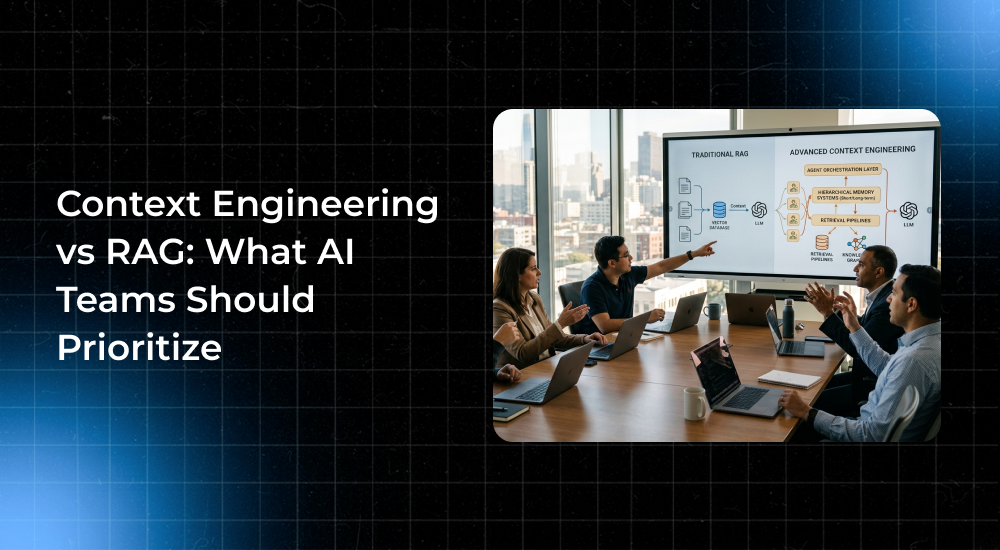
Artificial intelligence is evolving from simple prompt-based systems to highly structured, intelligent architectures that can understand, retrieve, and reason with information more effectively. Two major approaches shaping this evolution are Context Engineering and Retrieval Augmented Generation (RAG).
For AI teams working on modern products, choosing between these approaches or combining them strategically has become a critical decision in building scalable and reliable AI systems.
As organizations invest more in AI Systems Development, understanding the difference between these two methods is essential for creating high-performance AI applications.
Understanding Context Engineering
Context Engineering is the practice of designing and structuring the information environment that an AI system uses to generate responses.
Instead of relying only on prompts or external retrieval, context engineering focuses on providing AI models with:
-
Structured memory
-
Relevant background data
-
User behavior history
-
System-level instructions
-
Domain-specific knowledge
The goal is to ensure that the AI has the right “context” before generating any output.
This approach makes AI systems more consistent, accurate, and aligned with user intent.
In modern AI Application Development, context engineering plays a key role in building intelligent assistants, enterprise tools, and personalized AI experiences.
Understanding Retrieval Augmented Generation (RAG)
Retrieval Augmented Generation (RAG) is a technique where AI systems retrieve relevant information from external sources (like databases or documents) before generating a response.
In simple terms, RAG combines two steps:
-
Retrieve relevant data
-
Generate response using that data
This approach helps AI systems stay updated with external knowledge without retraining the model.
RAG is widely used in:
-
Enterprise search systems
-
Knowledge-based chatbots
-
Document processing tools
-
Customer support automation
According to IBM AI Guide on RAG, RAG improves accuracy by grounding AI responses in real-time or domain-specific data sources.
While RAG is powerful, it depends heavily on retrieval quality and external data infrastructure.
Key Differences Between Context Engineering and RAG
Although both approaches aim to improve AI performance, they work in different ways.
1. Source of Intelligence
-
Context Engineering: Uses structured internal context and memory
-
RAG: Uses external data retrieval systems
2. System Design
-
Context Engineering: Focuses on memory, structure, and system design
-
RAG: Focuses on retrieval pipelines and vector databases
3. Performance Dependency
-
Context Engineering: Depends on quality of context and system architecture
-
RAG: Depends on retrieval accuracy and data indexing
4. Use Cases
-
Context Engineering: Personal assistants, adaptive AI systems
-
RAG: Knowledge bases, document search, enterprise Q&A systems
Both approaches are valuable, but they solve different problems in AI Systems Development.
How AI Systems Development Is Evolving
Modern AI Systems Development is no longer limited to training models or writing prompts. It now includes designing complete intelligent ecosystems that combine:
-
Context-aware memory systems
-
Retrieval-based architectures (RAG)
-
Real-time data pipelines
-
Scalable cloud infrastructure
-
Intelligent automation layers
AI teams are increasingly combining both Context Engineering and RAG to build hybrid systems that are more powerful and flexible.
For example, a customer support AI may use RAG to fetch policy documents while also using context engineering to remember the user’s previous issues and preferences.
This combination creates a more complete and intelligent AI experience.
Which Approach Should AI Teams Prioritize?
There is no single winner between Context Engineering and RAG. The right choice depends on the product goal.
AI teams should prioritize:
-
Context Engineering when personalization, memory, and user experience are critical
-
RAG when external knowledge accuracy and document retrieval are important
-
Hybrid systems when both intelligence and knowledge access are required
In most modern applications, a combination of both approaches delivers the best results.
The Role of AI Application Development
In modern AI Application Development, developers are expected to design systems that go beyond static responses.
They must build applications that:
-
Understand user context
-
Retrieve accurate external information
-
Maintain long-term memory
-
Scale across enterprise systems
-
Deliver real-time intelligent responses
This requires expertise in system design, data engineering, and AI architecture.
As AI continues to evolve, development is shifting toward building intelligent, adaptive ecosystems rather than isolated models.
Challenges in Implementing Context + RAG Systems
While powerful, combining Context Engineering and RAG introduces challenges:
-
Complex system architecture
-
High infrastructure costs
-
Data consistency issues
-
Latency in retrieval systems
-
Security and privacy concerns
AI teams must carefully design pipelines to ensure both performance and scalability.
Proper system optimization is essential for production-ready AI applications.
The Future of AI Architecture
The future of AI systems will likely combine multiple intelligence layers:
-
Context-aware memory systems
-
Real-time retrieval engines
-
Multi-agent AI frameworks
-
Adaptive learning models
-
Autonomous decision-making systems
This hybrid approach will make AI systems more human-like, reliable, and efficient.
Organizations that adopt these architectures early will have a strong competitive advantage in the AI-driven economy.
Conclusion
Both Context Engineering and Retrieval Augmented Generation (RAG) are essential components of modern AI Systems Development. While Context Engineering focuses on structured memory and user understanding, RAG enhances AI with external knowledge retrieval.
In modern AI Application Development, the best results come from combining both approaches into a unified system that delivers accuracy, intelligence, and personalization.
As AI continues to evolve, teams that master both techniques will be better positioned to build scalable, intelligent, and future-ready AI solutions.
At Vasundhara Infotech, we help businesses design and develop advanced AI-powered systems using Context Engineering, RAG architectures, and modern AI development practices. From enterprise AI systems to intelligent automation solutions, our team delivers scalable technology built for real-world impact.
If your organization is planning to build next-generation AI systems using Context Engineering or RAG-based architectures, Contact Us to connect with our experts and accelerate your AI transformation journey.

 English
 Arabic
 French
 Spanish
 Portuguese
 Deutsch
 Turkish
 Dutch
Dutch
 Italiano
 Russian
 Portuguese (Brazil)
 Greek
Greek