


The Importance of Data-Driven Analysis in Modern Sports on Playinmatch
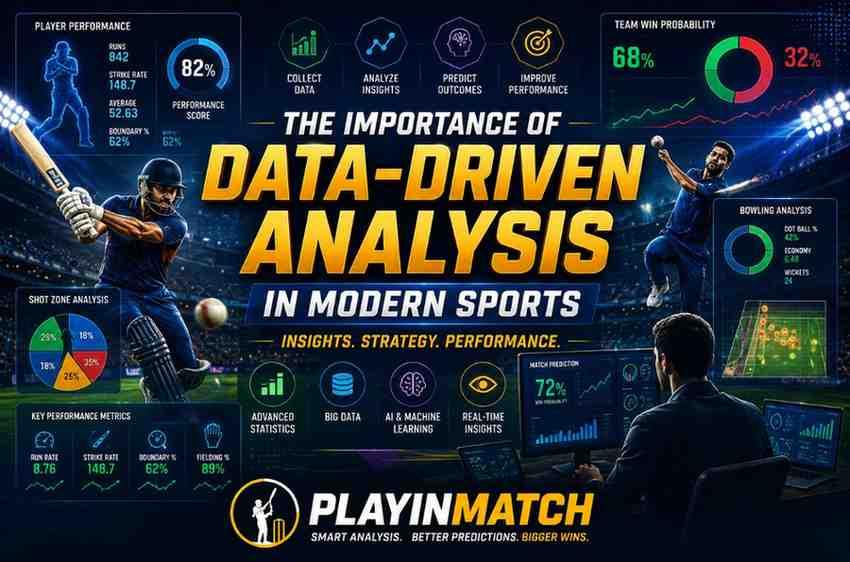
There is a moment in every professional sport when intuition and experience are no longer enough. When the margin between winning and losing becomes small enough — when opponents are equally talented, equally prepared, and equally motivated — the teams and analysts who find even a marginal informational edge over their rivals are the ones who most consistently produce the right outcome in the most critical situations.
That edge, across almost every major professional sport in 2026, comes from data.
The shift toward data-driven analysis in sport has been underway for two decades, but its acceleration in the past five years has been dramatic. From cricket's IPL to football's Premier League, from basketball's NBA to motorsport's Formula 1, the organisations that have adopted systematic data analysis most comprehensively have outperformed their competitors in ways that talent assessments alone would never have predicted. On Playinmatch, where every major cricket fixture is analysed through a data-driven lens, understanding why this shift has happened — and what it means for how we follow and predict sport — is as relevant for fans as it is for professional teams.
From Scorecards to Systems: How Data Changed Sport
The first generation of sports data was essentially record-keeping — scorecard statistics, career averages, and win-loss records that provided a historical summary of performance but offered limited predictive utility. Those numbers told you what had happened. They did not reliably tell you what was likely to happen next.
The analytical revolution changed the question being asked of data. Instead of asking what has happened, data-driven analysis asks what is likely to happen — and why. This shift from descriptive to predictive analysis is the core transformation that has made modern sports analytics so powerful.
In cricket, this manifested most clearly in the development of phase-specific performance data. A batter's career average tells you something. Their powerplay average against left-arm pace on low, slow surfaces in a chase situation tells you something fundamentally more predictive about how they will perform in a specific upcoming match. The difference between those two levels of granularity is the difference between a historical record and a tactical instrument.
The IPL has been the laboratory for this transformation in cricket. With 74 matches in a single season, producing data across ten franchises, multiple venues, and varying conditions, the IPL generates more detailed T20 performance data in a single edition than the previous decade of bilateral T20 cricket produced in total. Teams that process that data systematically — identifying matchup advantages before selection, anticipating pitch behaviour before the toss, flagging fatigue patterns before key matches — make better decisions than teams relying on reputation and intuition alone. Do Playinmatch Login Now.
The Specific Metrics That Matter Most
Not all data carries equal predictive value, and one of the most important skills in modern sports analysis is the ability to identify which metrics are genuinely informative and which are noise dressed as signal.
In T20 cricket, three categories of data have proven most consistently predictive: phase-specific batting and bowling statistics, individual matchup records, and venue-specific performance history.
Phase-specific data — powerplay strike rates, death-over economy rates, middle-over averages — is more predictive than overall season averages because T20 cricket is played in clearly defined phases where specific skills are differentially rewarded. A bowler with an overall economy of 8.5 who has a powerplay economy of 6.8 is a fundamentally different tactical resource from a bowler with the same overall figure who achieves it through the middle overs. Managing that distinction — knowing which bowler to use in which phase and against which batting combination — is exactly the kind of decision that data-driven teams get right more often than their rivals.
Individual matchup records — how a specific batter has performed against a specific bowler type, or in a specific ground against a particular style of attack — provide the most granular predictive input available. Bhuvneshwar Kumar's record of six dismissals against Shubman Gill in IPL 2026, across 79 balls at a cost of 80 runs, is a data point that changed how every captain using Bhuvneshwar approached GT fixtures this season. That information did not emerge from observation alone — it was surfaced by systematic analysis of ball-by-ball data across multiple seasons.
How Data Shapes Tactical Decisions
The translation of data into tactical decisions is where the analytical value of modern sports statistics is most directly visible. Every team at the elite level now makes decisions — from squad selection to in-match bowling changes — that are influenced by data inputs.
In cricket, the Impact Player rule in the IPL has made data-driven squad construction more consequential than at any previous point in the competition's history. The ability to substitute a specialist player mid-match requires teams to predict, before the game begins, which phase of the match they are most likely to need a specific skill. That prediction relies on pitch data, opposition batting profiles, venue history, and current form — all of which are data questions.
Toss decisions in the IPL are another area where data has materially improved outcomes for well-prepared teams. The decision to bowl or bat first at a specific venue is no longer made purely on the captain's gut reading of the surface at 7:15 PM. It is made with reference to the venue's historical toss-outcome correlation, the dew data for that specific date, the opposition's batting depth in a chase scenario, and the bowling attack's performance record when defending at that ground. Each of those inputs is a data question, and the captain who has answered them before the toss has a measurable decision-making advantage over one who has not.
Data-Driven Analysis for Sports Followers
The democratisation of sports data over the past decade has extended its benefits well beyond professional teams and coaches. Today, the same statistical frameworks that elite T20 franchises use to build their squads are accessible to any serious follower of the sport through platforms that publish granular performance data, match-level analysis, and historical record databases.
For fans who want to move beyond the scorecard and understand why specific results happened — and what they predict about future contests — data-driven analysis provides a structured, evidence-based way to engage with sport at a deeper level.
This is precisely the framework that Playinmatch is built to support. Every match preview draws on pitch reports, form data, head-to-head records, individual matchup statistics, and venue-specific performance history — all of the data categories that professional analysts use to build match predictions at the highest level. The same inputs that shaped a GT captain's decision to open with Kagiso Rabada in the powerplay, or an RCB analyst's identification of Bhuvneshwar Kumar's specific value against GT's top order, are the inputs that Playinmatch makes accessible before every major cricket fixture.
Why Data Alone Is Never Enough
The final and most important nuance in data-driven sports analysis is that data is a guide, not a guarantee. The value of analytical frameworks lies in their ability to shift probabilities, not determine outcomes. Cricket — like all sport — contains genuine uncertainty that no dataset fully resolves. A pitch can behave unexpectedly. A player can produce a career-defining innings in a context where the data provided no indication. A single delivery can change a match that every model assessed as comfortably decided.
The best analytical practitioners understand this. They use data to build the most accurate probability estimate the available information supports, then hold that estimate with appropriate humility. They revise it as new information becomes available — through the toss, through the first six overs, through each phase of the match. And they never mistake the map for the territory.
On Playinmatch App, that analytical humility is built into every piece of match analysis. Data informs the prediction. The match decides the result. Following both with equal attention is what data-driven sports engagement at its best looks like.
Follow data-driven match analysis, performance statistics, and live cricket coverage at playinmatch.net.in.

 English
 Arabic
 French
 Spanish
 Portuguese
 Deutsch
 Turkish
 Italiano
 Russian
 Romaian
 Portuguese (Brazil)
 Greek
Greek