Primary care practices form the backbone of the healthcare system. From routine checkups and chronic disease management to preventive screenings, these clinics handle a wide range of patient services every day. But behind every consultation lies a complex financial process that determines whether the practice gets paid accurately and on time.
This is where medical billing for primary care becomes critical. It is not just about sending claims—it is about ensuring accuracy, compliance, reduced denials, and steady cash flow. When billing is handled properly, primary care providers can focus more on patients and less on paperwork stress.
In this guide, we will break down how primary care billing works, common challenges, best practices, and how practices can improve revenue cycle performance.
Understanding Medical Billing for Primary Care
Medical billing for primary care refers to the process of translating patient encounters in a primary care setting into standardized medical claims that insurance companies can process and reimburse.
Primary care clinics deal with a wide variety of services, including:
- Annual physical exams
- Preventive screenings
- Vaccinations and immunizations
- Chronic condition management (diabetes, hypertension, asthma)
- Acute illness visits (flu, infections, injuries)
- Minor procedures and follow-ups
Each service must be documented correctly and translated into CPT, ICD-10, and HCPCS codes before submitting claims to payers.
The billing cycle typically includes:
- Patient registration and insurance verification
- Medical coding of services provided
- Charge entry and claim creation
- Claim submission to insurance companies
- Payment posting and reconciliation
- Denial management and appeals
Even a small error at any stage can lead to claim rejection or delayed payment. That’s why accuracy and consistency are essential in primary care billing operations.
Key Challenges in Primary Care Medical Billing
Primary care practices often experience high patient volume and relatively low reimbursement per visit. This makes billing efficiency extremely important. However, several challenges can disrupt the revenue cycle.
1. Coding Complexity and Frequent Updates
One of the biggest issues in medical billing for primary care is the constantly changing coding system. CPT and ICD-10 codes are updated regularly, and failing to stay current can result in incorrect billing.
For example:
- Preventive visits vs. problem-oriented visits must be coded differently
- Chronic care management requires specific documentation
- Vaccination administration codes vary based on payer rules
Even experienced staff may struggle to keep up with annual coding updates.
2. Claim Denials and Rejections
Denials are common in primary care billing due to:
- Missing or incomplete documentation
- Incorrect patient information
- Eligibility issues
- Duplicate billing
- Non-covered services
Each denied claim requires time-consuming rework, which delays revenue and increases administrative burden.
A high denial rate often indicates gaps in billing processes or documentation practices.
3. Insurance Verification Issues
Many revenue losses happen before the patient even sees the doctor. If insurance eligibility is not verified properly, claims may be rejected later.
Common issues include:
- Expired insurance coverage
- Incorrect policy details
- Lack of pre-authorization (for certain services)
- Out-of-network provider limitations
Without proper verification, practices risk providing non-reimbursable care.
4. Documentation Gaps
In primary care, physicians often focus on patient care rather than documentation details. However, incomplete clinical notes can lead to:
- Under-coding (lost revenue)
- Over-coding (compliance risk)
- Claim denials due to lack of medical necessity
Clear, detailed, and structured documentation is essential for accurate billing.
Best Practices to Improve Primary Care Billing Efficiency
Improving medical billing for primary care requires a combination of process optimization, staff training, and technology support. Below are proven strategies that help clinics improve revenue cycle performance.
1. Strengthen Front-End Verification
Front-end processes are the foundation of successful billing. Before any treatment begins, clinics should ensure:
- Insurance eligibility is verified in real time
- Copay and deductible information is collected
- Referral or authorization requirements are checked
This reduces downstream claim issues and improves first-pass acceptance rates.
2. Improve Clinical Documentation Standards
Physicians and staff should follow structured documentation practices that clearly support the services billed.
Good documentation includes:
- Patient history and symptoms
- Clinical findings
- Assessment and diagnosis
- Treatment plan and follow-up instructions
When documentation aligns with coding requirements, claim accuracy improves significantly.
3. Regular Coding Audits
Routine audits help identify:
- Under-coded services that reduce revenue
- Over-coded services that increase compliance risk
- Patterns of recurring errors
Audits ensure that billing practices stay aligned with payer rules and regulatory requirements.
Even small improvements in coding accuracy can significantly impact annual revenue.
4. Denial Management System
A strong denial management workflow is essential in primary care billing. Instead of ignoring rejected claims, practices should:
- Categorize denial reasons
- Fix root causes (not just resubmit claims)
- Track denial trends monthly
- Appeal valid claims promptly
This helps recover lost revenue and prevents repeated mistakes.
5. Use Technology for Automation
Modern billing systems can automate several time-consuming tasks such as:
- Eligibility verification
- Claim scrubbing before submission
- Payment posting
- Reporting and analytics
Automation reduces human errors and improves billing speed, especially in high-volume primary care settings.
6. Staff Training and Updates
Medical billing rules change frequently. Regular training ensures that billing staff are aware of:
- Updated CPT/ICD guidelines
- Payer-specific rules
- Compliance requirements
- Documentation standards
Well-trained staff reduce errors and improve overall revenue cycle efficiency.
Importance of Outsourcing Medical Billing for Primary Care
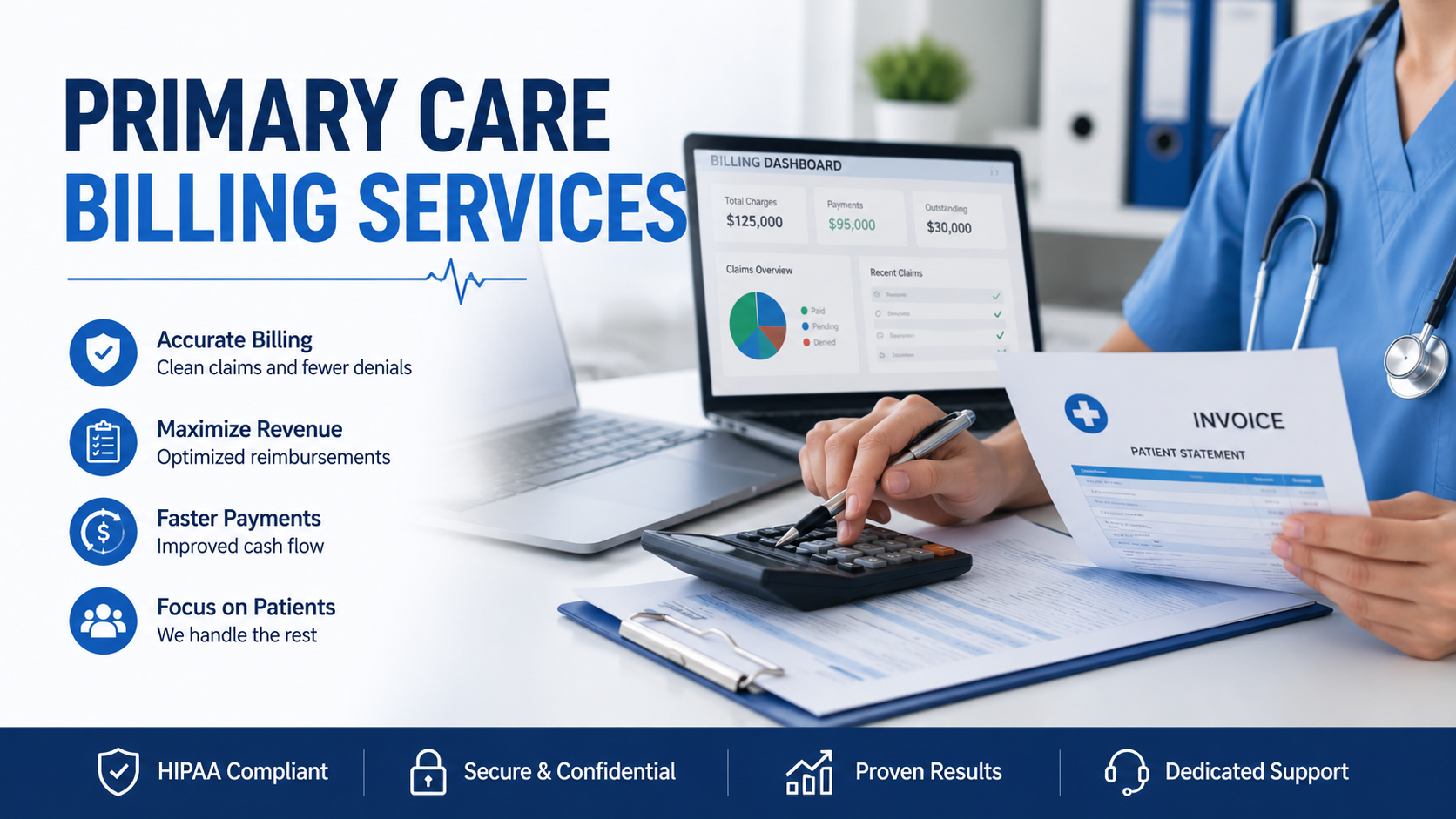
Many primary care clinics are now choosing outsourcing as a strategic solution to improve efficiency and reduce administrative burden.
Outsourcing medical billing for primary care offers several advantages:
- Reduced claim errors and faster reimbursements
- Lower operational costs
- Access to certified billing professionals
- Better denial management
- Improved cash flow consistency
- More time for physicians to focus on patients
Instead of managing complex billing processes internally, outsourcing allows clinics to rely on specialized expertise that ensures accuracy and compliance.
For small and mid-sized practices, this can significantly improve financial stability.
FAQ: Medical Billing for Primary Care
1. What is medical billing for primary care?
It is the process of converting primary care services into standardized medical claims for insurance reimbursement using CPT, ICD-10, and HCPCS codes.
2. Why is primary care billing challenging?
It involves frequent coding updates, high patient volume, insurance complexities, and strict documentation requirements, which increase the risk of errors and denials.
3. How can primary care clinics reduce claim denials?
By improving insurance verification, maintaining accurate documentation, using claim scrubbing tools, and implementing strong denial management systems.
4. What services are commonly billed in primary care?
Common services include preventive checkups, chronic disease management, vaccinations, minor procedures, and acute illness treatment.
5. Is outsourcing medical billing a good option for primary care practices?
Yes. Outsourcing can improve accuracy, reduce administrative workload, speed up reimbursements, and help practices maintain compliance with billing regulations.
Conclusion
Efficient medical billing for primary care is essential for maintaining a healthy revenue cycle and ensuring long-term financial stability. With rising administrative demands and constantly changing payer rules, primary care clinics must adopt smarter billing strategies to avoid revenue leakage.
By focusing on accurate documentation, proper coding, denial management, and automation, practices can significantly improve reimbursement outcomes.
For clinics looking to streamline operations and reduce billing complexity, partnering with professional Medical Billing Services can be a practical and cost-effective solution. It allows healthcare providers to shift focus back to patient care while ensuring that every service is billed accurately and reimbursed on time.




 English
 Arabic
 French
 Spanish
 Portuguese
 Deutsch
 Turkish
 Italiano
 Russian
 Romaian
 Portuguese (Brazil)
 Greek
Greek