


Why Modern Teams Depend on Document Management Software
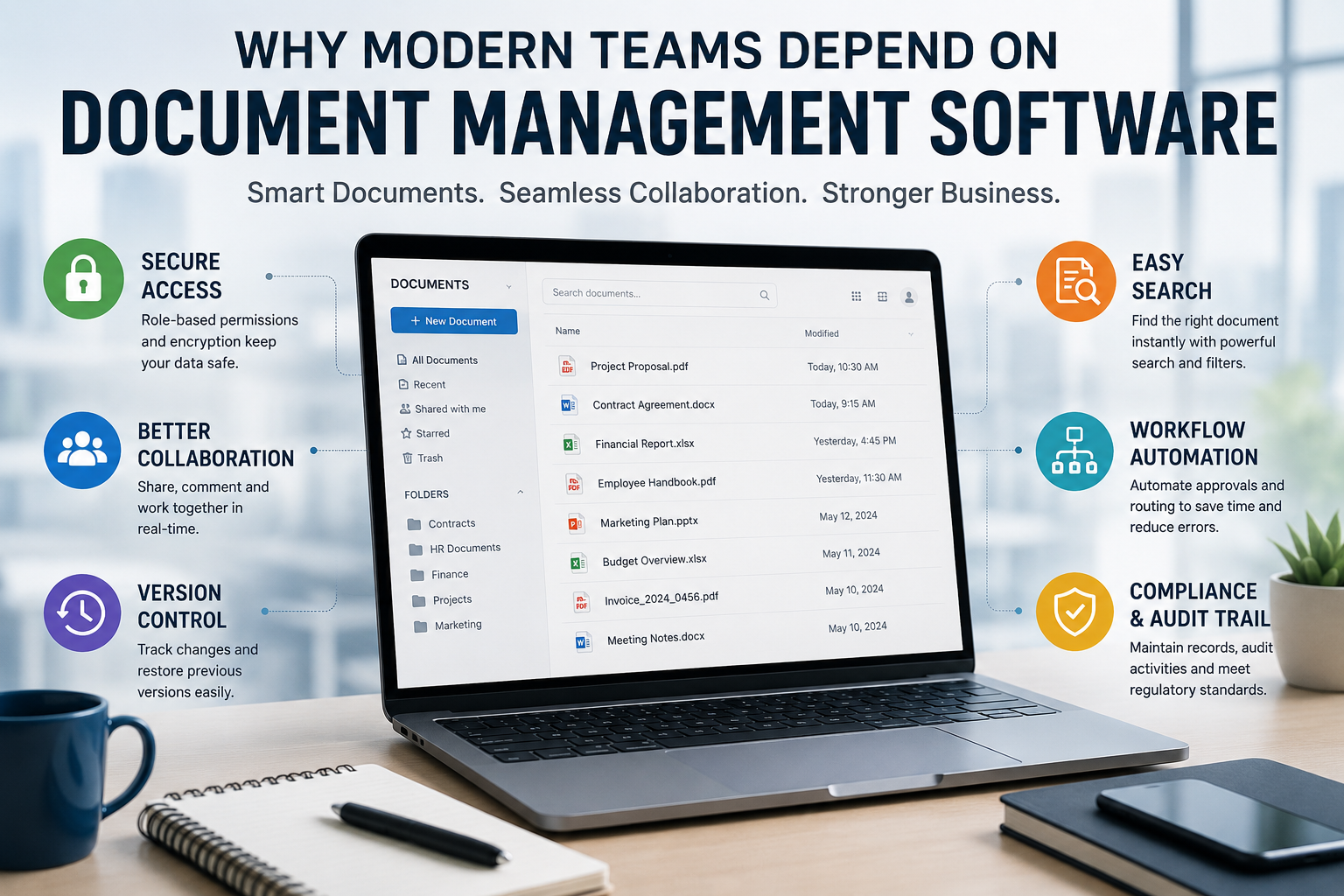
In today's digital-first business environment, organizations handle an enormous volume of documents every day. From contracts and invoices to project files and compliance records, information is constantly being created, shared, edited, and archived. Managing these documents efficiently has become essential for maintaining productivity, accuracy, and security. As teams become more distributed and workflows increasingly digital, document management software has emerged as a critical business tool. It helps organizations centralize information, improve collaboration, reduce administrative burdens, and ensure that employees can access the documents they need when they need them.
Document Growth Challenges Facing Modern Business Teams
The growing reliance on digital information has significantly increased the demand for structured document management systems. Consider the following industry observations:
-
Businesses generate thousands of digital documents annually across multiple departments.
-
Employees often spend a significant portion of their workweek searching for information stored across different systems.
-
Remote and hybrid work models have accelerated the need for centralized document access.
-
Data security regulations continue to place greater emphasis on document governance and record management.
-
Organizations that digitize document workflows often experience measurable improvements in operational efficiency.
These trends demonstrate why businesses are investing in solutions that simplify document handling while supporting collaboration and compliance requirements.
Centralized Access Improves Information Availability Daily
One of the primary reasons modern teams depend on document management software is centralized access to information. Traditional file storage methods often result in documents being scattered across email inboxes, local drives, cloud folders, and shared servers. This fragmentation creates confusion and makes it difficult for employees to locate the latest version of a document.
A centralized document repository ensures that all authorized users can access relevant files from a single location. Whether team members are working from the office, home, or another location, they can quickly retrieve important documents without relying on lengthy email chains or manual searches.
Centralization provides several benefits:
-
Faster document retrieval
-
Reduced duplication of files
-
Better visibility into document status
-
Consistent access across departments
-
Improved knowledge sharing
As organizations grow, maintaining a single source of truth becomes increasingly important for operational efficiency.
Enhanced Team Collaboration Across Multiple Workflows
Modern projects often involve contributions from multiple departments, stakeholders, and external partners. Collaboration can become challenging when documents are shared through outdated processes that rely heavily on email attachments and manual updates.
Document management software streamlines collaboration by enabling multiple users to work within a unified environment. Team members can review documents, leave comments, track modifications, and share feedback without creating unnecessary confusion.
Key collaboration advantages include:
-
Real-time document access
-
Version tracking and history
-
Controlled document sharing
-
Streamlined approval processes
-
Reduced communication bottlenecks
Many organizations also adopt white label document management software to align document workflows with their internal systems and branding requirements while maintaining collaborative capabilities. This approach supports a more seamless user experience across departments and business units.
Stronger Security Controls Protect Sensitive Business Data
Information security remains a top concern for organizations across industries. Sensitive business documents often contain financial information, customer data, intellectual property, and confidential operational details. Unauthorized access or accidental exposure can lead to significant financial and reputational consequences.
Document management software provides advanced security measures that help organizations safeguard critical information. Rather than relying on unsecured file-sharing practices, businesses can establish structured controls governing who can view, edit, download, or share documents.
Common security features include:
-
Role-based permissions
-
User authentication protocols
-
Audit trails
-
Encryption technologies
-
Secure document storage
-
Activity monitoring
These capabilities help organizations reduce risks associated with data breaches and unauthorized document access while maintaining operational flexibility.
Version Control Eliminates Costly Errors and Confusion
Document version issues are among the most common challenges faced by growing teams. When multiple versions of the same file exist across different systems, employees may unknowingly work with outdated information. This can lead to errors, delays, and duplicated efforts.
Version control functionality addresses this challenge by maintaining a structured history of document changes. Users can identify the latest version, review previous revisions, and track modifications made by specific contributors.
Benefits of version control include:
-
Greater document accuracy
-
Reduced risk of conflicting edits
-
Improved accountability
-
Faster review processes
-
Better project coordination
When version management is automated, teams spend less time resolving document discrepancies and more time focusing on productive work.
Compliance Requirements Demand Better Document Governance
Regulatory compliance has become increasingly complex across industries. Organizations are expected to maintain accurate records, preserve audit trails, and demonstrate accountability regarding document handling practices.
Document management software supports compliance initiatives by providing structured governance capabilities. These systems help organizations establish policies for document retention, access control, storage, and disposal.
Important compliance-related functions include:
-
Automated retention schedules
-
Audit logging
-
Controlled access permissions
-
Record classification
-
Document lifecycle management
For organizations operating in regulated sectors, maintaining proper documentation is not only a best practice but often a legal requirement. Effective governance reduces compliance risks while improving operational transparency.
Automation Features Reduce Administrative Workloads Significantly
Many business processes involve repetitive document-related tasks that consume valuable employee time. Activities such as document routing, approval requests, notifications, filing, and status tracking often require substantial manual effort.
Document management software introduces automation capabilities that simplify these routine processes. Automated workflows help ensure consistency while reducing administrative burdens.
Examples of workflow automation include:
-
Automatic document routing
-
Approval notifications
-
Status updates
-
Metadata tagging
-
Scheduled archiving
-
Task assignments
Automation creates measurable efficiency gains by minimizing manual intervention and reducing process delays. Teams can focus on higher-value activities rather than administrative tasks.
Organizations seeking highly customized workflow solutions often collaborate with a bespoke software development company to integrate document management capabilities with existing enterprise systems and specialized operational requirements.
Scalability Supports Growing Organizations and Teams Effectively
As businesses expand, document volumes increase substantially. Systems that work effectively for a small team may become inefficient when supporting hundreds or thousands of users.
Document management software provides scalability that supports organizational growth without compromising accessibility or performance. Businesses can manage increasing amounts of information while maintaining consistent workflows and governance standards.
Scalable systems offer several advantages:
-
Flexible storage capacity
-
Support for larger user bases
-
Consistent performance
-
Expanded workflow capabilities
-
Easier integration with business applications
Many organizations choose white label document management software because it allows them to adapt the platform to evolving operational needs while maintaining a consistent user experience. Scalability ensures that document management processes continue to support business objectives as organizational demands increase.
Future Workplace Success Depends on Smart Information Management
The future of work is increasingly defined by digital collaboration, data-driven decision-making, and distributed teams. In this environment, information management is no longer a back-office function. It has become a strategic capability that directly influences productivity, innovation, and organizational agility.
Document management software enables businesses to transform information into a valuable organizational asset. Rather than treating documents as isolated files, organizations can create connected systems that support collaboration, compliance, security, and operational efficiency.
Several trends are shaping the future of document management:
-
Greater adoption of cloud-based platforms
-
Increased use of artificial intelligence for document processing
-
Enhanced workflow automation
-
Stronger security frameworks
-
Improved integration with business applications
-
More personalized user experiences
As these technologies continue to evolve, organizations that invest in structured document management practices will be better positioned to respond to changing business requirements and market conditions.
Businesses across various industries increasingly recognize the value of white label document management software for creating customized solutions that align with operational objectives while delivering efficient document handling capabilities. These systems help bridge the gap between growing information demands and the need for streamlined business processes.
Additionally, organizations seeking greater flexibility and control often evaluate white label document management software as part of broader digital transformation initiatives. By supporting secure collaboration, efficient workflows, and scalable information management, these platforms contribute to long-term operational resilience.
Conclusion
Modern organizations operate in an environment where information moves quickly, collaboration spans multiple locations, and regulatory expectations continue to evolve. Effective document management has become essential for maintaining productivity, protecting sensitive data, supporting compliance efforts, and enabling seamless teamwork. By centralizing information, improving accessibility, automating routine processes, and strengthening governance practices, document management software helps organizations manage growing volumes of digital content with greater efficiency. As workplaces continue to embrace digital transformation, structured document management will remain a fundamental component of successful business operations.

 English
 Arabic
 Spanish
 Portuguese
 Deutsch
 Turkish
 Dutch
Dutch
 Italiano
 Russian
 Romaian
 Portuguese (Brazil)
 Greek
Greek