


Smart Labels Market Projected to Grow at 6.13% CAGR, Reaching US$ 21.4 Billion by 2033
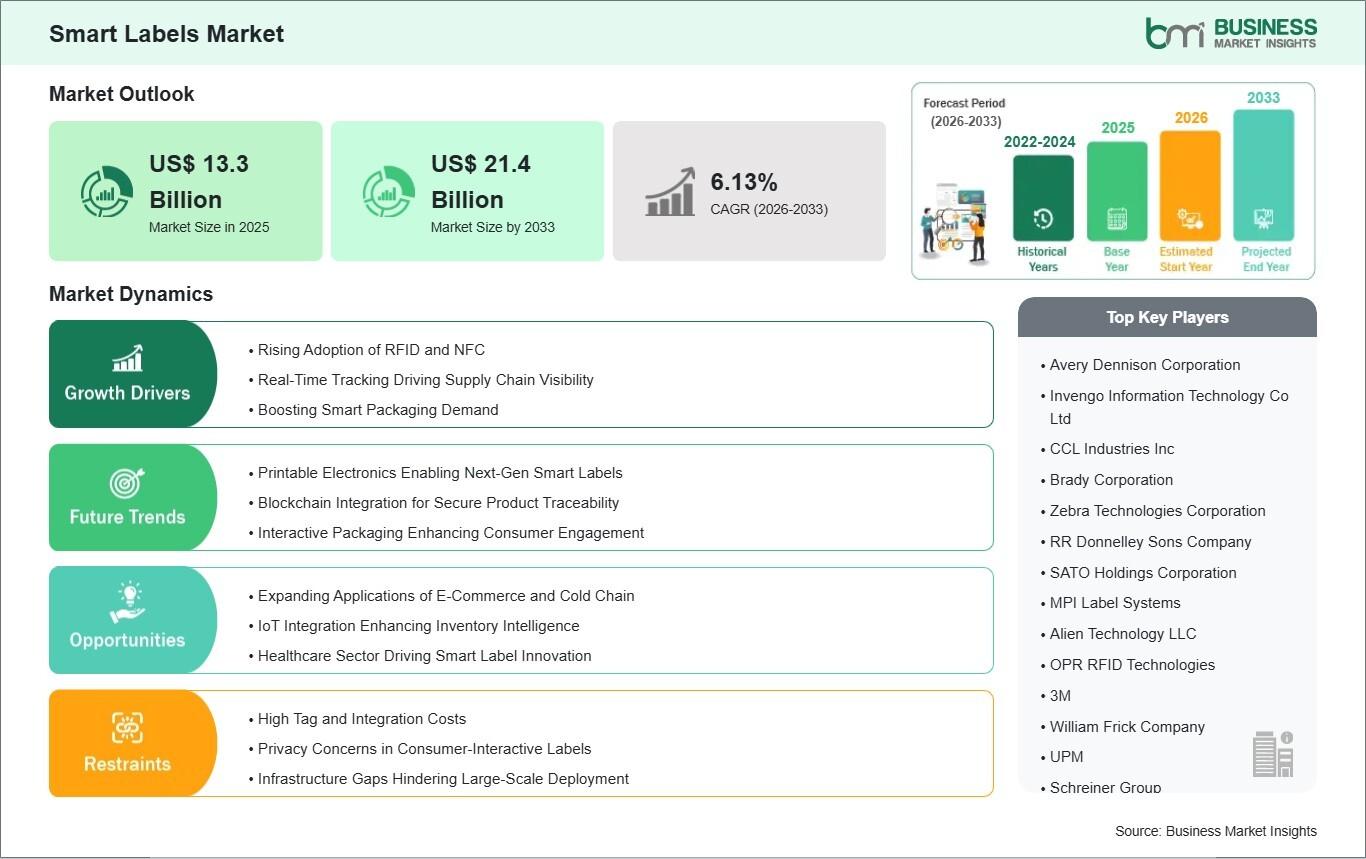
A massive digital overhaul is reshaping global supply chain operations, fueled by a critical technical shift away from legacy, static barcodes toward the widespread deployment of active, data-driven smart labeling systems.
Based on market intelligence from Business Market Insights, the global Smart Labels Market is anticipated to reach US$ 21.4 billion by 2033, mounting from its 2025 value of US$ 13.3 billion at a projected CAGR of 6.13% from 2026 to 2033.
Recent breakthroughs in printable electronics, flexible microchips, and energy-harvesting antennas are fundamentally altering the capabilities of product tracking. Leading packaging and logistics companies are aggressively deploying smart label technologies to eliminate supply chain blind spots, automate inventory counts, and deliver dynamic, interactive experiences directly to the end consumer.
Download Sample Report : https://www.businessmarketinsights.com/sample/BMIPUB00034369
What Are Smart Labels?
Unlike conventional printed labels, a smart label integrates advanced electronic or chemical functionalities directly into its substrate layers. These labels typically comprise a microchip, an antenna structure, a substrate or inlay, and sometimes miniature flexible sensors or printed batteries. They interact dynamically with scanning devices, cloud databases, and smartphones, enabling automatic identification, real-time location tracking, tamper-proofing, and environmental monitoring without requiring a direct line of sight.
The core technologies defining this space include Radio-Frequency Identification (RFID), Near-Field Communication (NFC), Electronic Article Surveillance (EAS), and dynamic Electronic Shelf Labels (ESL). Smart labels essentially turn physical products into digital assets, allowing them to communicate their location, authenticity, and physical condition as they move from the factory floor to the retail shelf.
Market Drivers
The primary driver fueling the Smart Labels Market is the massive boom in omnichannel retail and the subsequent demand for near-perfect inventory accuracy. Traditional inventory management systems frequently suffer from a 20% to 30% error margin due to manual scanning gaps and misplaced items. By deploying RFID smart tags, major retailers have reported boosting their inventory count rates from 200 items per hour to over 12,000 items per hour. This massive jump in data accuracy (often topping 95%) significantly reduces out-of-stock scenarios and streamlines online-order-fulfillment-from-store models.
Furthermore, strict serialization mandates in the pharmaceutical and healthcare sectors are acting as a major catalyst. Pharmaceutical counterfeiting represents a multibillion-dollar global threat. Regulatory frameworks—such as the FDA's Drug Supply Chain Security Act (DSCSA) and the EU's Falsified Medicines Directive—mandate strict, unit-level item tracing. Smart labels embedded with unique serialized NFC or RFID chips allow manufacturers, distributors, and pharmacists to verify a drug's authentic origin in seconds, ensuring patient safety and regulatory compliance.
Additionally, the rising demand for cold-chain integrity and spoilage detection is driving the adoption of sensing labels. Food waste and ruined biologics create severe financial and environmental strain. The introduction of smart sensing labels—equipped with time-temperature indicators (TTIs) and chemical gas sensors—enables continuous quality monitoring. If a seafood pallet or a vaccine box exceeds safe temperature limits during transport, the label changes state or logs the violation, allowing operators to spot compromised goods before they reach shelves.
Market Segmentation
By Technology
- Radio-Frequency Identification (RFID)
- Near-Field Communication (NFC)
- Electronic Article Surveillance (EAS)
- Electronic Shelf Labels (ESL)
- Sensing Labels (Time-Temperature, Moisture, pH)
By Component
- Transceivers and Microprocessors
- Batteries
- Memories
- Antennas
- Substrates
By End User
- Retail
- Healthcare & Pharmaceuticals
- Food & Beverages
- Logistics & Supply Chain
- Aerospace & Automotive
The RFID technology segment currently dominates the market, heavily utilized for long-range, bulk-item scanning in high-volume warehouses and distribution centers. However, NFC technology is experiencing the fastest growth rate, highly favored for its interoperability with smartphones, driving consumer engagement and anti-counterfeiting applications. Among end-users, the retail sector captures the largest revenue share, though the logistics and supply chain segment is rapidly expanding as global shipping networks digitize.
Regional Insights
- North America represents the largest market share globally. This dominance is heavily anchored by the early and aggressive adoption of RFID infrastructure by massive retail conglomerates (like Walmart and Target), stringent FDA regulations for pharmaceutical tracing, and a highly advanced logistics ecosystem across the United States.
- Asia-Pacific is projected to witness the fastest regional growth rate. This explosive expansion is driven by the region's status as the global manufacturing hub, massive investments in automated warehousing, and the rapid rise of modern hypermarkets across China, India, and Southeast Asia deploying ESL technologies.
- Europe holds a strong market position, highly influenced by rigorous European Union regulations concerning food safety, drug traceability, and environmental sustainability. European retailers are also pioneers in adopting Electronic Shelf Labels to optimize dynamic pricing strategies.
- Middle East & Africa and South America are demonstrating steady adoption, primarily fueled by modernization efforts in retail infrastructure, expanding cold-chain logistics networks, and efforts to combat rampant product counterfeiting in premium goods sectors.
Top Players in the Smart Labels Industry
The global marketplace features a dynamic mix of established barcode printing giants, specialized semiconductor manufacturers, and innovative IoT startups. Key industry participants place heavy emphasis on reducing the per-unit cost of smart labels and improving the environmental sustainability of the substrates.
- Avery Dennison Corporation
- Zebra Technologies Corporation
- CCL Industries Inc.
- SATO Holdings Corporation
- Checkpoint Systems, Inc.
- Alien Technology, LLC
- Mühlbauer Holding AG
- Thin Film Electronics ASA
- Smartrac N.V. (Avery Dennison)
- NXP Semiconductors N.V.
These market leaders consistently expand their capabilities through strategic acquisitions of specialized RFID inlay manufacturers and by developing cloud-based software platforms that help clients make sense of the massive data streams generated by smart labels.
Technological Innovations
Technological innovations in Printable Electronics and Chipless RFID are profoundly altering the cost dynamics of the industry. Historically, the presence of a rigid silicon microchip made smart labels expensive to produce in massive volumes. Next-generation smart labels utilize conductive inks to print both the antenna and the memory circuits directly onto the paper or plastic substrate. This chipless approach slashes manufacturing costs, paving the way for item-level tagging on low-margin fast-moving consumer goods (FMCG).
Furthermore, the integration of Blockchain Technology with smart labels is revolutionizing supply chain transparency. When a product is tagged with a serialized NFC or RFID label, its physical movements and environmental conditions can be automatically recorded as immutable blocks on a decentralized ledger. This creates an unhackable, permanent record of provenance, which is crucial for authenticating luxury goods, verifying ethical sourcing claims (like conflict-free diamonds or fair-trade coffee), and streamlining customs clearance.
Additionally, the development of Eco-Friendly and Compostable Smart Labels is directly addressing the massive e-waste concerns associated with single-use electronics. Traditional RFID tags contain aluminum antennas and PET plastics that contaminate paper recycling streams. Innovators are now manufacturing smart labels using graphene-based conductive inks and cellulose or paper substrates. These biodegradable tags provide the same tracking capabilities but can be safely recycled or composted along with the packaging box.
Future Market Outlook
The long-term trajectory for the Smart Labels Market is exceptionally promising, transitioning from a supplementary tracking tool to the fundamental backbone of the global digital supply chain. As the cost per tag continues to fall below the sub-cent threshold, item-level tagging will become ubiquitous across almost every retail category.
The upcoming maturation of 5G networks and Edge Computing will further supercharge smart label capabilities. Future labels will not just wait to be scanned; they will actively broadcast their status to autonomous warehouse robots, instantly updating dynamic pricing algorithms on store shelves, and interacting directly with consumers' smart home appliances (e.g., a milk carton telling a smart fridge it is about to expire). Companies that can deliver highly integrated, secure, and environmentally sustainable smart label ecosystems will dominate the future of connected commerce.
Frequently Asked Questions (FAQs)
What is the difference between RFID and NFC labels?
Radio-Frequency Identification (RFID) labels are designed for long-range, bulk scanning. A warehouse scanner can read hundreds of ultra-high frequency (UHF) RFID tags simultaneously from several meters away. Near-Field Communication (NFC) is a specialized subset of RFID designed for short-range, one-to-one communication. NFC tags must be tapped or held very close (within a few centimeters) to a reader, usually a smartphone, making them ideal for consumer engagement and secure authentication.
Do smart labels require batteries?
Most smart labels (specifically passive RFID and NFC tags) do not have built-in batteries. They are "passive" devices that draw the tiny amount of energy they need to transmit their data directly from the radio waves emitted by the scanning device. "Active" smart labels do contain small printed batteries, allowing them to broadcast signals over much longer distances or power internal sensors (like temperature loggers), but they are larger and more expensive.
How do Electronic Shelf Labels (ESL) work?
Electronic Shelf Labels are digital display tags placed on retail store shelves replacing traditional paper price tags. They use e-ink or LCD technology to display product information and prices. ESLs are connected to the store's central pricing server via Wi-Fi or infrared networks, allowing retailers to execute instant, store-wide dynamic pricing changes across thousands of products without manual labor.
Are smart labels bad for the environment?
Traditional smart labels pose recycling challenges because they combine paper, plastic, aluminum antennas, and silicon chips, which are difficult to separate in standard recycling facilities. However, the industry is rapidly shifting towards sustainable solutions, developing antennas made from conductive carbon or graphene inks and utilizing fully paper-based substrates that are certified recyclable and compostable.
Browse More Reports:
https://www.businessmarketinsights.com/reports/resin-capsules-market
https://www.businessmarketinsights.com/reports/rf-tunable-filter-market
https://www.businessmarketinsights.com/reports/rotary-and-rf-rotary-joints-market
About Us
Business Market Insights is a market research platform that provides a comprehensive subscription service for targeted industry and company intelligence reports. Our research team has extensive professional expertise across dynamic industrial domains such as Electronics & Semiconductor; Aerospace & Defense; Automotive & Transportation; Energy & Power; Healthcare; Manufacturing & Construction; Food & Beverages; Chemicals & Materials; and Technology, Media, & Telecommunications.
Contact Us
If you have any questions about this report or would like further information, please contact us:
Contact person: Ankit Mathur
Email: sales@businessmarketinsights.com
Phone: +16467917070

 English
 Arabic
 Spanish
 Portuguese
 Deutsch
 Turkish
 Dutch
Dutch
 Italiano
 Russian
 Romaian
 Portuguese (Brazil)
 Greek
Greek