


Bio Acrylic Acid Market Set for Significant Expansion, Achieving US$ 1,212.85 Million by 2033
A massive structural pivot is modernizing global chemical operations, fueled by the technical and environmental necessity to transition toward renewable feedstocks, marking the bio-acrylic acid sector as a critical industrial frontier.
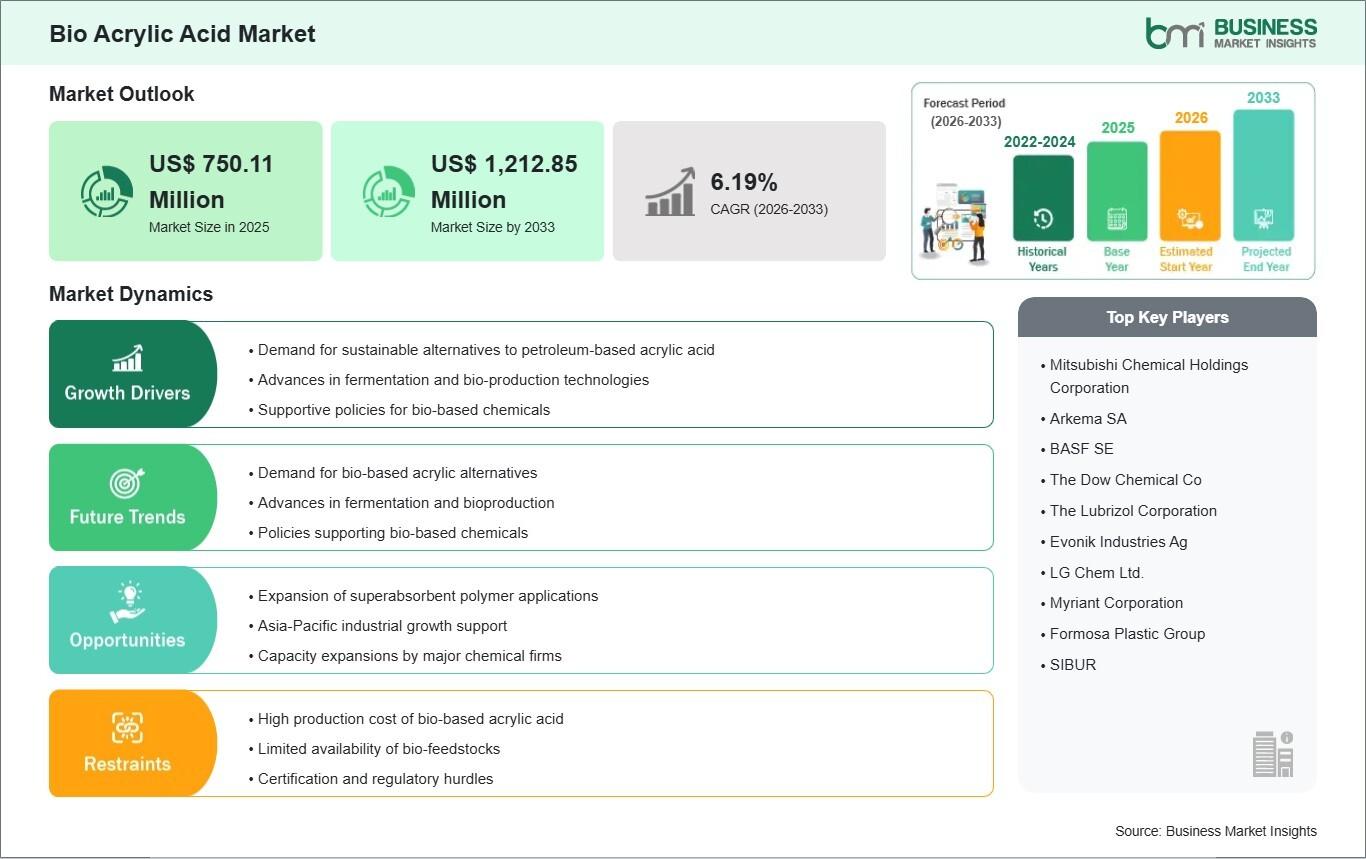
Based on market intelligence from Business Market Insights, the global Bio-Acrylic Acid Market is anticipated to reach US$ 1,212.85 Million by 2033, mounting from its 2025 value of US$ 750.11 Million at a projected CAGR of 6.19% from 2026 to 2033.
Recent advancements in biochemical fermentation, specifically the commercialization of the 3-hydroxypropionic acid (3-HP) route, alongside innovations in catalytic dehydration of glycerol, are drastically improving manufacturing yields. As global consumer goods and chemical giants aggressively decarbonize their supply chains, the demand for bio-acrylic acid to produce green superabsorbent polymers (SAPs), water-borne paints, and biodegradable adhesives is reaching an all-time high.
Download Sample Report : https://www.businessmarketinsights.com/sample/BMIPUB00033672
What Is Bio-Acrylic Acid?
Bio-acrylic acid is a highly reactive organic compound and chemical intermediate utilized extensively to manufacture acrylate esters and superabsorbent polymers. Structurally and functionally, it is completely identical to conventional petrochemical acrylic acid; the sole difference lies in its origin. While traditional acrylic acid is produced via the oxidation of propylene (a fossil-fuel derivative), bio-acrylic acid is synthesized from renewable biomass feedstocks.
Producers extract sugars and starches from agricultural crops like corn, sugarcane, or tapioca, which are then fermented using engineered microorganisms into intermediate chemicals (like lactic acid or 3-HP) before being dehydrated into bio-acrylic acid. Another highly promising pathway involves upcycling crude glycerol—a massive waste byproduct of the biodiesel manufacturing industry—and converting it into bio-acrylic acid via advanced catalytic oxidation. This renewable chemical forms the backbone for thousands of everyday products, dictating the absorbency of baby diapers, the durability of architectural paints, and the tackiness of industrial tapes.
Market Drivers
The primary driver accelerating the Bio-Acrylic Acid Market is the surging global demand for green Superabsorbent Polymers (SAPs). SAPs are cross-linked polyacrylates capable of absorbing and retaining massive amounts of liquid relative to their own mass. They are the essential functional component in disposable baby diapers, adult incontinence products, and feminine hygiene items. As global hygiene standards rise and the aging demographic expands (particularly in Asia-Pacific and Europe), the sanitary products sector is booming. Consumer demand for eco-friendly, biodegradable diapers is directly compelling hygiene brands to substitute petroleum-based SAPs with bio-based alternatives.
Furthermore, stringent governmental regulations targeting Volatile Organic Compounds (VOCs) and hazardous chemicals are forcing the paints, coatings, and adhesives sectors to innovate. Regulatory frameworks such as the European Union's REACH and the European Green Deal heavily penalize high carbon-footprint materials. Bio-acrylic acid is essential for formulating advanced, low-VOC water-borne coatings and bio-adhesives that allow construction firms and automakers to meet rigid environmental compliance standards without sacrificing material performance.
Additionally, the volatility of crude oil prices acts as a significant economic catalyst. Because traditional acrylic acid is directly tethered to the petrochemical supply chain, its pricing is highly susceptible to geopolitical instability and oil market fluctuations. Bio-acrylic acid, derived from localized agricultural feedstocks, offers long-term price stability and supply chain resilience for major downstream chemical manufacturers.
Market Segmentation
By Derivative / Type
- Superabsorbent Polymers (SAPs)
- Butyl Acrylate
- Ethyl Acrylate
- Methyl Acrylate
- 2-Ethylhexyl Acrylate
- Elastomers
By Raw Material
- Sugarcane & Sugar Beet
- Corn & Starch
- Crude Glycerol (Biodiesel Byproduct)
- Lignocellulosic Biomass
By Application
- Paints and Coatings
- Sanitary & Personal Care Products
- Adhesives and Sealants
- Surfactants & Water Treatment
- Textiles
The Superabsorbent Polymers (SAPs) segment accounts for the absolute largest share of global market revenue, intrinsically tied to the non-cyclical, high-volume sanitary products industry. However, the Butyl Acrylate segment is projected to be the fastest-growing derivative, driven by explosive demand for flexible, weather-resistant binders in the architectural coatings and construction adhesives sectors.
Regional Insights
- Asia-Pacific represents the largest and fastest-growing regional market globally. This dominance is anchored by massive agricultural output (providing cheap raw biomass), a rapidly expanding middle class driving the consumption of personal care and hygiene products, and the presence of colossal chemical manufacturing hubs in China, India, and Japan.
- North America holds a highly sophisticated market position. Growth here is fueled by strong consumer preference for sustainable, "green-labeled" consumer goods, robust investments in biotechnology research, and stringent EPA regulations pushing the adhesives and coatings industries toward bio-based formulations.
- Europe maintains a critical market share, fundamentally defined by pioneer sustainability initiatives, the Circular Economy Action Plan, and aggressive corporate carbon-neutrality pledges from multinational chemical and automotive giants based in Germany and France.
- Middle East & Africa and South America are exhibiting steady growth. Brazil, in particular, offers immense potential as a manufacturing hub due to its dominant sugarcane industry and established bio-ethanol infrastructure, providing an ideal foundation for bio-acrylic acid production.
Top Players in the Bio-Acrylic Acid Industry
The competitive landscape is characterized by strategic joint ventures between traditional petrochemical giants and specialized industrial biotechnology firms. To overcome high initial R&D costs, companies are forming alliances to scale fermentation technologies and secure reliable agricultural feedstock supply chains.
- BASF SE
- Arkema S.A.
- The Dow Chemical Company
- NIPPON SHOKUBAI CO., LTD.
- Evonik Industries AG
- LG Chem Ltd.
- China Petroleum & Chemical Corporation (SINOPEC)
- Mitsubishi Chemical Holdings Corporation
- Cargill, Incorporated
- SIBUR International GmbH
These market leaders are heavily investing in pilot plants specifically designed to test the scalability of the glycerol-to-acrylic-acid pathway, aiming to achieve price parity with fossil-based acrylic acid within the next five years.
Technological Innovations
Technological innovations in Metabolic Engineering and Fermentation are the primary forces driving the commercial viability of bio-acrylic acid. Historically, achieving high yields of 3-hydroxypropionic acid (3-HP) via microbial fermentation was difficult because the acid would become toxic to the bacteria producing it. Recent breakthroughs in CRISPR gene editing and synthetic biology have yielded highly resilient yeast and bacterial strains that can tolerate high acid concentrations, drastically reducing downstream purification costs and boosting overall production efficiency.
Furthermore, the advancement of Gas-Phase Catalytic Dehydration of Glycerol is revolutionizing raw material sourcing. As the global push for renewable energy drives up biodiesel production, crude glycerol is being generated in massive, surplus quantities. Chemical engineers have developed highly specialized zeolite and metal-oxide catalysts that efficiently strip water molecules from this waste glycerol to produce high-purity bio-acrylic acid, creating a perfect circular economy loop that solves a waste problem while generating a high-value chemical.
Future Market Outlook
The long-term trajectory for the Bio-Acrylic Acid Market is exceptionally strong. The ultimate tipping point for mass adoption will be achieving cost parity with petrochemical acrylic acid. As fermentation technologies mature and economies of scale are realized in commercial-scale bio-refineries, the "green premium" currently associated with bio-acrylic acid will evaporate.
The future of the market will be heavily defined by the complete "cradle-to-cradle" life cycle of consumer goods. Brands will increasingly demand not just bio-based materials, but materials that are fully biodegradable. Organizations that successfully engineer 100% bio-based, compostable superabsorbent polymers for the diaper industry will unlock billions in unprecedented revenue, fundamentally transforming the global personal care ecosystem.
Frequently Asked Questions (FAQs)
What is the difference between bio-acrylic acid and traditional acrylic acid?
Chemically and functionally, there is zero difference; they perform exactly the same in industrial applications. The difference lies entirely in the raw materials used to make them. Traditional acrylic acid is derived from propylene, a fossil fuel byproduct. Bio-acrylic acid is produced from renewable biomass such as sugar, corn starch, or waste glycerol.
What are Superabsorbent Polymers (SAPs)?
SAPs are materials that can absorb and retain extremely large amounts of a liquid relative to their own mass. They are manufactured by polymerizing acrylic acid. Their most common application is acting as the absorbent core in baby diapers, adult incontinence products, and feminine hygiene pads.
Why is bio-acrylic acid currently more expensive than traditional acrylic acid?
The petrochemical infrastructure for producing traditional acrylic acid has been optimized over several decades, operating at massive economies of scale. The biotechnology required to ferment sugars or catalytically convert glycerol into bio-acrylic acid is still relatively new. High R&D costs, lower initial production volumes, and the cost of sugar/corn feedstocks contribute to a higher current market price.
How does bio-acrylic acid benefit the paints and coatings industry?
The paints and coatings industry is under intense regulatory pressure to eliminate toxic, petroleum-based solvents that emit Volatile Organic Compounds (VOCs). Bio-acrylic acid allows manufacturers to formulate high-performance, water-based (acrylic emulsion) paints that are environmentally safe, odor-free, and highly durable against weathering and UV degradation.
Browse More Reports:
https://www.businessmarketinsights.com/reports/bioprocess-containers-market
https://www.businessmarketinsights.com/reports/building-automation-system-market
https://www.businessmarketinsights.com/reports/carbon-fiber-resin-market
About Us
Business Market Insights is a market research platform that provides a comprehensive subscription service for targeted industry and company intelligence reports. Our research team has extensive professional expertise across dynamic industrial domains such as Electronics & Semiconductor; Aerospace & Defense; Automotive & Transportation; Energy & Power; Healthcare; Manufacturing & Construction; Food & Beverages; Chemicals & Materials; and Technology, Media, & Telecommunications.
Contact Us
If you have any questions about this report or would like further information, please contact us:
Contact person: Ankit Mathur
Email: sales@businessmarketinsights.com
Phone: +16467917070

 English
 Arabic
 French
 Spanish
 Deutsch
 Turkish
 Dutch
Dutch
 Italiano
 Russian
 Romaian
 Portuguese (Brazil)
 Greek
Greek