


FinTech Software Integration in 2026: Benefits, Process, and Business Impact
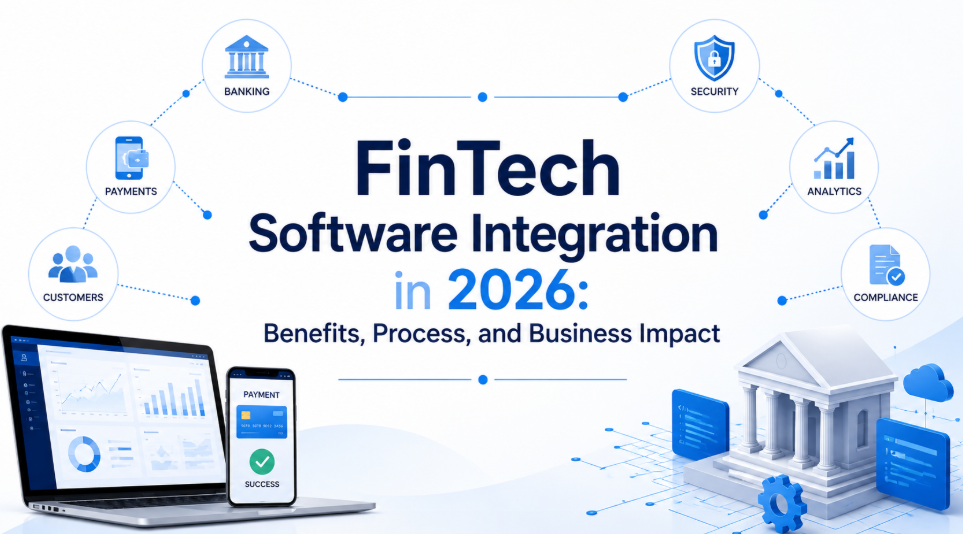
The financial industry is evolving faster than ever before. Customers now expect instant payments, seamless digital experiences, personalized financial services, and secure transactions across multiple channels. Businesses that fail to meet these expectations risk losing customers to competitors that embrace innovation. This is where fintech software integration becomes a game-changing strategy for organizations looking to thrive in the digital-first economy.
In 2026, financial technology is no longer limited to banks and financial institutions. Retail businesses, healthcare providers, insurance companies, eCommerce platforms, logistics firms, and startups are integrating financial services directly into their digital ecosystems. Whether it's enabling digital payments, automating lending processes, facilitating international money transfers, or improving customer onboarding, fintech integrations are transforming how organizations operate and deliver value.
As the fintech market continues to expand, businesses are recognizing that standalone financial systems are no longer sufficient. Modern enterprises require interconnected platforms that can communicate seamlessly with payment gateways, banking APIs, accounting software, customer relationship management systems, fraud detection tools, compliance platforms, and digital wallets. Fintech software integration serves as the foundation for this interconnected financial ecosystem.
This article explores the importance of fintech software integration in 2026, its benefits, implementation process, challenges, emerging trends, and the overall business impact organizations can expect from adopting integrated financial technology solutions.
Understanding FinTech Software Integration
FinTech software integration is the process of connecting financial technology solutions to existing business systems, applications, databases, and digital platforms. The goal is to create a unified environment in which data flows securely and efficiently across various financial and operational systems.
Traditionally, businesses relied on separate systems for payments, accounting, customer management, and financial reporting. These disconnected platforms often resulted in data silos, operational inefficiencies, manual processes, and higher operational costs. Through integration, organizations can eliminate these barriers and establish a seamless flow of information across departments and systems.
Modern fintech integrations commonly involve APIs, cloud-based infrastructure, banking-as-a-service platforms, open banking frameworks, artificial intelligence engines, digital payment gateways, blockchain networks, and compliance monitoring tools. Together, these technologies create a robust ecosystem capable of supporting complex financial operations while delivering superior customer experiences.
Why FinTech Software Integration Matters in 2026
The financial landscape has undergone significant transformation over the past decade. Digital-first consumers now expect convenience, speed, transparency, and security in every financial interaction. Businesses that continue relying on fragmented systems often struggle to keep up with these growing demands.
Fintech software integration addresses this challenge by enabling organizations to create connected digital experiences. Instead of forcing customers to navigate multiple platforms or wait for manual processing, integrated systems deliver real-time financial services that enhance convenience and satisfaction.
Additionally, regulatory requirements continue to evolve globally. Financial institutions and businesses must comply with increasingly complex rules related to anti-money laundering, data privacy, customer verification, and transaction monitoring. Integrated fintech solutions simplify compliance management by centralizing data and automating regulatory workflows.
The rise of embedded finance further reinforces the need for integration. Companies across industries are embedding financial services directly into their applications, creating new revenue streams and improving customer engagement. Without robust fintech integrations, delivering these embedded financial experiences becomes nearly impossible.
Core Components of a Successful FinTech Integration Strategy
Successful fintech integration involves multiple technological components working together harmoniously. APIs play a central role by enabling communication between systems and facilitating secure data exchange. Modern API-driven architectures allow businesses to connect with banking networks, payment processors, and third-party financial services quickly and efficiently.
Cloud computing infrastructure provides the scalability needed to support growing transaction volumes and user demands. Cloud-based fintech solutions offer flexibility, cost efficiency, and enhanced reliability compared to traditional on-premise systems.
Data management platforms serve as another critical component. Since financial operations generate vast amounts of data, organizations need centralized systems capable of storing, processing, and analyzing information in real time.
Security frameworks are equally important. Encryption, tokenization, identity verification, fraud detection algorithms, and multi-factor authentication mechanisms help protect sensitive financial information from cyber threats.
Compliance management systems ensure adherence to evolving regulations while reducing administrative burdens. Automated compliance workflows improve accuracy and minimize regulatory risks.
Key Benefits of FinTech Software Integration
One of the most significant advantages of fintech software integration is operational efficiency. By automating financial workflows and eliminating manual processes, organizations can reduce errors, accelerate transaction processing, and optimize resource utilization.
Improved customer experiences represent another major benefit. Integrated systems enable faster transactions, personalized services, real-time account updates, and frictionless payment experiences. Customers increasingly value convenience, and seamless financial interactions contribute significantly to customer satisfaction and loyalty.
Enhanced data visibility provides organizations with actionable insights into financial performance, customer behavior, and operational trends. Real-time analytics empower decision-makers to make informed strategic choices and respond quickly to market changes.
Cost reduction is another compelling advantage. Automation decreases labor requirements, minimizes errors, and reduces operational overhead. Businesses can allocate resources more effectively while improving overall profitability.
Scalability becomes much easier when financial systems are integrated properly. Organizations can expand services, enter new markets, and support growing customer bases without major infrastructure overhauls.
Security improvements also result from modern fintech integrations. Advanced fraud detection systems, automated monitoring, and centralized security controls help organizations identify and mitigate threats more effectively.
The FinTech Software Integration Process
Implementing a fintech integration strategy requires careful planning and execution. The process typically begins with a comprehensive assessment of existing systems and business objectives. Organizations must identify integration requirements, operational challenges, and desired outcomes before selecting appropriate technologies.
The next stage involves defining the integration architecture. Businesses need to determine how different systems will communicate, what data will be exchanged, and which security measures will be implemented.
Technology selection follows architecture planning. Organizations evaluate fintech providers, APIs, cloud platforms, and third-party solutions based on scalability, security, compatibility, and compliance capabilities.
Development and integration activities then commence. Development teams configure APIs, establish data flows, implement authentication mechanisms, and create custom integrations where necessary.
Testing plays a crucial role throughout the implementation process. Functional testing, performance testing, security testing, and compliance validation help ensure reliable operation before deployment.
Following deployment, organizations monitor system performance continuously, address emerging issues, and optimize integrations to maximize efficiency and user satisfaction.
Emerging Trends Shaping FinTech Integrations in 2026
Artificial intelligence is becoming a core component of fintech ecosystems. AI-powered systems automate decision-making, detect fraud patterns, assess risk, and deliver personalized financial recommendations.
Open banking continues to gain momentum worldwide. Financial institutions are increasingly leveraging APIs to share data securely and create innovative customer experiences. Open banking integrations enable businesses to access banking services more efficiently while promoting financial innovation.
Blockchain technology is also influencing fintech integration strategies. Distributed ledger systems enhance transparency, security, and transaction traceability while reducing reliance on intermediaries.
Real-time payments are becoming the industry standard. Customers expect instant transaction processing regardless of location or payment method. Fintech integrations support this demand by enabling immediate fund transfers and settlement capabilities.
Embedded finance is another rapidly growing trend. Businesses are integrating lending, payments, insurance, and investment services directly into their digital platforms, creating seamless customer journeys and new revenue opportunities.
In the middle of this transformation, many startups are investing heavily in P2P payment transfer app development to meet growing consumer demand for fast, secure, and convenient peer-to-peer transactions. Integrated fintech infrastructure provides the backbone required to support these advanced payment ecosystems while ensuring scalability and regulatory compliance.
Challenges Businesses Face During FinTech Integration
Despite its benefits, fintech integration can present several challenges. Legacy systems often lack compatibility with modern technologies, making integration projects more complex and time-consuming.
Data security remains a primary concern. Financial information is highly sensitive, and organizations must implement rigorous security measures to prevent breaches and unauthorized access.
Regulatory compliance adds another layer of complexity. Businesses operating across multiple jurisdictions must navigate varying legal requirements while maintaining operational consistency.
Integration costs can also be substantial, particularly for organizations with outdated infrastructure. However, the long-term benefits typically outweigh initial investment expenses.
Managing organizational change represents another challenge. Employees may require training and support to adapt effectively to new technologies and workflows.
Measuring the Business Impact of FinTech Integration
The impact of fintech integration extends far beyond operational improvements. Businesses often experience measurable increases in revenue, customer retention, and market competitiveness following successful implementation.
Integrated financial systems enable faster product launches and service innovations, allowing organizations to respond more effectively to changing market demands. This agility creates a significant competitive advantage in rapidly evolving industries.
Customer acquisition costs may decrease as businesses deliver superior digital experiences that attract and retain users more efficiently. Personalized financial services further strengthen customer relationships and increase lifetime value.
Organizations also benefit from improved risk management capabilities. Real-time monitoring and predictive analytics enhance visibility into financial operations, enabling proactive decision-making and threat mitigation.
Enhanced reporting and analytics support strategic planning initiatives by providing accurate, up-to-date financial insights. Leaders gain a clearer understanding of performance metrics and growth opportunities.
How Businesses Can Future-Proof Their Financial Ecosystems
As financial technology continues evolving, organizations must adopt forward-thinking strategies to remain competitive. Future-proofing begins with selecting scalable technologies that can adapt to emerging trends and changing customer expectations.
Businesses should prioritize API-first architectures, cloud-native platforms, and modular systems that support flexibility and innovation. These technologies facilitate seamless integration with new services and reduce the risk of technological obsolescence.
Investing in cybersecurity infrastructure is equally important. As digital transactions increase, protecting customer data and maintaining trust become critical business priorities.
Continuous monitoring, optimization, and innovation should form part of every fintech strategy. Organizations that embrace ongoing improvement are better positioned to capitalize on new opportunities and navigate industry disruptions successfully.
In addition, companies looking to expand their digital financial offerings often explore ways to develop a money transfer app that serves both domestic and international users. By leveraging modern fintech integrations, businesses can build secure, scalable, and user-friendly money transfer solutions that deliver exceptional customer experiences while meeting regulatory requirements.
Conclusion
FinTech software integration has become a strategic necessity for businesses operating in the modern digital economy. As customer expectations continue to rise and financial technologies evolve, organizations must move beyond isolated systems and embrace connected financial ecosystems.
From enhancing operational efficiency and improving customer experiences to enabling embedded finance and real-time payments, the benefits of integration are extensive. Businesses that invest in robust fintech integration strategies position themselves for sustainable growth, innovation, and long-term competitiveness.
As 2026 unfolds, fintech integration will continue shaping the future of financial services across industries. Organizations that adopt scalable, secure, and intelligent integration frameworks today will be better equipped to navigate tomorrow's challenges while unlocking new opportunities for success in an increasingly interconnected financial world.

 English
 Arabic
 French
 Spanish
 Portuguese
 Deutsch
 Turkish
 Dutch
Dutch
 Italiano
 Russian
 Romaian
 Portuguese (Brazil)