


Types of Performance Testing Explained: Load, Stress, Spike, and Endurance Testing
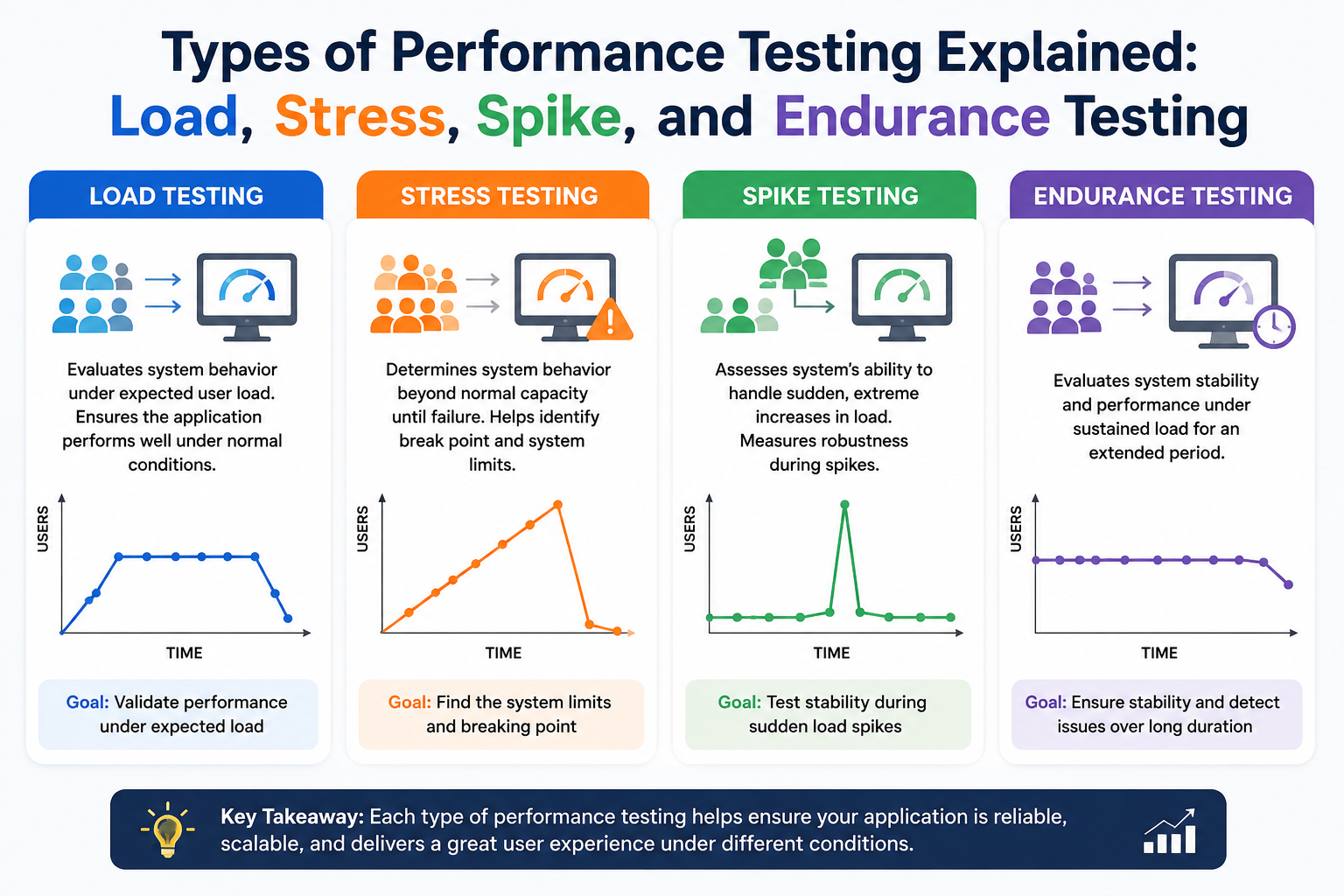
In the competitive digital world, application speed and reliability can make or break user satisfaction and business success. Performance Testing ensures your software can handle real-world demands without compromising on speed, stability, or user experience. Among the various approaches, Load Testing, Stress Testing, Spike Testing, and Endurance Testing stand out as the most critical types.
This comprehensive 2000-word guide explains each type of Performance Testing in detail, with practical examples, tools, metrics, and actionable insights for beginners and intermediate testers alike. Whether you're a developer, QA engineer, or product manager, understanding these testing types will help you build robust applications that scale gracefully.
What is Performance Testing?
Performance Testing is a non-functional testing discipline that evaluates how a system behaves under specific workloads. It measures key aspects such as response time, throughput, resource utilization, and stability. Unlike functional testing that verifies what the application does, Performance Testing focuses on how well it performs under pressure.
Modern applications face unpredictable traffic—from sudden viral surges to sustained high usage. Performance Testing identifies bottlenecks early, prevents costly outages, and ensures compliance with user expectations and SLAs. The four primary types—Load, Stress, Spike, and Endurance—address different risk scenarios and are often used together in a comprehensive strategy.
Why Different Types of Performance Testing Matter
No single test covers every scenario. A system might perform well under expected loads but collapse during unexpected spikes or prolonged usage. By applying targeted Performance Testing types, teams can:
- Improve user retention through faster experiences.
- Optimize infrastructure costs.
- Reduce downtime risks.
- Support confident scaling decisions.
Businesses partnering with Performance Testing experts or using advanced tools gain a significant edge in today’s cloud-native and microservices-driven environments.
1. Load Testing: Validating Expected Usage
Load Testing simulates the anticipated number of concurrent users or transactions to verify the system performs acceptably under normal and peak expected conditions.
Key Objectives:
- Measure response times and throughput at various load levels.
- Identify the system’s breaking point within realistic parameters.
- Validate scalability configurations.
How It Works: Testers gradually ramp up virtual users to the expected maximum (e.g., 10,000 concurrent users for an e-commerce platform during a sale). They monitor how the application, database, servers, and network respond.
Real-World Example: An online ticketing website expects 8,000 users during a major concert sale. Load testing revealed that the checkout process slowed from 2 seconds to 12 seconds at 6,000 users due to inefficient database queries. After optimization (indexing and caching), response times stabilized below 3 seconds, preventing lost sales.
Key Metrics:
- Average, median, and 95th percentile response time
- Transactions per second (TPS)
- Error rate
- CPU, memory, and database connection pool usage
Tools for Load Testing:
- Apache JMeter (open-source, versatile)
- k6 (modern, scriptable in JavaScript)
- Gatling (high performance)
- LoadRunner / Performance Center
- BlazeMeter (cloud scaling)
Best Practices for Load Testing:
- Use realistic user journeys and test data.
- Include think times (pauses between actions).
- Test in an environment mirroring production.
- Run tests iteratively after code or infrastructure changes.
Load Testing is usually the starting point in any Performance Testing initiative because it mirrors day-to-day operations.
2. Stress Testing: Finding Breaking Points
Stress Testing intentionally pushes the system beyond its normal operational capacity to identify its upper limits, failure modes, and recovery capabilities.
Key Objectives:
- Determine maximum capacity.
- Observe behavior under extreme load (crashes, slowdowns, data corruption).
- Test recovery mechanisms after overload.
How It Works: Load is increased far beyond expected levels until components fail. Testers then reduce load and check if the system recovers gracefully without manual intervention or data loss.
Real-World Example: A banking mobile app underwent stress testing simulating 5x expected traffic during end-of-month salary processing. The authentication service failed at 3x load, causing temporary outages. The team implemented circuit breakers and auto-scaling, ensuring the system degraded gracefully instead of crashing completely.
Key Metrics:
- Failure threshold (users/transactions at breakdown)
- Recovery time objective (RTO)
- Resource saturation points
- Error types and frequency
Common Issues Uncovered:
- Memory leaks
- Database deadlocks
- Unhandled exceptions
- Third-party service timeouts
Tools: Same as Load Testing, with emphasis on monitoring tools like Prometheus + Grafana, New Relic, Datadog, or AppDynamics for deep infrastructure insights.
Stress Testing is crucial for mission-critical applications where failure is not an option. It helps teams design better failover and resilience strategies.
3. Spike Testing: Handling Sudden Surges
Spike Testing evaluates system behavior when there is a sudden, dramatic increase in load, followed by a quick return to normal levels.
Key Objectives:
- Test elasticity and auto-scaling capabilities.
- Ensure the system doesn’t crash or lose data during sudden bursts.
- Measure recovery speed after the spike.
How It Works: Load jumps rapidly (e.g., from 1,000 to 10,000 users in minutes) and then drops. This mimics real events like flash sales, news breaks, or viral social media moments.
Real-World Example: A news website experienced a massive spike when a celebrity passed away. Without prior Spike Testing, the site went down for 45 minutes. After implementing and testing auto-scaling groups on AWS with proper caching (CDN + Redis), subsequent spikes were handled with minimal degradation—response times stayed under 4 seconds.
Key Metrics:
- Time to scale up and scale down
- Error rate during spike
- Impact on ongoing sessions
- Latency under sudden load
Tools: k6 and Gatling excel here due to flexible scripting for sudden ramps. Cloud platforms like AWS, Azure, and Google Cloud offer built-in load generation services.
Best Practices:
- Test with realistic spike patterns.
- Validate session persistence and data consistency.
- Combine with infrastructure monitoring.
Spike Testing has become increasingly important in the age of social media and live events, where traffic can explode unpredictably.
4. Endurance (Soak) Testing: Long-Term Stability
Endurance Testing, also known as Soak Testing, checks system performance under sustained load over extended periods—hours or even days.
Key Objectives:
- Detect memory leaks, resource exhaustion, and gradual degradation.
- Ensure stability for long-running processes.
- Validate behavior during overnight or weekend operations.
How It Works: Apply a steady, realistic load (or slightly above) for a prolonged duration while continuously monitoring resource usage and performance metrics.
Real-World Example: A SaaS collaboration tool passed Load and Stress Testing but failed Endurance Testing after 48 hours. A subtle memory leak in the notification service caused gradual slowdowns and eventual crashes. Fixing the leak and adding better garbage collection tuning resolved the issue, resulting in rock-solid performance for enterprise customers.
Key Metrics:
- Memory usage trends over time
- Response time degradation
- Database connection growth
- Disk I/O accumulation
Tools: JMeter, k6, and LoadRunner support long-duration runs. Monitoring solutions like Prometheus with long-term storage are essential.
Endurance Testing is vital for applications expected to run continuously, such as streaming services, monitoring dashboards, or backend processors.
Comparing the Types of Performance Testing
| Type | Goal | Load Pattern | Duration | Best For |
|---|---|---|---|---|
| Load Testing | Normal + peak validation | Gradual ramp-up | Short-Medium | Daily operations |
| Stress Testing | Breaking point & recovery | Extreme overload | Short | Resilience planning |
| Spike Testing | Sudden surges | Sharp ramp up/down | Short | Unpredictable traffic |
| Endurance | Long-term stability | Sustained realistic load | Long (hours+) | Memory leaks & degradation |
Understanding these differences allows teams to create balanced Performance Testing strategies.
Tools and Technologies for Comprehensive Performance Testing
Popular choices in 2026 include:
- Open Source: JMeter, k6, Gatling, Locust
- Enterprise: LoadRunner, NeoLoad
- Cloud-Native: BlazeMeter, AWS Distributed Load Testing, Azure Load Testing
- Monitoring: Prometheus, Grafana, Dynatrace, New Relic
Many teams integrate these into CI/CD pipelines using Jenkins, GitHub Actions, or GitLab for continuous Performance Testing.
Step-by-Step Performance Testing Process
- Identify Objectives & Scenarios – Define success criteria for each test type.
- Prepare Test Environment – Mirror production as closely as possible.
- Develop Scripts – Record or code realistic user behaviors.
- Execute Tests – Start with baseline, then apply specific load patterns.
- Monitor & Analyze – Collect metrics from all layers.
- Report & Remediate – Prioritize fixes and retest.
- Automate & Shift Left – Integrate early in development.
Best Practices Across All Types of Performance Testing
- Start early (shift-left approach).
- Use production-like data and environments.
- Focus on user-centric metrics (e.g., 95th percentile).
- Test third-party integrations and APIs.
- Document everything for future reference.
- Combine automated testing with manual analysis.
- Regularly update test scenarios as the application evolves.
Challenges in Performance Testing
- High infrastructure costs for realistic testing.
- Difficulty creating truly representative loads.
- Analyzing massive volumes of data.
- Frequent application changes breaking test scripts.
- Skill gap in modern cloud-native performance engineering.
Professional Performance Testing services can help overcome these hurdles with specialized expertise and scalable cloud resources.
Future Trends in Performance Testing
AI-driven test generation, observability platforms, and tighter DevOps integration are shaping the future. Emphasis on real-user monitoring (RUM) alongside synthetic testing, along with green performance testing (energy efficiency), is gaining traction.
Conclusion
Mastering Load Testing, Stress Testing, Spike Testing, and Endurance Testing equips you with the knowledge to deliver fast, stable, and resilient applications. Each type of Performance Testing addresses unique challenges, and together they form a powerful strategy for modern software development.
By investing time in understanding and implementing these testing types, organizations can significantly reduce risks, optimize costs, and delight users even under the most demanding conditions. Start small—pick one critical user journey, choose an accessible tool like JMeter or k6, and run your first Load Test today. Over time, expand to full-spectrum Performance Testing for maximum impact.

 English
 Arabic
 French
 Spanish
 Portuguese
 Deutsch
 Turkish
 Dutch
Dutch
 Italiano
 Romaian
 Portuguese (Brazil)
 Greek
Greek