


The Legacy Lifeline: Why RS485 to Ethernet Converters Remain Vital in Modern Automation
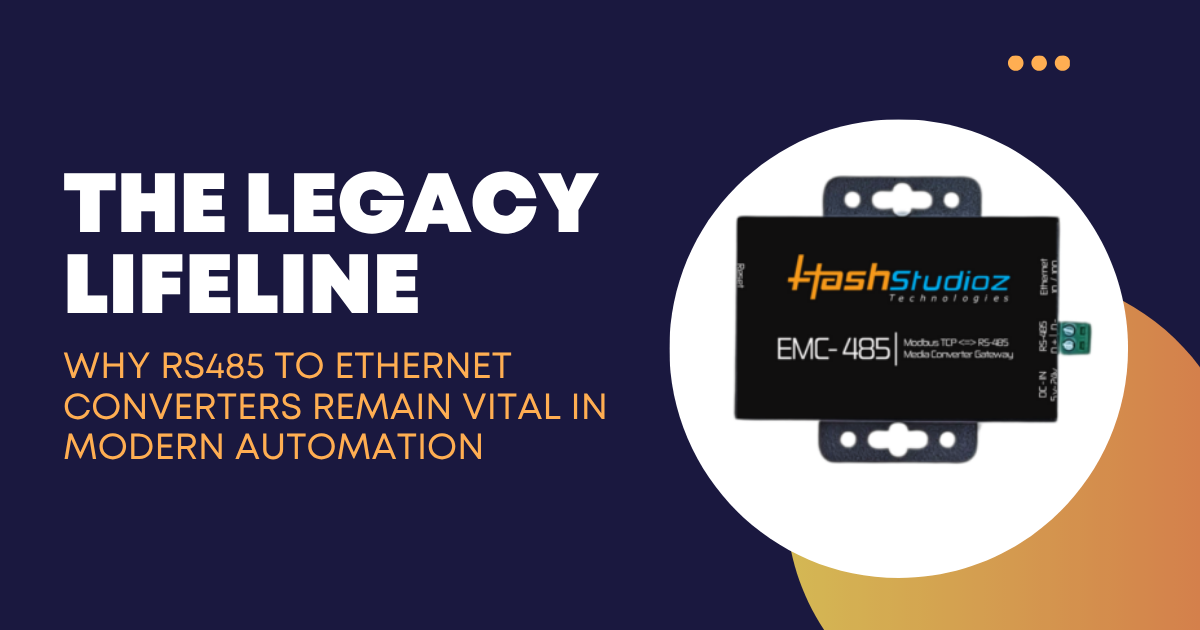
Industrial automation moves fast. Factories deploy cloud computing, artificial intelligence, and real-time ethernet networks daily. Yet, older infrastructure remains on the plant floor. Recent market studies show that over 60% of active factory sensors still rely on older serial protocols. Millions of functional field devices rely on the serial RS485 physical layer worldwide. These legacy systems cannot talk directly to modern network switches. The RS485 to Ethernet Converter bridges this massive technological gap. This simple hardware link keeps older machines active. This technical article analyzes why this RS485 to Lan Converter remains essential today.
Understanding the Physical Network Gap
Industrial communication uses two different physical layouts. Legacy systems use serial wiring. Modern infrastructure uses Ethernet cabling.
1. The Power of RS485 Serial Lines
RS485, introduced in 1983, is a differential serial communication standard designed for industrial use. It supports up to 32 devices on a single twisted-pair cable and can transmit data over distances up to 1200 meters. Its differential signaling provides strong resistance to electromagnetic interference, making it ideal for harsh factory environments. However, its master-slave architecture allows only one device to communicate at a time, limiting overall data throughput and communication speed.
2. The Rise of Industrial Ethernet
Industrial Ethernet enables high-speed automation with gigabit-level data transfer and a scalable star topology using network switches. This allows multiple devices to communicate simultaneously while supporting cloud integration, web services, and centralized monitoring. However, many legacy serial devices lack Ethernet ports and TCP/IP capabilities, preventing direct connectivity to modern industrial networks without protocol conversion solutions.
The Critical Role of the Interface Converter
An RS485 to Lan Converter acts as an industrial translator. The device contains a physical serial transceiver, a processor, and an Ethernet interface.
The converter encapsulates raw serial data into standard TCP or UDP network packets. This process happens in real time with minimal latency.
1. Virtual COM Port Mapping
Many legacy software applications look for a local serial port. They expect to find data on COM1 or COM2. The converter software creates a virtual COM port on the central host computer. The software redirects network packets to this virtual port. The legacy software thinks it connects directly to a local serial cable. This software trick saves companies from rewriting expensive automation applications.
2. Protocol Conversion Mechanics
Basic converters just wrap serial bytes into TCP packets. Advanced models perform full protocol translation. They convert Modbus RTU serial frames into Modbus TCP Ethernet packets. The converter alters the frame structure on the fly:
|
Modbus RTU Frame Element |
Modbus TCP Equivalent Element |
|
Slave Address (1 Byte) |
Unit Identifier (1 Byte) |
|
Function Code (1 Byte) |
Function Code (1 Byte) |
|
Data Payload (Variable) |
Data Payload (Variable) |
|
CRC Checksum (2 Bytes) |
MBAP Header (7 Bytes, Removes CRC) |
The converter strips the serial cyclic redundancy check. It adds the standard Ethernet transport header. This translation lets old meters communicate with modern programmable logic controllers.
Why Automation Engineers Refuse to Replace RS485
Replacing legacy infrastructure costs a lot of money. It also requires significant engineering time.
1. The Massive Financial Burden of Replacement
Replacing legacy industrial instruments with modern Ethernet-native devices is extremely costly. In a large plant, upgrading 400 flow meters could cost hundreds of thousands of dollars, excluding new cabling infrastructure. In contrast, RS485 to Ethernet converters support multiple devices per unit, reducing total upgrade expenses dramatically and saving hundreds of thousands in capital investment.
2. Avoiding Operational Downtime
Replacing field instruments typically requires production shutdowns, draining systems, and extensive maintenance work, leading to significant financial losses. Industrial downtime can cost tens of thousands of dollars per minute. Using RS485 to LAN converters allows integration without stopping operations, enabling quick installation and preventing costly interruptions to production lines.
3. The Long Lifespan of Industrial Components
Industrial equipment is designed for long-term durability, often operating reliably for decades without performance degradation. Replacing fully functional devices solely for connectivity upgrades is economically inefficient. RS485 to Ethernet converters preserve existing assets by extending their usability while enabling modern network communication, maximizing return on existing infrastructure investments.
Technical Features of Industrial-Grade Converters
Commercial office adapters fail quickly on factory floors. Industrial automation requires rugged conversion hardware with specific protective electrical circuits.
1. Electrical Isolation and Surge Protection
Industrial environments generate strong electromagnetic interference and voltage surges from motors, welding equipment, and switchgear. Converters use galvanic isolation, often rated up to 2 kV, to protect circuits. Optocouplers convert signals into light, breaking electrical paths and ensuring surges do not damage processors or connected Ethernet infrastructure.
2. Flexible Operating Modes
Industrial converters support multiple communication modes to fit different network architectures. In TCP Server mode, the device waits for incoming connections. In TCP Client mode, it initiates connections to a server automatically. UDP mode enables fast, lightweight broadcasting across networks, giving engineers flexible deployment options.
3. Industrial Enclosures and Mounting Options
Designed for harsh environments, industrial converters use rugged metal enclosures with DIN rail mounting for easy cabinet installation. They typically feature IP30 or higher protection against dust and debris. Wide-range DC power inputs, often 9V to 48V, allow direct operation from standard 24V industrial power systems.
Real-World Examples: The Converter in Action
1. Updating Electrical Substation Networks
A regional utility company manages fifty power distribution substations built in the late 1990s. Each station contains 24 electrical meters communicating via Modbus RTU over RS485. The utility provider deployed a central energy management system in their corporate headquarters. This software requires network data access over standard TCP/IP connections. The company installed two RS485 to Ethernet Converter units inside each substation cabinet. Technicians wired twelve meters to each converter. The converters translate the serial telemetry into Modbus TCP packets. The data moves across a secure wide-area network directly to headquarters. This update gave engineers real-time visibility into grid power quality. The utility company achieved this without replacing a single substation meter.
2. HVAC Integration in Commercial High-Rises
A facility management firm operates a 40-story office tower. The building uses an older building management system to control variable air volume boxes. These climate control boxes use the serial BACnet MS/TP communication protocol. The main building controller requires modern BACnet/IP connectivity over standard local area networks. The firm installed compact converters on every fifth floor of the tower. The converters gather data from the local serial networks on those levels. They route the aggregated climate data over the building's existing category-6 Ethernet backbone. This network update lowered building energy consumption by 14% through better centralized programming.
Addressing Technical Challenges and Misconceptions
While converters are highly useful, engineers must design around their inherent technical limitations.
1. Managing Serial Latency
Ethernet networks operate at high data rates. Serial lines run at slow speeds, often 9600 bits per second. A fast network controller can easily flood a slow serial bus with too many requests. This speed mismatch creates data bottlenecks inside the converter memory buffer.
Engineers resolve this issue by tuning packet timeout parameters. They configure transmission delays inside the converter web management interface. This adjustment ensures the converter waits for the serial bus to clear before sending new requests.
2. Bandwidth Allocation Limits
An RS485 to Lan Converter does not speed up the underlying serial bus line. It simply allows serial data to ride across an Ethernet network cable. If a serial bus requires 400 milliseconds to complete a polling cycle, that delay remains. Engineers must not plan high-frequency control loops around converted serial lines. The hardware suits monitoring, configuration, and data logging tasks perfectly.
Future Outlook: The Next Decade of Serial Connectivity
Legacy serial technology shows no signs of disappearing from modern factories. Industrial market surveys indicate that manufacturers purchase over one million new serial-to-ethernet converters annually worldwide. The rise of the industrial internet of things increases this conversion demand. Companies need historical data to train machine learning models.
Legacy machines hold this valuable data deep inside their serial registers. The interface converter serves as the most economical tool to collect this information.
Modern converters now include basic edge-processing features. They can run script files to filter out corrupted data packets locally. This local processing saves upstream network bandwidth. The hardware evolves to meet new automation demands while keeping its core translation function intact.
Conclusion
The ongoing development of automation technology does not require discarding older, reliable hardware systems. True engineering efficiency balances modern performance against capital cost constraints. The RS485 to Ethernet Converter provides an essential lifeline for older factory equipment. It helps legacy hardware meet modern connectivity demands. Using an RS485 to Lan Converter allows companies to avoid expensive device replacements. It prevents operational downtime and protects existing infrastructure investments. The hardware brings the benefits of modern Ethernet networking to durable serial instruments. Interface converters remain vital components in modern industrial automation networks worldwide.

 English
 Arabic
 French
 Spanish
 Portuguese
 Deutsch
 Turkish
 Dutch
Dutch
 Italiano
 Russian
 Romaian
 Greek
Greek