


Frozen Vegetable Market Analysis 2026-2035: Size, Segmentation & Growth Forecast | FMI
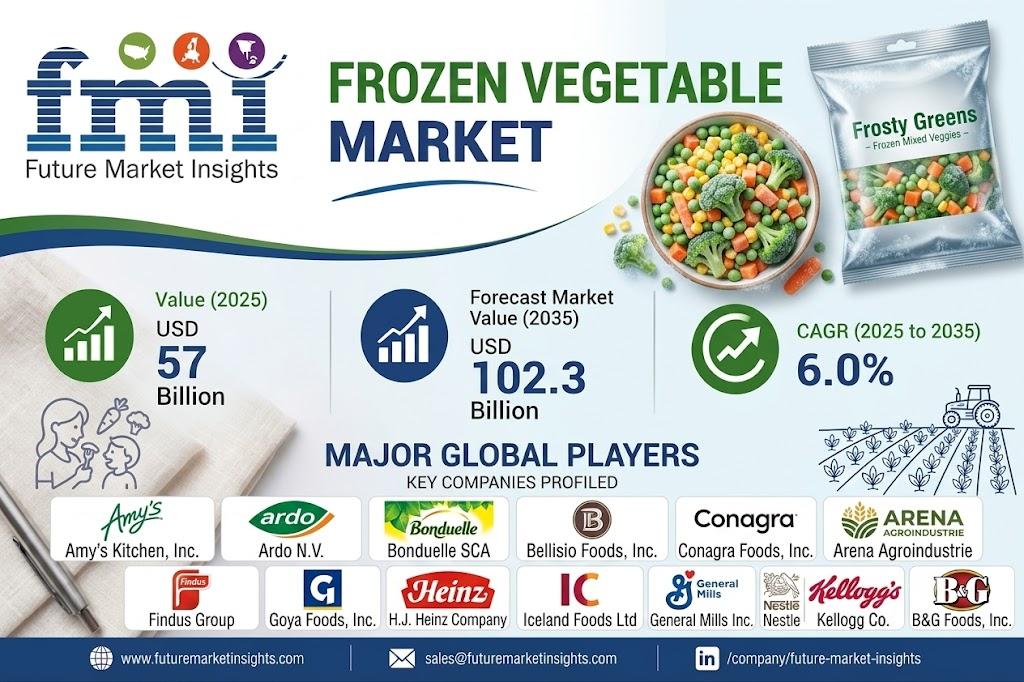
NEWARK, Del., June 12, 2026 — The global Frozen Vegetable Market is projected to grow from USD 57 billion in 2025 to USD 102.3 billion by 2035, registering a CAGR of 6.0% during the forecast period, according to Future Market Insights (FMI).
Growing consumer preference for convenient meal solutions, rising urbanization, increasing demand for ready-to-cook foods, and improvements in cold chain infrastructure are driving growth in the global frozen vegetable market.
Frozen vegetables are gaining popularity as consumers increasingly prioritize longer shelf life, year-round availability, and easy meal preparation. Advanced freezing technologies are improving product quality by supporting texture preservation, nutrient retention, and consistent supply.
The market is expanding across retail households, foodservice operations, packaged foods, and prepared meal applications. Increasing investments in freezer infrastructure, innovative packaging, and expanded retail distribution are creating long-term growth opportunities through 2035.
👉 Get Detailed Market Forecasts, Competitive Benchmarking, and Pricing Trends: https://www.futuremarketinsights.com/reports/sample/rep-gb-15255
Key Frozen Vegetable Market Highlights
- Market Value (2025): USD 57 Billion
• Forecast Market Value (2035): USD 102.3 Billion
• CAGR (2025 to 2035): 6.0%
• Leading Product Segment: Broccoli and Cauliflower
• Broccoli and Cauliflower Share (2025): 18.0%
• Leading Nature Segment: Conventional
• Leading End Use Segment: Retail Customers
• Retail Customers Share (2025): 65.0%
• Leading Distribution Channel: Indirect
• Indirect Channel Share (2025): 60.0%
• Fastest Growing Market: Japan (6.1% CAGR)
• Key Applications: Household cooking, foodservice, ready meals, bakery, and processed food products
Rising Demand for Convenience Foods Fuels Market Expansion
The frozen vegetable market is benefiting from changing consumer lifestyles and increasing demand for convenient nutrition solutions.
Urban households are increasingly adopting frozen vegetables as they reduce preparation time while offering access to vegetables throughout the year. Consumers are choosing frozen peas, broccoli, spinach, corn, and mixed vegetable blends for quick meal preparation.
Foodservice operators are also expanding frozen vegetable usage due to supply consistency, reduced food waste, and improved menu planning. Restaurants, catering companies, and institutional kitchens rely on frozen produce to maintain quality despite seasonal variations.
Analyst Viewpoint
According to Nandini Roy Choudhury, Principal Consultant for Food and Beverage at Future Market Insights, the frozen vegetable market is evolving from occasional freezer purchases into a mainstream packaged food category.
“Frozen vegetable demand is expected to strengthen as consumers place greater value on convenience, quality preservation, and year-round availability. Manufacturers with efficient freezing technology and reliable cold chain networks are likely to gain competitive advantages.”
Product Innovation and Cold Chain Development Strengthen Market Growth
Industry participants are focusing on improving freezing systems, packaging solutions, and product accessibility.
Key industry developments include:
- Expansion of ready-to-cook vegetable products
• Improved flash freezing technologies
• Premium organic frozen vegetable launches
• Sustainable packaging solutions
• Enhanced cold chain infrastructure
• Growth of private-label frozen foods
• Expansion of supermarket freezer sections
• Increased foodservice supply partnerships
• Mixed vegetable blend innovation
• Online frozen food distribution growth
These initiatives are helping companies improve product availability, strengthen consumer trust, and expand market penetration.
Regional Market Analysis
Asia Pacific
Asia Pacific is expected to remain a high-growth region due to urbanization, improving cold storage networks, and increasing acceptance of packaged foods.
Japan is projected to grow at a CAGR of 6.1% through 2035, supported by aging populations, convenience-focused consumption, and demand for premium frozen produce.
China and other emerging markets are expected to witness increased adoption as retail infrastructure and household freezer ownership improve.
Europe
Europe continues to experience steady demand due to strong vegetarian food trends, sustainability awareness, and preference for convenient meal options.
Germany is projected to expand at a 5.6% CAGR, supported by organic frozen vegetable demand, health-conscious consumers, and established retail channels.
France is expected to grow at a 5.4% CAGR, driven by foodservice adoption and increasing preference for vegetable-based meals.
North America
North America remains a significant market due to strong supermarket penetration, busy lifestyles, and demand for convenient healthy foods.
The United States frozen vegetable market is expected to grow at a 5.0% CAGR, supported by organic products, meal preparation trends, and private-label expansion.
Segment Analysis
Broccoli and Cauliflower Lead Product Demand
The broccoli and cauliflower segment is expected to account for approximately 18.0% of product demand in 2025.
Growth is supported by increasing health awareness, high fiber content, and rising popularity of plant-based diets.
Retail Customers Dominate End Use
The retail customer segment is projected to represent approximately 65.0% of demand in 2025.
Households are increasingly purchasing frozen vegetables due to convenience, affordability, and the ability to store products for longer periods.
Indirect Channels Lead Distribution
The indirect distribution channel is expected to account for approximately 60.0% of market demand in 2025.
Supermarkets, grocery stores, convenience retailers, and online channels provide consumers with easy access to frozen vegetable products.
Expanding Frozen Food Landscape Creates Opportunities
The growing preference for convenient and nutritious food options is creating opportunities across the frozen vegetable value chain.
Major growth opportunities include:
- Ready-to-cook vegetable products
• Organic frozen vegetables
• Premium vegetable blends
• Foodservice supply expansion
• Sustainable packaging
• Private-label products
• Online frozen grocery channels
• Plant-based meal solutions
• Advanced freezing technology
• Cold chain development
Companies combining product innovation, supply reliability, and strong distribution networks are expected to strengthen their competitive positions through 2035.
Competitive Landscape
The global frozen vegetable market remains moderately consolidated, with companies competing through product quality, processing technology, packaging innovation, and distribution expansion.
Leading players are focusing on expanding product portfolios, improving sustainability practices, and strengthening cold chain capabilities.
Key Market Participants
Major industry players include:
- Nestle
• Bonduelle SCA
• Conagra Brands Inc.
• General Mills Inc.
• Ardo N.V.
• Amy’s Kitchen Inc.
• Bellisio Foods Inc.
• Arena Agroindustrie Alimentari SPA
• Findus Group
• Goya Foods Inc.
• H.J. Heinz Company
• Iceland Foods Ltd
• Kellogg Co.
• B&G Foods Inc.
Recent Industry Developments
Recent developments highlight continued innovation in frozen food categories.
- In September 2024, Green Giant launched new frozen vegetable products including Crispy Smashed Potatoes, Corn Cob Bites, Veggie Ramen, and Roasting Veggies.
• In June 2024, Conagra Brands introduced more than 50 new frozen food products across meals, vegetables, and snacks.
Market Drivers
The frozen vegetable market growth trajectory is supported by rising convenience food demand, urban lifestyles, cold chain expansion, health awareness, and increasing preference for year-round vegetable availability.
Challenges Facing Industry Participants
Despite strong growth prospects, the frozen vegetable market faces challenges including raw material price fluctuations, climate-related agricultural uncertainty, cold storage costs, and logistics complexities.
However, improving freezing technology, expanding retail access, and growing consumer acceptance of frozen produce are expected to support sustained market expansion through 2035.
Read More Exclusive Discounts on Full Report: https://www.futuremarketinsights.com/reports/frozen-vegetables-market
About Future Market Insights (FMI)
Future Market Insights is a leading provider of market intelligence, consulting services, and syndicated research reports. The company delivers actionable insights across food and beverage, consumer goods, healthcare, chemicals, biotechnology, industrial products, and emerging technologies, helping organizations identify growth opportunities and make informed strategic decisions in rapidly evolving markets.
Contact
Future Market Insights
Christiana Corporate, 200 Continental Drive, Suite 401
Newark, Delaware 19713, USA
Email: sales@futuremarketinsights.com
Website: www.futuremarketinsights.com

 English
 Arabic
 French
 Spanish
 Deutsch
 Turkish
 Dutch
Dutch
 Italiano
 Russian
 Romaian
 Portuguese (Brazil)
 Greek
Greek