


Which Industries Depend on Extruded Rubber?
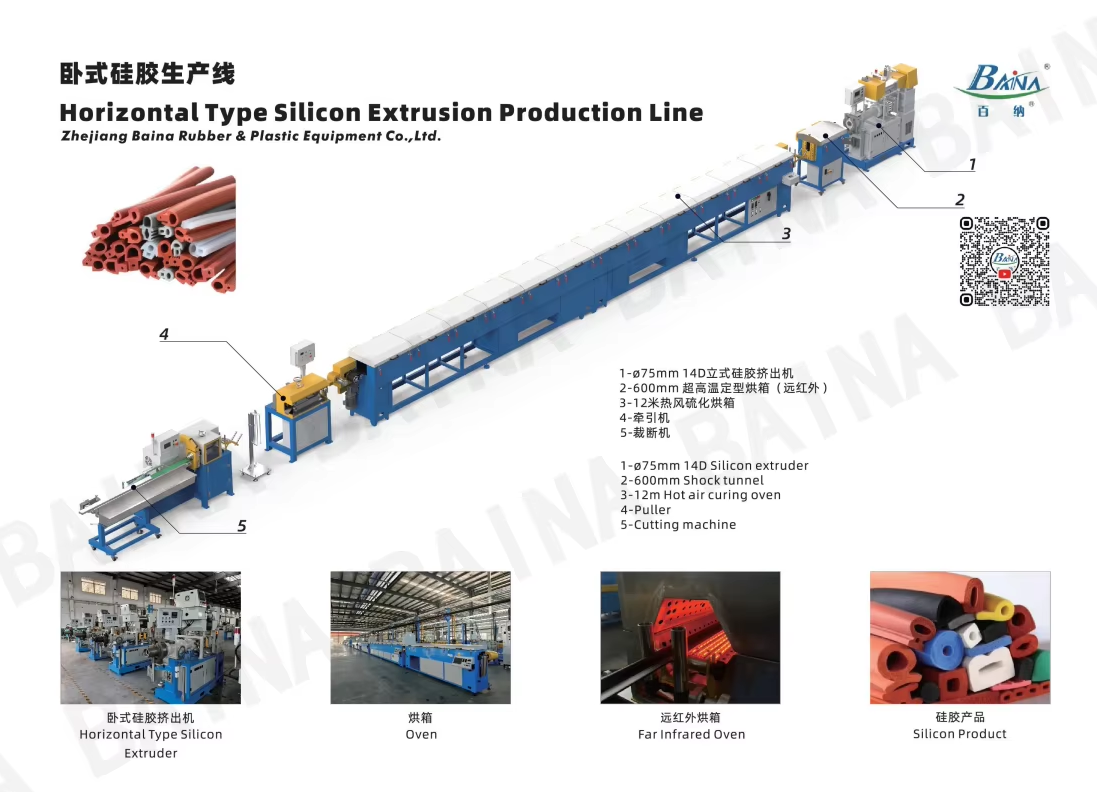
Continuous rubber shaping technology supports a wide range of industrial sectors where sealing, flexibility, vibration absorption, and durability are required. The ability to produce long, uniform profiles makes extrusion-based manufacturing essential in modern production chains.
Automotive applications represent a major usage area. Door seals, window channels, trunk gaskets, and anti-vibration profiles are commonly produced using extrusion systems. Typical hardness ranges between 55 Shore A and 75 Shore A depending on sealing pressure requirements. EPDM compounds dominate this sector due to UV and ozone resistance, with service temperatures ranging from -40°C to 120°C.
Construction systems also rely heavily on extruded rubber products. Expansion joints, glazing seals, and waterproofing strips require dimensional stability under thermal expansion conditions. Profiles used in building facades often include multi-durometer structures combining soft and rigid sections. Thickness accuracy is usually maintained within ±0.2 mm to ensure airtight installation.
Industrial machinery applications include conveyor belts, vibration dampers, and protective tubing. Conveyor sidewalls may require tensile strength above 10 MPa, while abrasion resistance is enhanced using carbon black fillers. These profiles often operate in environments with temperatures between -20°C and 100°C.
Electrical and electronic industries use silicone-based extrusion products. Cable insulation, sealing gaskets, and heat-resistant tubing require stable performance from -60°C to 200°C. Dielectric strength is a critical parameter, often exceeding 20 kV/mm for insulation-grade materials.
Hydraulic and fluid transport systems depend on hose extrusion. Multi-layer hose structures may include inner rubber liners, reinforcement layers, and outer protective coatings. Pressure resistance can exceed 20 bar for standard industrial hoses, while reinforced designs handle significantly higher loads.
A rubber extrusion production line supports all these industries by enabling continuous production of customized cross-sections. Line configurations can be adjusted for profile complexity, curing requirements, and material type.
Railway and marine applications also utilize extruded rubber for sealing and damping systems. These environments demand high resistance to vibration, salt corrosion, and long-term compression set stability.
The adaptability of extrusion technology allows manufacturers to switch between product categories with minimal equipment changes. Die replacement and parameter adjustment enable rapid transitions between different profile designs.
Industrial demand continues to expand as infrastructure and transportation systems grow, reinforcing the importance of extrusion-based rubber manufacturing across global markets.

 English
 Arabic
 French
 Spanish
 Portuguese
 Deutsch
 Turkish
 Dutch
Dutch
 Italiano
 Romaian
 Portuguese (Brazil)
 Greek
Greek