


Grease Lubrication Systems Manufacturer in India: Automatic & Centralized Solutions
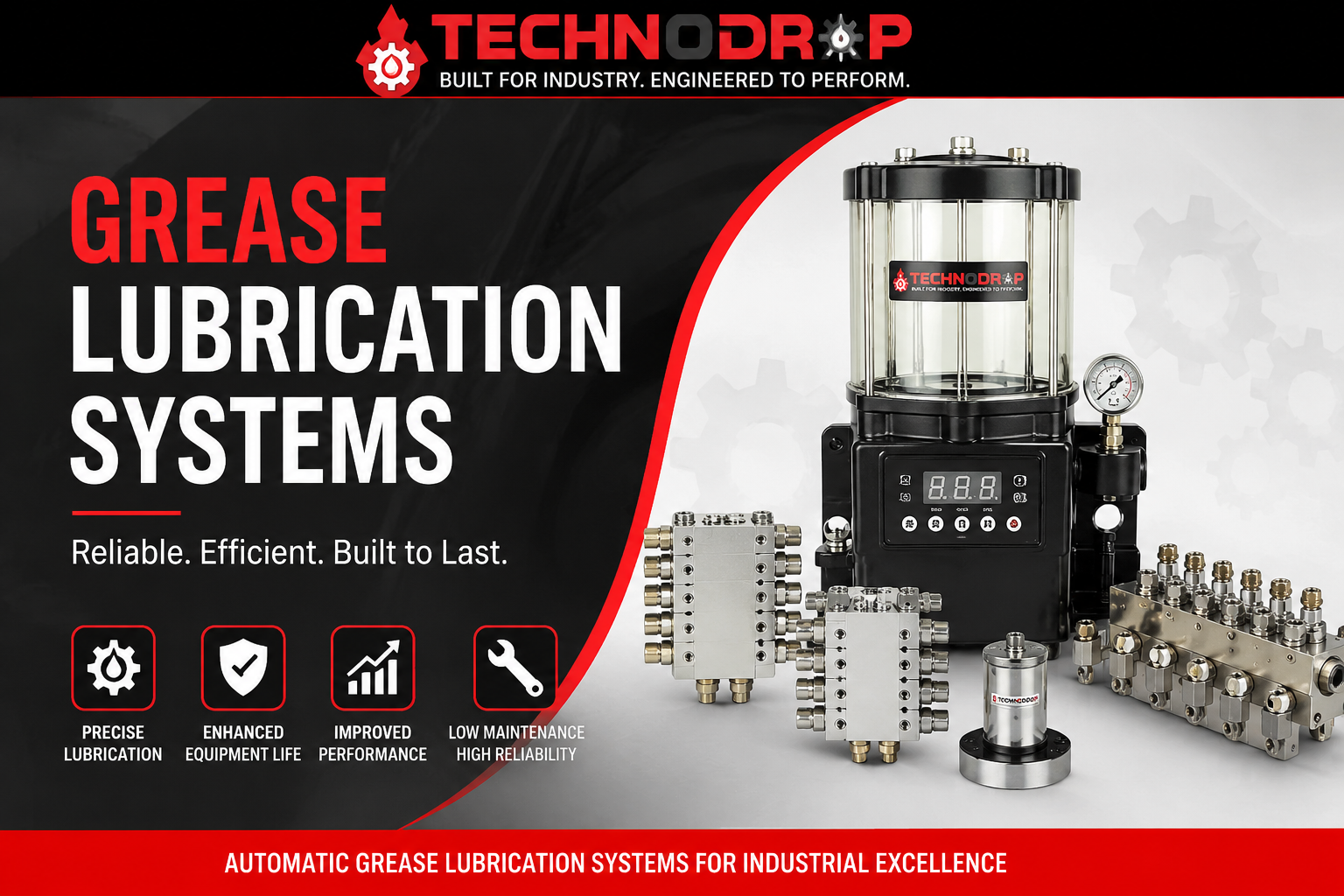
By the time a bearing starts screaming, the damage is already paid for. Grease Lubrication Systems are not a “maintenance upgrade” for steel mills, cement plants, mining conveyors or OEM machines. They are a control point for breakdown cost. SKF data links poor lubrication with over 36% of premature bearing failures, and any plant manager who has replaced a seized bearing during a production run knows that number does not feel exaggerated.
Grease Lubrication Systems Built Around Pressure, Points and Duty Cycle
The Main System Types Buyers Actually Compare
Most industrial buyers look at pump price first. That is a mistake. A centralized grease system, automatic grease pump, dual-line grease system, multiline lubricator, pneumatic grease pump and progressive distribution block solve different site problems. Techno Drop’s centralized specification range includes 240 V supply, up to 35 bar maximum pressure and 3 litre to 100 litre capacity options. That spread matters because a 12-point packaging machine and a rolling mill conveyor do not deserve the same quotation format.
The Spec Detail Most Buyers Skip
Nobody tells you that line length, grease grade and metering block selection can spoil a technically “correct” system. Use NLGI grade, ambient temperature, point count, pipe route and duty hours as buying inputs. If the supplier only asks for machine name and quantity, they are guessing.
Five Checks Before You Trust Any Supplier
1. Ask how they calculate grease quantity
A good answer mentions point count, bearing size, cycle timing and operating hours. A bad answer is: “standard pump chalega.” That is not engineering.
2. Ask what happens when one point blocks
A reliable supplier explains relief pressure, visual indicators or progressive block monitoring. A bad supplier says the operator will notice later. Later is where maintenance budgets go to die.
3. Ask for installation support
Most buyers underestimate site routing. A 3 metre pipe run on drawing can become 5.4 metres after guards, brackets and access panels come into play. A weak answer ignores commissioning.
4. Ask about spares
You need pump elements, metering cartridges, pipes, fittings and seals available after dispatch. A bad answer is “available on request” without lead time.
5. Ask for application history
Manufacturers should know steel dust, cement dust, furnace heat and mining vibration. If every industry gets the same catalogue PDF, walk away.
Benefits That Protect Margin, Not Just Machines
Less unplanned stoppage
Automatic grease delivery keeps critical points fed while equipment is operating. Which means maintenance teams do not need to stop a machine only to grease a difficult bearing.
Lower component replacement risk
Poor lubrication damages bearings, chains, gears and slides. Even a small reduction in premature failures protects margin because bearing cost is rarely the real cost; shutdown labour and lost output are.
Cleaner grease use
Manual greasing often creates two losses: under-lubricated points and wasted grease around seals. Measured delivery gives maintenance heads better control over consumption.
Safer access
And yet, many plants still send workers near moving conveyors or hot zones for manual greasing. That is bad planning, not bravery.
Better OEM machine value
For machine builders, a fitted lubrication setup can reduce warranty arguments. It also makes preventive maintenance easier for the end user.
Availability Across India Is a Supply Chain Decision
India’s manufacturing GVA is estimated at Rs. 323.48 lakh crore for FY 2025-26, with 7.7% growth over FY 2024-25, so uptime pressure is not getting lighter. Buyers searching for Grease Lubrication Systems Manufacturers in India, Lubrication Systems Suppliers in India or Grease Lubrication System Dealers in India should look beyond catalogue ranking. Location matters. Faridabad gives practical access to North Indian industrial belts, OEM clusters, fabrication vendors and transport routes toward Rajasthan, Punjab, Uttar Pradesh, Gujarat and central India.
Here’s the real issue: a delayed fitting worth a few hundred rupees can hold a full commissioning schedule.
About Techno Drop Engineers
We manufacture centralized and automatic lubrication systems for industrial machines from Faridabad, Haryana, and we have been in this line since 1999. Our work covers grease systems, oil systems, motorised lubrication units, progressive blocks, dual-line systems and related equipment for steel, cement, power, mining, heavy engineering and OEM applications.
We ask for lubrication point details before quoting because two machines with the same motor rating can still need different metering logic.
We are not interested in pushing the largest pump just because it looks safer on paper. Oversized systems waste grease, create pressure issues and make operators distrust automation.
Send Us the Details and We’ll Quote Properly
Share your machine type, number of lubrication points, grease grade, duty cycle, operating temperature, line distance and photos of the machine layout. We usually respond within 24 working hours after receiving usable inputs. MOQ starts from 1 system or 1 project requirement after technical review. For a faster quote, send your drawing, existing manual greasing schedule and any past failure history.
Grease Lubrication Systems Are Becoming a Maintenance Standard
Grease Lubrication Systems make sense wherever missed lubrication can turn into downtime, warranty disputes or unsafe access. From 3 litre units to 100 litre plant requirements, the buying logic should begin with points, pressure and duty cycle. The harder plants push production hours, the less room they have for casual greasing habits. Buyers who specify lubrication early will own more predictable machines tomorrow.
1. Which Grease Lubrication Systems are best for heavy-duty machines?
Centralized or dual-line grease systems usually suit heavy-duty machines with many lubrication points. The right choice depends on point count, distance, pressure requirement and grease grade.
2. How do Lubrication Systems Suppliers decide pump capacity?
They should check lubrication points, duty hours, lubricant viscosity, pipe route and cycle frequency. If Lubrication Systems Suppliers quote only from machine name, the sizing may be weak.
3. Are Grease Lubrication System Dealers useful for installation support?
Good dealers can help with local coordination, fittings and basic site support. Caveat: not every dealer can solve pressure balancing or metering errors, so technical backup from the manufacturer still matters.
4. Why choose Grease Lubrication Systems Manufacturers instead of traders?
A manufacturer can usually support sizing, spares, customization and after-sales correction better than a trader. A trader may still be useful for urgent standard parts, but custom plant applications need engineering input.
5. Can automatic grease lubrication reduce maintenance cost?
Yes, mainly by reducing missed points, uncontrolled grease use and unsafe manual access. The caveat is simple: savings come only when the system is sized and installed correctly.

 English
 Arabic
 French
 Spanish
 Portuguese
 Deutsch
 Turkish
 Italiano
 Russian
 Romaian
 Portuguese (Brazil)
 Greek
Greek