


Understanding Prediction Market Dynamics: How Prices Move, AMMs Work, and Order Books Function
Introduction
Most people who participate in prediction markets focus on the outcome, will this candidate win, will this product launch succeed, will this match go into overtime? Very few stop to ask the more fundamental question: how does the market itself work? What is happening behind the scenes every time a price shifts by a cent, or a trade gets matched in milliseconds?
The answer lies inside what developers call the "matching engine," and for anyone serious about building or understanding modern prediction markets, it is no longer acceptable to treat this mechanism as a black box. Whether you are a trader trying to make smarter decisions, a business exploring prediction markets software development, or a founder thinking about what drives prediction market app development cost, knowing how price discovery, Automated Market Makers, and order books function is foundational knowledge.
This blog breaks it all down clearly, without jargon overload, and with real context on how these pieces connect.
What Actually Is a Prediction Market?
A prediction market is a platform where people buy and sell contracts based on the probability of real world events. The price of a contract, which typically ranges from 0 to 1 dollar (or 0 to 100 cents), reflects the crowd's estimated probability that an event will occur. If a "Yes" share on an election outcome is trading at 65 cents, the market collectively believes there is roughly a 65 percent chance that outcome happens.
The beauty of this system is that it aggregates information from thousands of independent actors, each putting real money behind their beliefs. The result is often more accurate than polls, analyst reports, or media narratives. But none of this happens by magic. It happens because of the mechanics underneath: the price discovery engine, the matching architecture, and the liquidity systems that keep trades flowing.
Create Smarter Trading Experiences with Advanced Technology→
The Three Pillars of a Prediction Market Engine
Before diving into individual components, it helps to understand the three core pillars that every prediction market platform must handle.
The first is how prices are set and updated in real time as new information and new trades arrive. The second is how buyers and sellers are matched, either through human order matching or algorithmic liquidity provision. The third is how the economics of trading, including fees, spreads, and incentives, are structured to keep the market healthy and sustainable.
These three pillars determine whether a market thrives with tight spreads and active participation, or dies with wide gaps and no one willing to trade.
How Prediction Market Prices Move: The Discovery Process
Price discovery is the process through which a market finds what an outcome is truly worth at any given moment. In a prediction market, this is driven almost entirely by supply and demand.
When new information enters the world, such as a polling update, a company earnings report, or a referee's controversial call, informed traders respond. They rush to buy contracts they believe are underpriced or sell contracts they believe are overpriced. This collective action shifts the price toward a new equilibrium that reflects the updated probability of the event occurring.
What makes prediction markets particularly powerful is the speed and accuracy of this process. Unlike traditional financial assets where value is anchored to earnings or dividends, prediction market contracts have a clean binary resolution: they either pay out fully or pay out nothing. This clarity makes mispricing easy to spot and fast to correct.
The key forces that drive prices include new public information like news or data releases, large trades that signal strong conviction from well-informed participants, approaching resolution dates that compress uncertainty, and changes in overall market sentiment or related market prices.
Understanding how prices move in real time is the first step. The next question is what mechanism actually executes the trades when two parties want to transact.
Order Books: The Traditional Matching Engine
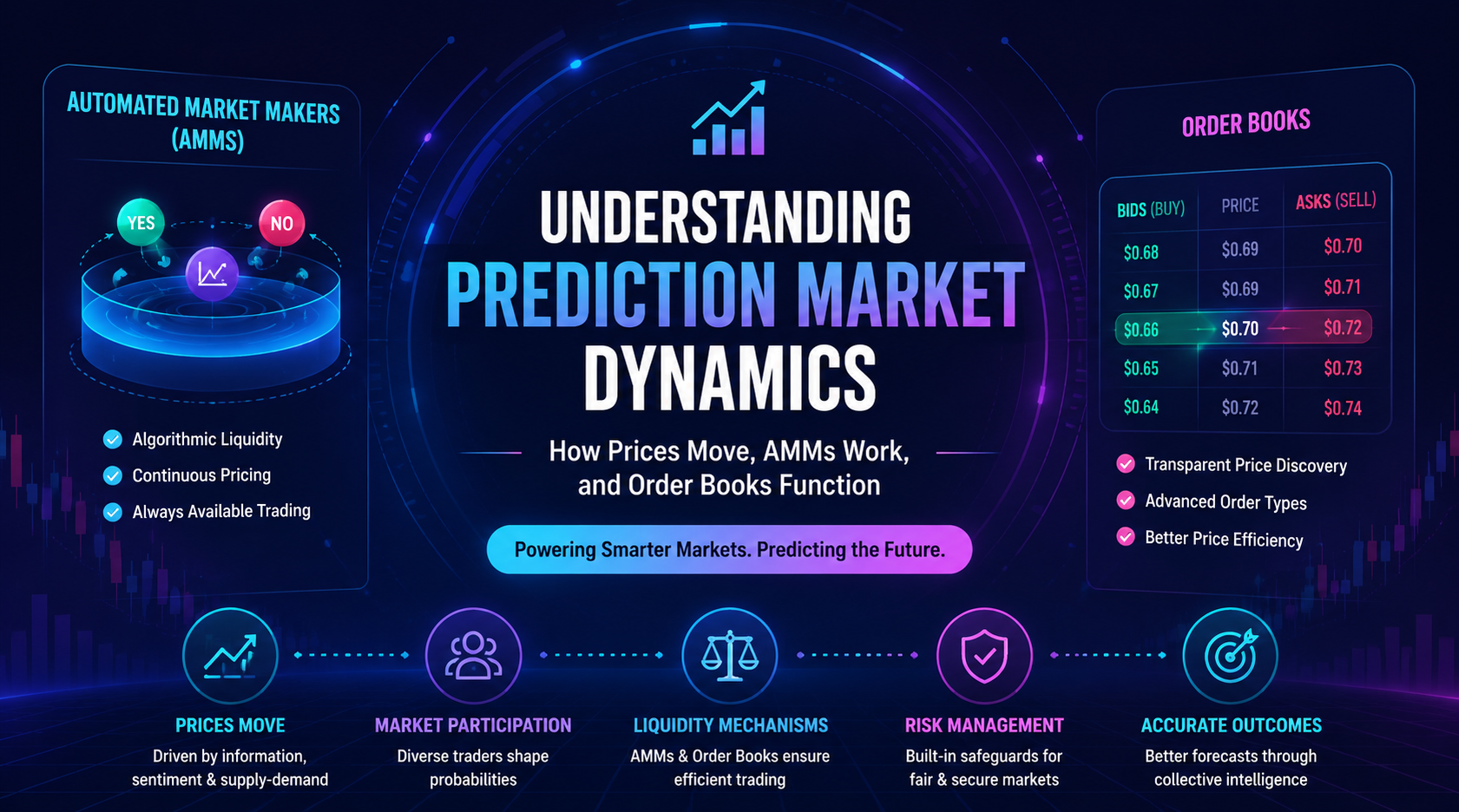
The Central Limit Order Book, commonly called CLOB, is the oldest and most widely used mechanism for matching buyers and sellers in financial markets. It works exactly as it sounds: a live, continuously updated list of all open buy orders and sell orders, organized by price.
On one side of the book you have "bids," which are buyers stating the maximum price they are willing to pay. On the other side you have "asks," which are sellers stating the minimum price they are willing to accept. When a bid price meets or exceeds an ask price, a match occurs, a trade executes, and both orders are removed from the book.
In prediction markets, order books bring several powerful advantages. They offer complete price transparency because every participant can see exactly where supply and demand sit at any moment. They give traders full control over execution price through limit orders. They reward market makers, which are participants who post resting orders on both sides, with the bid-ask spread as compensation for their service.
However, order books come with a significant weakness: they depend entirely on human participation to provide liquidity. In low-volume markets or during off-peak hours, the book can become thin. Spreads widen, slippage increases, and trading becomes expensive or nearly impossible. This is where Automated Market Makers enter the picture.
Automated Market Makers: Algorithmic Liquidity on Demand
Automated Market Makers are one of the most important innovations in modern market design. Instead of relying on humans to post buy and sell orders, an AMM uses a mathematical formula to automatically provide liquidity at all times, regardless of whether any human market maker is present.
The original and most famous version of this formula is the constant product rule, expressed as x multiplied by y equals k, where x and y are the quantities of two assets in a pool and k is a constant that never changes. Every trade that occurs moves the balance between x and y, and the formula automatically adjusts the price to keep the product constant.
In prediction markets, AMMs are often adapted with more specialized formulas suited to the binary nature of outcomes. One of the most widely cited is the Logarithmic Market Scoring Rule, or LMSR, developed by Robin Hanson. LMSR ensures that prices always remain between 0 and 1, that the sum of all outcome prices always equals 1, and that the market is always willing to trade at some price regardless of volume.
The practical result is that AMMs solve the cold-start problem that kills most order-book markets. A new prediction market with zero users and zero liquidity would be completely untradable under a pure order-book model. With an AMM seeded with an initial liquidity pool, any trader can immediately buy or sell at a mathematically determined price.
The trade-off is that AMM prices follow a predictable formula. Large trades move prices more than they might in a deep order book, and sophisticated traders can sometimes anticipate price movements. But for most prediction market applications, especially in early stage markets or niche topics, AMMs are far superior to empty order books.
Hybrid Models: When AMMs and Order Books Work Together
The most sophisticated modern prediction markets do not choose between AMMs and order books. They combine both.
In a hybrid model, the AMM acts as the liquidity provider of last resort. It is always there, always quoting prices, always willing to trade. Around it, an order book layer allows human market makers and traders to post their own limit orders. If a human market maker can offer a better price than the AMM, the order book fills first. If not, the AMM absorbs the trade.
This architecture produces the best of both worlds. New markets start with guaranteed liquidity from the AMM. As markets grow and attract more participants, the order book layer deepens and the AMM becomes less relied upon. Spreads tighten. Price discovery improves. The market matures.
For any team serious about developing prediction markets software, understanding this hybrid architecture is essential. The decision of which model to implement and how to tune each model's parameters has direct consequences for user experience, liquidity quality, and the long-term health of the platform.
What This Means for Builders and Businesses
If you are building a prediction market platform, the mechanics described above are not just academic. They translate directly into product decisions and budget allocations.
A platform that wants to launch with guaranteed liquidity from day one will invest in AMM infrastructure. One that targets high frequency professional traders will prioritize a low-latency order book. One that wants to serve both audiences will need to build or license a hybrid engine, which is more complex and more expensive to develop and maintain.
These architectural choices have a direct bearing on the cost of developing the prediction market app. A simple AMM-only implementation using existing open-source liquidity formulas costs far less than building a custom hybrid matching engine with real-time price feeds, smart order routing, and advanced market maker tooling. The right choice depends on your audience, expected volume, regulatory environment, and long-term product vision.
Working with a development partner that understands not just how to write code but how these financial mechanisms actually behave under real market conditions is what separates platforms that survive from those that struggle.
Key Takeaways
Prediction market prices move through the collective action of informed traders responding to new information, pushing prices toward accurate probability estimates. Order books provide transparency and control but depend on human liquidity, which may not always be available. Automated Market Makers solve the liquidity problem algorithmically, ensuring markets are always tradeable even in the absence of active participants. Hybrid models combine both approaches to serve the full spectrum of user needs. And the architecture you choose shapes everything from user experience to development cost and market quality.
Understanding these dynamics is not just useful for engineers. It is essential knowledge for anyone building, investing in, or seriously participating in the growing world of prediction markets.
Final Thoughts
Prediction markets are often described as the most efficient information aggregation mechanism ever designed. That efficiency does not emerge from the topics markets cover or the prizes they offer. It emerges from the mechanics beneath the surface: the price discovery process, the matching engine, the liquidity architecture, and the incentive structures that bring participants together.
As these markets continue to expand across politics, sports, finance, and science, the teams that understand the mechanics at this level will build better products, attract more participants, and ultimately create markets that are more accurate, more liquid, and more valuable to everyone who uses them.
If you are exploring what it takes to enter this space, starting with the fundamentals is always the right move.

 English
 Arabic
 French
 Spanish
 Portuguese
 Deutsch
 Turkish
 Italiano
 Russian
 Romaian
 Portuguese (Brazil)
 Greek
Greek