


How to Compare Cloud Contact Centre Providers in the UAE Without Vendor Lock-In
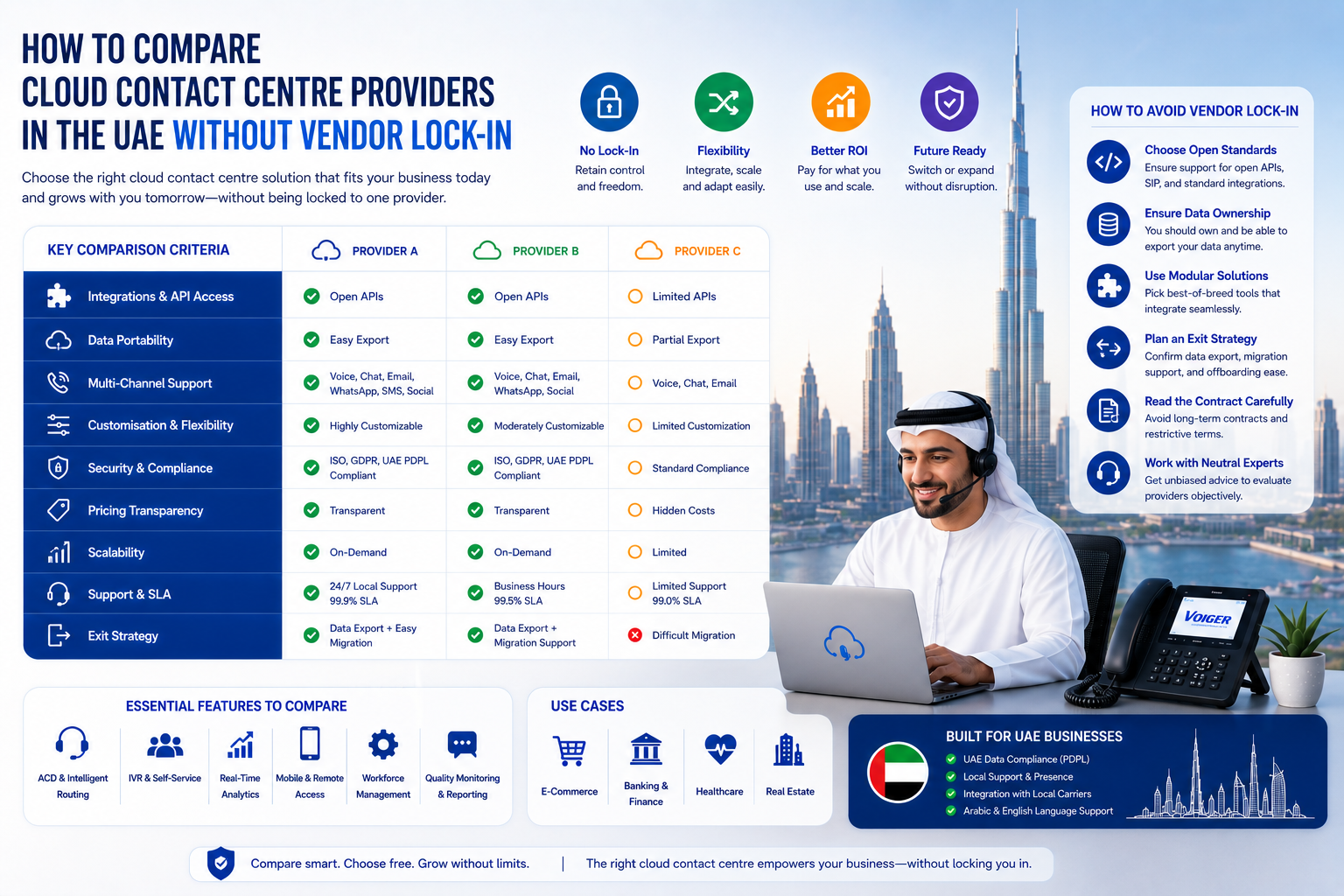
Choosing a cloud contact centre is no longer just about finding a platform with calling features.
For many businesses in the UAE, it is a decision that affects:
-
how quickly leads are handled
-
how support calls are routed
-
how managers track performance
-
how flexible the business can be as it grows
-
how easily AI, integrations, and new workflows can be added later
That is why comparing providers properly matters so much.
At first glance, many cloud contact centre providers in the UAE can look similar.
Most talk about:
-
cloud telephony
-
dashboards
-
AI
-
CRM integrations
-
reporting
-
routing
-
modern customer communication
But once the buying process goes deeper, the real differences become clearer.
Some platforms are flexible.
Some are more rigid.
Some make rollout practical.
Some create dependency that only becomes obvious later.
This is where vendor lock-in becomes a real concern.
If your business is evaluating cloud contact centre UAE options, here is how to compare providers more carefully and what to look for before making a decision you may later struggle to change.
Why Vendor Lock-In Matters More Than Buyers Expect
Vendor lock-in is not always obvious at the beginning.
A platform may look attractive in the demo. The pricing may appear simple. The feature list may seem complete. The provider may sound like it can handle everything.
But lock-in often appears later, when the business wants to:
-
keep its current carrier
-
add new workflows
-
expand into different use cases
-
connect with new tools
-
change how voice is delivered
-
add AI later instead of upfront
-
support more teams or branches
-
make changes without depending heavily on one vendor’s model
This is why the best buying question is not only:
“Which provider looks strongest today?”
The better question is:
“Which provider gives us the best fit today without limiting us tomorrow?”
That is the right comparison mindset.
Why Comparing Providers in the UAE Requires a Different Lens
The UAE market has its own operational realities.
Businesses here often need:
-
practical rollout paths
-
flexibility around voice setup
-
support for multilingual customer handling
-
faster implementation without heavy disruption
-
room for sales and support workflows to evolve
-
a setup that can work across branches, hybrid teams, or distributed staff
-
clarity around BYOC and deployment options
That is why comparing contact centre software UAE providers should go beyond generic global feature lists.
The best provider is not simply the one with the biggest product page.
It is the one that fits how your business actually operates in the UAE.
Start by Comparing the Operating Model, Not Just the Interface
A lot of businesses compare platforms mainly by:
-
dashboard design
-
AI language
-
surface-level feature count
-
visible price points
Those things matter, but they are not enough.
A better comparison starts with the operating model.
Ask:
-
How will this actually fit our sales and support workflows?
-
How flexible is the telecom and deployment model?
-
How much control do we keep as the business evolves?
-
Will this platform make us more agile or more dependent?
This is especially important for businesses comparing contact centre as a service UAE options, because the platform often becomes deeply tied to how customer communication is run day to day.
1. Compare Flexibility First
One of the biggest differences between providers is flexibility.
Some platforms are built around a more controlled, bundled model. Others allow the business to preserve more of its current environment and modernise in phases.
This is where BYOC UAE becomes a major comparison point.
Ask:
-
Can we keep our current carrier?
-
Can we preserve existing numbers where possible?
-
Does the provider support bring your own carrier UAE?
-
Can we change the workflow or deployment model later if needed?
-
Does the platform reduce lock-in or increase it?
For many businesses, this matters more than a long list of optional features.
A flexible provider gives the business more room to adapt without being forced into one rigid operating model.
2. Compare the Voice Layer and the Workflow Layer Separately
A lot of providers combine voice and contact centre messaging in ways that make it harder to compare clearly.
That is why businesses should separate the evaluation into two parts.
Voice Layer
This includes:
-
cloud telephony
-
user access
-
numbers and calling
-
connectivity
-
browser or app access
-
basic business communication
Workflow Layer
This includes:
-
routing
-
queues
-
dashboards
-
supervisor visibility
-
CRM or helpdesk integration
-
support handling
-
sales responsiveness
-
post-call analytics
-
AI features
A provider may be strong in cloud telephony UAE but weaker in workflow support.
Another provider may offer stronger workflow tools but less deployment flexibility.
This is why comparing the whole operating model matters more than looking only at “cloud calling.”
3. Compare Routing Quality, Not Just Routing Availability
Almost every provider says it supports routing.
That is not the real comparison.
The real comparison is:
How good is the routing, and how well does it fit our business?
A strong routing setup should support:
-
team-based routing
-
language selection
-
business hours logic
-
queue prioritisation
-
overflow handling
-
cleaner sales and support paths
That matters because routing affects customer experience directly.
If calls still reach the wrong team, sit in the wrong queue, or require multiple transfers, the business has not really solved the problem.
This is why call routing software UAE capabilities should be looked at closely during evaluation.
4. Compare How Well the Platform Fits Sales and Support Teams
A lot of platforms look strong in general, but the better question is whether they fit your actual use cases.
For sales teams, compare providers based on:
-
lead response support
-
outbound calling workflows
-
CRM-connected calling
-
better activity visibility
-
call logging and follow-up support
-
after-hours lead capture
For support teams, compare based on:
-
queue handling
-
language support
-
escalation flow
-
summaries and visibility
-
supervisor tools
-
service consistency
This is where the difference between a generic platform and a practical cloud contact centre UAE platform becomes more obvious.
5. Compare Integration Readiness
The more your business depends on CRM, helpdesk, booking systems, ticketing tools, or internal workflows, the more important integration becomes.
Ask:
-
Can the platform connect with our CRM or support tools?
-
Will it reduce manual work?
-
Can our teams work with more context before and after calls?
-
Will we need workarounds for core workflows?
-
Can integrations grow with the business?
A contact centre that operates in isolation often creates friction later.
A stronger contact centre software UAE provider should help voice fit into the broader business workflow.
6. Compare AI as a Practical Layer, Not a Marketing Label
Most providers now talk about AI.
But the useful question is not whether AI is mentioned.
It is whether AI creates value in practical business workflows.
Compare providers by asking:
-
Can AI support after-hours lead capture?
-
Can AI improve support triage?
-
Are summaries, transcription, and sentiment insights available?
-
Can AI be added later instead of bundled upfront?
-
Does AI work with human handoff, not against it?
This is where AI voice bot UAE and analytics features should be evaluated carefully.
A good provider should make AI useful, not just visible in the sales pitch.
7. Compare Rollout Practicality
A platform may be strong in theory but difficult in rollout.
That creates its own kind of lock-in, because once the business has spent too much time and effort onboarding, it may feel forced to stay even if the fit is not ideal.
Ask:
-
What does rollout actually involve?
-
What does the provider handle?
-
What does our team need to prepare?
-
How easy is the setup for a lean business?
-
Can rollout happen in phases?
-
Will the platform still be manageable after launch?
This matters especially for SMB and mid-market teams without large internal telecom or IT functions.
The easier the rollout, the easier the business can retain control.
8. Compare Support Quality, Not Just SLA Language
Support quality is one of the biggest long-term differentiators, and one of the least discussed during buying.
Ask:
-
What support is included?
-
How are urgent issues handled?
-
Who helps after go-live?
-
Is support practical and accessible?
-
Can the provider help with changes as the business evolves?
-
Will we get guidance during rollout and beyond?
A platform with weak support can create a kind of operational lock-in where the business depends on the vendor but does not get the responsiveness it needs.
That is why support should be part of the comparison from the start.
9. Compare Commercial Structure, Not Just the Visible Price
Pricing can also create lock-in when the business does not fully understand how the platform scales.
Ask:
-
What is included in the base plan?
-
What costs extra?
-
Is AI included or separate?
-
Are integrations extra?
-
How does pricing change as users, teams, or workflows grow?
-
What will become more expensive later?
The lowest visible price is not always the best long-term commercial choice.
The more transparent the provider is, the easier it is for the business to make a confident decision.
This matters a lot when comparing contact centre as a service UAE or broader cloud communication models.
10. Compare Growth Fit
A provider may work for the business today but become restrictive later.
That is why businesses should compare growth fit early.
Ask:
-
Can we add more users easily?
-
Can we support more teams or branches?
-
Can we add analytics later?
-
Can we introduce AI voice or summaries later?
-
Can the platform support new workflows over time?
-
Will our current buying decision still make sense 12 to 24 months from now?
This is where vendor lock-in often becomes most visible.
A platform that cannot evolve with the business becomes a constraint.
A Better Comparison Framework for UAE Businesses
Instead of comparing providers based only on feature checklists, use this framework:
1. Flexibility
Can the platform adapt to our current setup and future needs?
2. Workflow Fit
Will it improve the way our sales and support teams actually operate?
3. Visibility
Will it give managers clearer control over performance and communication?
4. Practical Rollout
Can we launch without creating unnecessary disruption?
5. Growth Path
Can we expand into integrations, analytics, AI, and new workflows over time?
This helps move the comparison from “who looks strongest in the pitch” to “who actually fits the business best.”
Why This Matters for SMB and Mid-Market Teams
Large enterprises may have bigger internal teams, longer procurement cycles, and more room to absorb complexity.
SMB and mid-market businesses usually need something more practical.
They need:
-
clearer commercial structure
-
simpler rollout
-
stronger workflow fit
-
more flexibility
-
better support
-
room to grow without heavy dependency
That is why avoiding vendor lock-in matters so much in this segment.
The wrong decision does not just waste budget.
It slows down how the business communicates with customers.
The Bottom Line
Comparing cloud contact centre providers in the UAE is not only about finding the platform with the most features.
It is about finding the platform that gives your business the best mix of flexibility, workflow fit, visibility, practical rollout, and long-term growth potential.
That is how businesses avoid vendor lock-in.
A better provider does not just offer software.
It gives the business more control over how customer communication works today and how it can evolve tomorrow.
That is the real comparison that matters.
Ready to Explore a More Flexible Cloud Contact Centre Approach?
Voiger helps businesses modernise customer communication with practical cloud contact centre workflows, flexible deployment models, and room to add AI, analytics, and integrations over time.
If your team is comparing cloud contact centre providers in the UAE, book a demo with Voiger to explore a more practical path without unnecessary vendor lock-in.
FAQ's
What does vendor lock-in mean in a cloud contact centre?
Vendor lock-in happens when a business becomes too dependent on one provider’s model, making it harder to change carriers, workflows, integrations, pricing structure, or future deployment choices.
Why is vendor lock-in important when choosing a contact centre provider?
Because a contact centre affects day-to-day customer communication. If the platform becomes restrictive, it can slow down future growth, workflow changes, and operational flexibility.
How can businesses in the UAE avoid vendor lock-in?
They can avoid it by comparing provider flexibility, BYOC support, workflow fit, integration readiness, rollout practicality, support quality, pricing structure, and long-term growth fit.
Why does BYOC matter in provider comparison?
BYOC, or Bring Your Own Carrier, can give businesses more control over their telecom layer and reduce dependency on a fully bundled vendor model.
What should businesses compare besides pricing?
They should compare routing quality, support, rollout, integrations, AI fit, manager visibility, workflow alignment, and whether the platform can scale with the business.
How does support affect vendor lock-in?
Weak support can increase dependency because the business still relies on the vendor but does not get the responsiveness or operational help it needs.
Is this only relevant for large companies?
No. SMB and mid-market businesses often feel the impact of lock-in even more because they have less time, fewer resources, and a stronger need for practical rollout and flexibility.

 English
 Arabic
 French
 Spanish
 Portuguese
 Deutsch
 Dutch
Dutch
 Italiano
 Russian
 Romaian
 Portuguese (Brazil)
 Greek
Greek