


BIS License: Complete Guide to BIS Registration in India
Introduction
Businesses that manufacture or import products for the Indian market must comply with quality and safety standards established by the Bureau of Indian Standards (BIS). Obtaining a BIS License is an essential step for many regulated products, ensuring they meet the prescribed Indian Standards before reaching consumers. Whether you are a domestic manufacturer or an overseas supplier, understanding the BIS Licence process, the importance of BIS Registration, and the role of the BIS Certification Mark can help your business stay compliant while building customer confidence.
What is a BIS License?
A BIS License is an official authorization granted by the Bureau of Indian Standards that allows manufacturers to use the BIS Standard Mark on products that conform to applicable Indian Standards. This certification confirms that the product has successfully undergone testing and meets the required quality, safety, and performance standards. The BIS Licence is mandatory for several categories of products notified by the Government of India under Quality Control Orders (QCOs).
Why is a BIS Licence Important?
Obtaining a BIS Licence provides multiple advantages for manufacturers and importers.
1. Legal Compliance
Many products cannot be legally manufactured, imported, or sold in India without the required BIS approval.
2. Product Quality Assurance
A certified product demonstrates compliance with established Indian Standards, assuring customers of its reliability.
3. Consumer Trust
Products carrying the BIS Certification Mark are widely recognized as meeting government-approved quality benchmarks.
4. Easier Market Access
Retailers, distributors, and institutional buyers often prefer products that hold a valid BIS License.
5. Reduced Business Risk
Compliance helps businesses avoid regulatory penalties, product recalls, and import restrictions.
What is BIS Registration?
BIS Registration is the certification process through which eligible products receive approval from the Bureau of Indian Standards.
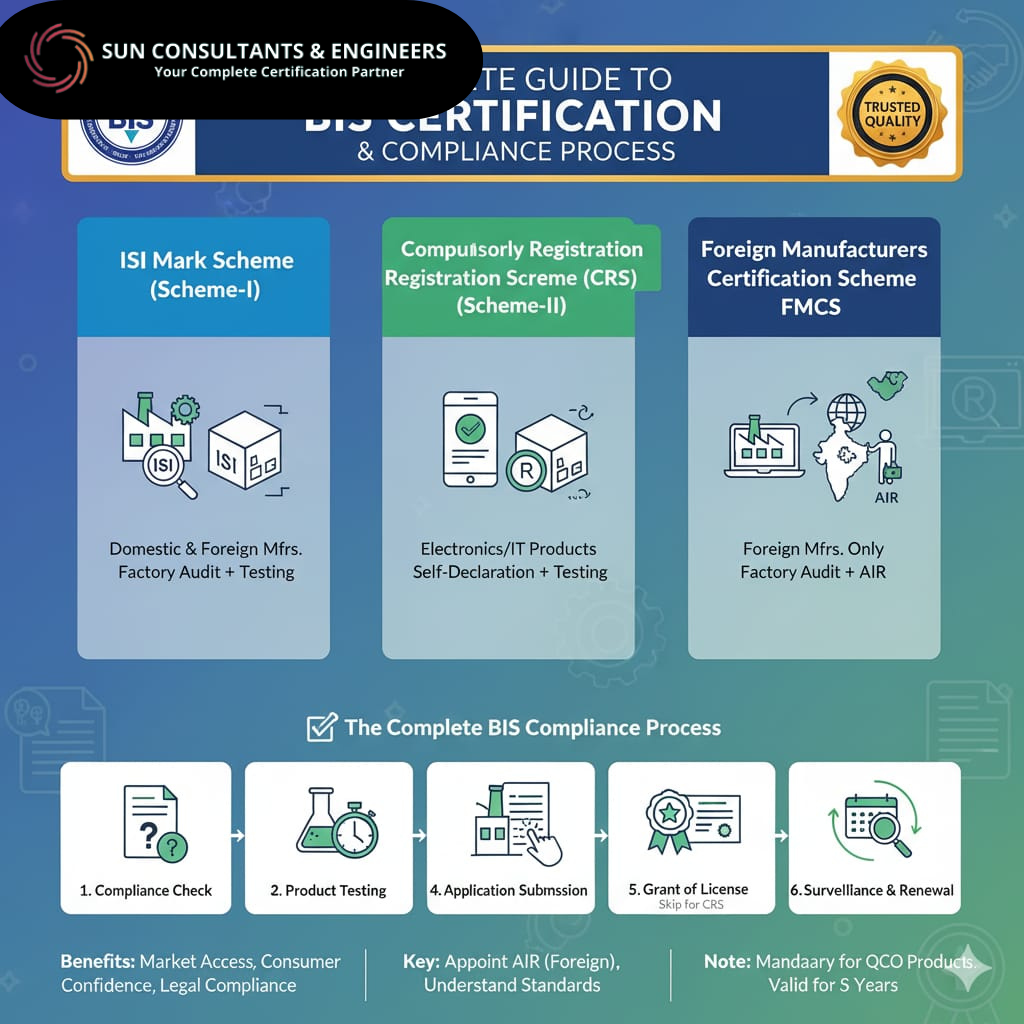
Different certification schemes are available depending on the product category, including:
-
Compulsory Registration Scheme (CRS)
-
ISI Certification Scheme
-
Foreign Manufacturers Certification Scheme (FMCS)
-
Hallmarking Scheme
The applicable scheme depends on the product type and regulatory requirements.
Products Requiring BIS Registration
Numerous products require mandatory BIS Registration, including:
-
LED lighting products
-
Mobile phones
-
Power adapters
-
Electronic appliances
-
Batteries
-
Steel products
-
Cement
-
Household electrical appliances
-
Toys
-
Pressure cookers
-
Solar equipment
Manufacturers should verify whether their products fall under mandatory certification before entering the Indian market.
What is the BIS Certification Mark?
The BIS Certification Mark is the official quality symbol issued after successful certification.
It indicates that:
-
The product complies with Indian Standards.
-
Manufacturing follows approved quality control procedures.
-
The product has passed required testing.
-
Consumers can rely on the product's safety and quality.
Displaying the BIS Certification Mark without authorization is prohibited and may lead to legal action.
How to Obtain a BIS License
The process of obtaining a BIS License generally includes the following steps:
Step 1: Product Identification
Determine whether your product requires mandatory certification.
Step 2: Applicable Standard
Identify the relevant Indian Standard (IS Code) applicable to the product.
Step 3: Documentation
Prepare the required documents, including:
-
Company registration certificate
-
Factory details
-
Manufacturing process
-
Product specifications
-
Quality management documents
-
Test reports
Step 4: Product Testing
Samples are tested in BIS-recognized laboratories to verify compliance.
Step 5: Application Submission
Submit the BIS Registration application along with supporting documents.
Step 6: Factory Inspection
Depending on the certification scheme, BIS officials may inspect the manufacturing facility.
Step 7: Certificate Approval
After successful verification, the applicant receives the BIS Licence, allowing the use of the BIS Certification Mark.
Documents Required for BIS Registration
The documentation requirements generally include:
-
Business registration certificate
-
Factory license
-
Product specifications
-
Manufacturing process details
-
Test reports
-
Quality control documents
-
Brand authorization letter (if applicable)
-
Identity and address proof
-
Authorized Indian Representative details (for foreign manufacturers)
Accurate documentation helps speed up the certification process.
Who Should Apply for a BIS License?
A BIS License is generally required for:
-
Indian manufacturers
-
Foreign manufacturers exporting to India
-
Importers
-
Brand owners
-
Original Equipment Manufacturers (OEMs)
-
Authorized Indian Representatives
Eligibility depends on the applicable certification scheme and product category.
Common Challenges During BIS Registration
Many businesses experience delays because of avoidable mistakes, such as:
-
Incorrect product classification
-
Missing documentation
-
Errors in application forms
-
Testing through non-approved laboratories
-
Incomplete technical specifications
-
Delayed responses to BIS queries
Proper preparation can significantly reduce approval time.
Benefits of the BIS Certification Mark
Using the BIS Certification Mark provides several business advantages:
-
Demonstrates compliance with Indian regulations
-
Improves customer confidence
-
Strengthens brand reputation
-
Enhances product credibility
-
Supports easier market acceptance
-
Reduces compliance-related risks
-
Encourages long-term business growth
The mark has become an important indicator of product quality in India.
Tips for a Successful BIS Registration
To improve the chances of obtaining your BIS Licence smoothly:
-
Verify whether certification is mandatory.
-
Identify the correct Indian Standard.
-
Prepare complete and accurate documentation.
-
Ensure products are tested in approved laboratories.
-
Maintain effective quality control systems.
-
Respond promptly to BIS communications.
-
Keep records updated for future audits or renewals.
These practices help avoid unnecessary delays and improve compliance.
Conclusion
Obtaining a BIS License is an essential requirement for many manufacturers and importers seeking to sell products in India. A valid BIS Licence not only ensures legal compliance but also demonstrates that products meet recognized quality and safety standards. Completing the BIS Registration process correctly enables businesses to use the BIS Certification Mark, which enhances consumer confidence, strengthens brand reputation, and improves market acceptance. By understanding the certification process, preparing accurate documentation, and following the applicable standards, businesses can achieve compliance efficiently and focus on sustainable growth.

 English
 Arabic
 French
 Spanish
 Portuguese
 Deutsch
 Turkish
 Dutch
Dutch
 Italiano
 Romaian
 Portuguese (Brazil)
 Greek
Greek