Mental health practices are growing rapidly across the USA as more people seek counseling, therapy, psychiatric care, and behavioral health support. While providers focus on helping patients improve their well-being, handling insurance claims, coding updates, denials, and reimbursement rules can become overwhelming.
Choosing the best mental health billing company is more than finding someone who submits claims. It means partnering with experts who understand behavioral health regulations, payer-specific requirements, documentation standards, and reimbursement challenges. A reliable billing partner helps reduce administrative stress, improve cash flow, and allow providers to spend more time with patients.
This guide explains what makes a billing company stand out and how mental health providers can make an informed decision.
Why Mental Health Billing Is More Complex Than Other Medical Specialties
Behavioral health billing has unique requirements that differ from many other medical specialties. Insurance companies often have different coverage rules for psychotherapy, psychiatric evaluations, telehealth visits, medication management, and family counseling.
Common challenges include:
- Frequent policy changes by insurance companies
- Prior authorization requirements
- Time-based CPT coding
- Documentation compliance
- Coordination of benefits
- Telehealth billing guidelines
- Higher denial rates compared to several other specialties
Even small billing mistakes can delay reimbursements or result in claim denials. This is why many practices seek professional medical billing services that specialize in behavioral healthcare.
What Defines the Best Mental Health Billing Company?
Every billing company may promise faster payments, but the best partners consistently deliver accuracy, transparency, and industry expertise.
Experience With Behavioral Health
Mental health billing requires specialized knowledge. An experienced billing team understands psychotherapy codes, psychiatric services, group therapy, medication management, and payer-specific documentation requirements.
Instead of applying general billing practices, specialists know how behavioral health claims should be processed correctly.
Strong Claim Accuracy
Accurate claims reduce payment delays and administrative work.
A dependable billing company focuses on:
- Correct patient information
- Accurate insurance verification
- Complete documentation review
- Proper coding
- Timely claim submission
Higher first-pass claim acceptance means providers spend less time correcting rejected claims.
Effective Denial Management
Claim denials happen in every practice, but how they're managed makes a significant difference.
The best billing companies:
- Investigate denial reasons
- Correct claim errors quickly
- Submit appeals when appropriate
- Monitor recurring issues
- Recommend workflow improvements
This proactive approach helps recover revenue that might otherwise be lost.
The Importance of Accurate Medical Coding
Billing begins with accurate documentation and coding. Even if services are provided correctly, incorrect coding may result in delayed payments or compliance concerns.
Professional medical coding services help ensure:
- CPT codes are assigned correctly
- ICD-10 diagnosis codes support medical necessity
- Documentation aligns with billed services
- Coding updates are implemented promptly
- Compliance standards are maintained
Accurate coding not only improves reimbursement but also reduces audit risks.
Insurance Credentialing Plays a Major Role
Many providers underestimate the importance of credentialing until reimbursement delays begin.
Credentialing allows providers to participate with insurance networks and receive payments for covered services.
An efficient credentialing process includes:
- Provider enrollment
- CAQH profile management
- Revalidation
- Payer follow-ups
- Network participation updates
Incomplete or delayed credentialing can prevent providers from billing insurance altogether, making it an essential part of a successful practice.
Revenue Cycle Management Supports Long-Term Financial Health
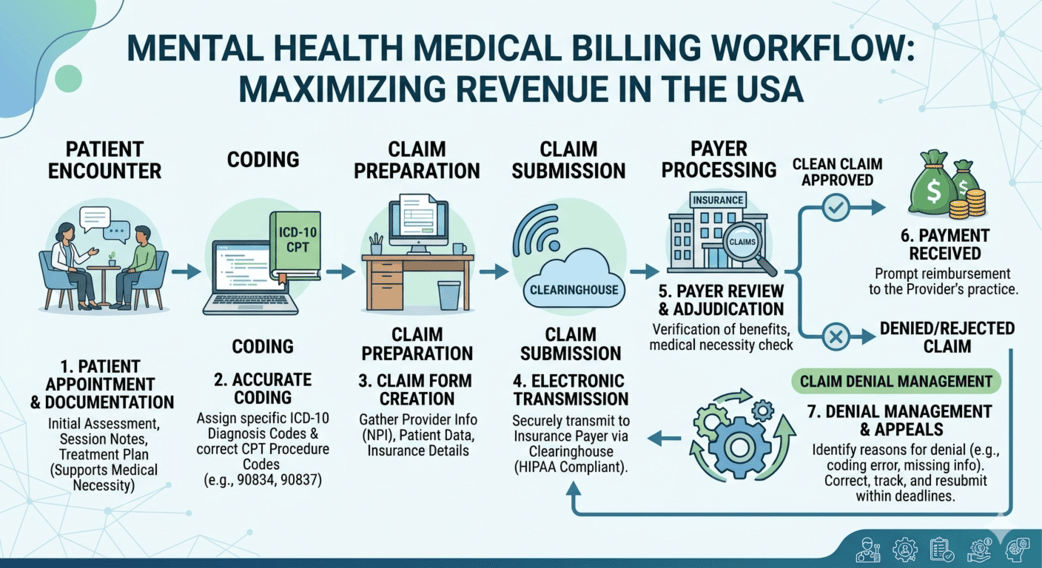
Billing is only one part of the financial process. Successful practices also focus on complete revenue cycle management.
This includes every financial step from patient registration through final payment collection.
A comprehensive revenue cycle typically covers:
- Insurance verification
- Patient eligibility checks
- Charge entry
- Medical coding
- Claim submission
- Payment posting
- Denial management
- Accounts receivable follow-up
- Patient billing
- Financial reporting
When every stage works efficiently, practices experience fewer payment delays and healthier cash flow.
Questions to Ask Before Choosing a Billing Partner
Selecting the best mental health billing company requires careful evaluation.
Consider asking:
Do They Specialize in Mental Health Billing?
Behavioral health billing differs from general medical billing. Ask about their experience with therapists, psychologists, psychiatrists, counselors, and behavioral health clinics.
What Is Their Claim Acceptance Rate?
High first-pass claim acceptance generally reflects strong internal quality controls and experienced billing professionals.
How Do They Handle Denials?
Understanding their denial management process helps you evaluate how proactive they are in protecting your revenue.
Can They Scale With Practice Growth?
Whether you're a solo therapist today or planning multiple providers tomorrow, your billing partner should support future expansion.
How Transparent Is Their Reporting?
Regular financial reports help providers understand collections, outstanding claims, denial trends, and overall practice performance.
Signs That Your Current Billing Process Needs Improvement
Many practices continue using inefficient billing workflows without realizing how much revenue they're losing.
Watch for these warning signs:
- Increasing claim denials
- Slow insurance reimbursements
- Aging accounts receivable
- Frequent coding corrections
- Staff spending excessive time on billing
- Inconsistent payment collections
- Poor financial visibility
Recognizing these issues early allows practices to improve operational efficiency before financial problems become more serious.
Technology Makes a Difference
Modern billing companies rely on technology to improve efficiency while maintaining compliance.
Helpful features include:
- Electronic claim submission
- Automated eligibility verification
- Real-time claim tracking
- Secure patient information management
- Reporting dashboards
- Denial analytics
- Electronic payment posting
Technology should enhance accuracy without replacing experienced billing professionals who understand the complexities of behavioral healthcare.
Compliance Should Never Be Overlooked
Healthcare regulations continue to evolve. Mental health practices must remain compliant with payer policies, documentation requirements, coding standards, and patient privacy regulations.
A quality billing company regularly updates its processes to reflect industry changes while helping providers reduce compliance risks.
Consistent documentation reviews and coding accuracy play a major role in maintaining long-term financial stability.
Finding the Right Balance Between Cost and Value
Choosing the lowest-priced billing service isn't always the smartest decision.
Instead, evaluate the overall value by considering:
- Industry experience
- Billing accuracy
- Customer support
- Coding expertise
- Reporting quality
- Denial recovery performance
- Compliance knowledge
- Scalability
An experienced billing company often generates higher collections that outweigh slightly higher service fees.
Supporting Practice Growth With the Right Partner
As mental health practices expand, administrative demands increase. More patients, additional providers, new insurance contracts, and changing regulations require stronger operational support.
Companies such as 247 Medical Billing Services assist healthcare organizations by offering integrated solutions that include medical billing services, medical coding services, credentialing, and revenue cycle management. The goal is not simply to process claims but to help practices maintain efficient financial operations while allowing providers to focus on delivering quality patient care.
Every practice has unique needs, so selecting a billing partner should involve evaluating experience, communication, reporting capabilities, and long-term support rather than focusing solely on pricing.
Frequently Asked Questions
1. Why should mental health providers use a specialized billing company?
Specialized billing companies understand behavioral health coding, payer policies, documentation requirements, and common denial reasons, helping improve reimbursement accuracy.
2. What services are typically included in mental health billing?
Most billing companies offer insurance verification, claim submission, payment posting, denial management, accounts receivable follow-up, reporting, and patient billing.
3. How does accurate coding affect reimbursements?
Correct coding supports medical necessity, reduces claim denials, improves payment speed, and helps maintain compliance with insurance requirements.
4. Is credentialing necessary before billing insurance?
Yes. Providers generally must complete credentialing with insurance companies before receiving reimbursement for covered services.
5. What is revenue cycle management in mental health practices?
Revenue cycle management covers the entire financial process, including patient registration, insurance verification, coding, billing, payment collection, denial management, and reporting.
6. How can providers identify a reliable billing company?
Look for behavioral health experience, transparent reporting, strong claim acceptance rates, effective denial management, compliance expertise, and responsive customer support.
7. Can outsourcing billing improve patient care?
Yes. When administrative tasks are handled efficiently, providers can dedicate more time to patient treatment, reduce staff workload, and improve overall practice operations.




 Arabic
 French
 Spanish
 Portuguese
 Deutsch
 Turkish
 Dutch
Dutch
 Italiano
 Russian
 Romaian
 Portuguese (Brazil)
 Greek
Greek