


Why Mental Health Billing Specialist Companies Matter in the USA
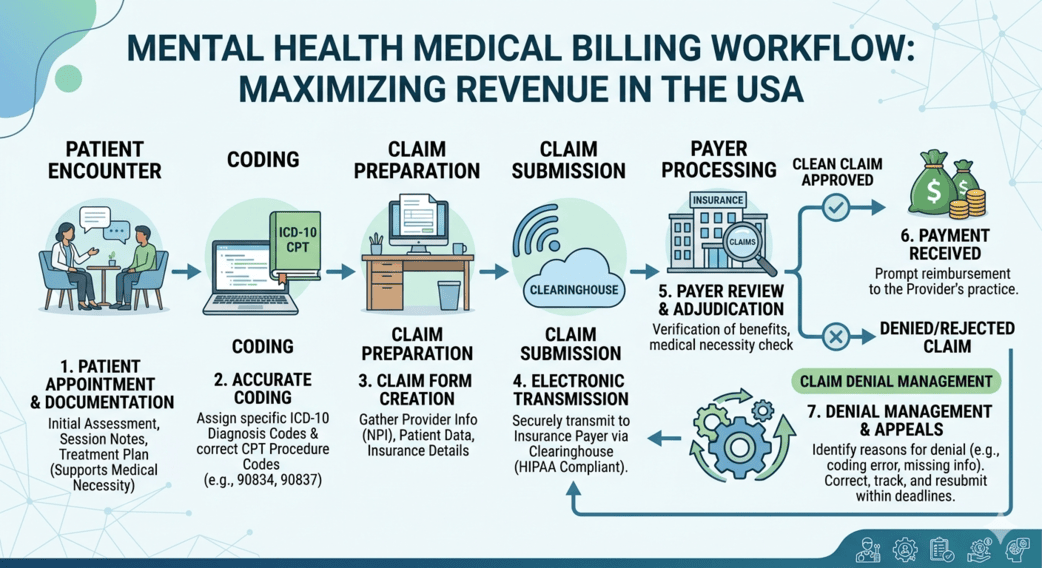
Mental health practices face a unique challenge: helping patients while also keeping up with complex insurance rules, coding changes, and reimbursement requirements. For many therapists, psychologists, psychiatrists, and counseling centers, billing can become a major source of stress. This is one reason mental health billing specialist companies have become increasingly important across the USA.
These companies focus specifically on behavioral and mental health claims. Unlike general billing providers, they understand therapy codes, psychiatric billing, telehealth regulations, authorization requirements, and the documentation needed for successful reimbursement.
In this article, we’ll explore what these companies do, why they matter, common billing challenges in mental health, and how practices can improve their financial performance without sacrificing patient care.
Understanding Mental Health Billing
Mental health billing is different from many other medical specialties. Claims often involve:
Individual therapy sessions
Family therapy
Group counseling
Psychiatric evaluations
Medication management
Teletherapy services
Crisis intervention
Each service may have different coding rules, payer policies, and documentation requirements. Even small errors can lead to claim denials or delayed payments.
What Do Mental Health Billing Specialist Companies Do?
These companies handle the financial side of behavioral healthcare. Their responsibilities typically include:
Insurance verification
Confirming patient eligibility and benefits before appointments.
Prior authorization management
Helping practices obtain approvals when required.
Accurate coding
Applying the correct CPT and ICD-10 codes for mental health services.
Claim submission
Sending clean claims to insurance payers.
Denial management
Investigating and correcting rejected claims.
Payment posting
Recording insurance and patient payments accurately.
Financial reporting
Providing insights into collections, denials, and revenue trends.
Why Mental Health Practices Struggle With Billing
Many behavioral health providers enter the field to help people, not to manage insurance paperwork. Common challenges include:
Challenge
Frequent claim denials
Mental health claims are often denied for missing documentation, authorization issues, or coding errors.
Challenge
Changing telehealth rules
Teletherapy regulations and payer policies continue to evolve across the USA.
Challenge
Complex insurance requirements
Different insurers may require different modifiers, documentation, or authorization steps.
Challenge
Staffing limitations
Small practices may not have dedicated billing experts on staff.
Challenge
Slow reimbursements
Delayed payments can affect cash flow and practice operations.
Benefits of Working With a Specialized Billing Company
Higher claim acceptance rates
Specialists understand mental health billing rules and can submit cleaner claims, reducing avoidable denials.
More time for patient care
Providers can focus on therapy sessions, treatment planning, and patient relationships instead of paperwork.
Better cash flow
Faster claim processing and follow-up can improve payment timelines.
Compliance support
Specialized companies stay updated on payer policies and regulatory changes.
Detailed financial insights
Many practices gain better visibility into collections, outstanding claims, and revenue trends.
The Role of Coding in Mental Health Billing
Accurate coding is one of the most important parts of behavioral health billing. A small coding mistake can result in:
Claim denials
Payment delays
Underpayment
Compliance risks
This is where medical coding services become valuable. Experienced coders help ensure that services are documented and coded correctly according to current guidelines.
How Credentialing Affects Reimbursement
Many providers overlook the importance of credentialing. If a clinician is not properly enrolled with insurance networks, claims may be denied even when the service was medically necessary.
Proper credentialing helps ensure that providers can bill payers correctly and receive reimbursement for covered services.
Revenue Cycle Management in Behavioral Health
Mental health billing is not just about submitting claims. It is part of a larger process called revenue cycle management.
This cycle includes:
1. Patient scheduling
2. Insurance verification
3. Coding
4. Claim submission
5. Payment posting
6. Denial follow-up
7. Patient collections
8. Reporting and analysis
When each step is managed efficiently, practices often experience fewer denials and more predictable revenue.
What to Look for in a Mental Health Billing Partner
If a practice decides to work with a billing company, it should evaluate several factors:
Factor
Why It Matters
Behavioral health experience
Specialized knowledge reduces errors
Denial management process
Improves collections
Reporting capabilities
Provides financial visibility
Compliance knowledge
Helps reduce risk
Communication
Ensures smooth collaboration
Technology integration
Supports efficient workflows
A Practical Example
Small Counseling Practice
Imagine a counseling practice with three therapists.
Before specialized billing support:
15% claim denial rate
45-day average payment time
Staff spending hours on insurance calls
After improving billing processes:
Lower denial rates
Faster reimbursements
More time available for patient care
Better visibility into financial performance
Results vary by practice, but this example shows why many behavioral health providers seek specialized billing expertise.
The Growing Demand for Mental Health Billing Expertise
Mental health services continue to grow across the USA. With increased demand for therapy, psychiatric care, and telehealth services, billing requirements are also becoming more complex.
As a result, many practices are looking for experts who understand behavioral health reimbursement, compliance, coding, and payer policies.
Companies that provide medical billing services for mental health practices often become an important operational partner, helping providers navigate the financial side of care.
Organizations such as 247 Medical Billing Services are frequently mentioned in discussions about behavioral health billing because practices increasingly seek specialized support rather than relying solely on general billing solutions.
Frequently Asked Questions
1. What are mental health billing specialist companies?
They are companies that focus on billing and reimbursement for behavioral health providers, including therapists, psychologists, psychiatrists, and counseling centers.
2. Why is mental health billing more complex than general medical billing?
Mental health billing often involves unique therapy codes, authorization requirements, telehealth rules, and detailed documentation standards.
3. Can a small therapy practice benefit from specialized billing support?
Yes. Small practices often benefit from reduced administrative workload, fewer claim denials, and improved cash flow.
4. What is the connection between billing and credentialing?
Proper credentialing ensures that providers are enrolled with insurance networks, which is necessary for successful reimbursement.
5. How do medical coding services help mental health providers?
Medical coding services help ensure that diagnoses and procedures are coded accurately, reducing the risk of denials and compliance issues.
6. What is revenue cycle management in behavioral health?
Revenue cycle management covers the entire financial process, from scheduling and insurance verification to claim submission, payment posting, and collections.
7. How can practices choose the right billing company?
Look for behavioral health experience, strong denial management, transparent reporting, compliance knowledge, and good communication.
Final Thoughts
Managing a mental health practice requires balancing compassionate patient care with increasingly complex insurance requirements. Mental health billing specialist companies help bridge that gap by bringing expertise in behavioral health coding, claims management, credentialing, and revenue cycle processes.
For many providers across the USA, specialized billing support can mean fewer administrative headaches, more predictable reimbursements, and more time dedicated to helping patients improve their mental well-being.

 English
 Arabic
 French
 Spanish
 Portuguese
 Deutsch
 Turkish
 Dutch
Dutch
 Italiano
 Russian
 Romaian
 Portuguese (Brazil)