


Municipal Water Security: Monitoring Remote Reservoir Modbus RTU Sensors Over WAN
Securing public water supplies requires continuous vigilance and robust engineering. Municipal water authorities manage vast geographic regions containing isolated infrastructure assets. Remote reservoirs, high-elevation storage tanks, and distribution channels often sit miles away from central metropolitan treatment centers.
Managing these spread-out facilities presents severe operational difficulties. Plant engineers must track water levels, pressure variations, and chemical quality parameters constantly. A lack of structural visibility can lead to undetected pipeline bursts, dangerous overflows, or critical drops in water pressure.
This technical guide examines how modern water utilities resolve these communication challenges. We analyze how organizations connect legacy serial field hardware to regional Wide Area Networks (WAN). Specifically, we demonstrate the role of the Modbus RTU to TCP Gateway and the Modbus TCP Gateway in maintaining municipal water security.
The Distributed Infrastructure Dilemma
Municipal water systems rely on hundreds of specialized sensors embedded across rural watersheds. These instruments check physical variables like water depth, flow velocity, valve positions, and chlorine residual levels.
1. The Problem with Serial Data Limitations
Most field instruments utilize the Modbus RTU protocol running on top of physical RS-485 copper lines. This protocol remains an industry standard because it offers great electrical noise resistance and simplicity. However, RS-485 networks carry extreme distance limitations. Standard serial segments cannot exceed 1,200 meters without suffering severe signal degradation.
Furthermore, serial cabling cannot cross mountain ranges or highway corridors easily. Laying private copper wire across a fifty-mile utility territory requires prohibitive capital investments. As a result, critical field data often remains trapped at the local reservoir site.
2. The Threat of Operational Blind Spots
Without a continuous data connection, water managers operate blindly. Technicians must drive to distant reservoir sites just to write down physical gauge readings. This manual monitoring practice creates dangerous delay periods.
If a water main cracks at midnight, the central control room will not receive an alert. Operators might only discover the catastrophic leak when customers begin calling to complain about dry taps. Modern security standards demand instantaneous, sub-second tracking of all utility assets to protect public health and maintain system availability.
The Role of WAN in Modern Water Utilities
To eliminate these operational blind spots, municipal authorities utilize modern Wide Area Networks. These networks connect distant geographic sites back to a single, centralized facility.
1. Utilizing Diverse Telemetry Media
Modern WAN architectures utilize multiple media types depending on local terrain constraints. Utilities use industrial cellular routers running on private 4G or 5G APN networks in urban and suburban areas. In rugged mountainous watersheds, long-range licensed microwave radio links bridge the gaps. Some ultra-remote sites rely on low-latency satellite links.
2. Transitioning to Data-Driven Water Utilities
The adoption of digital network connectivity alters how utilities manage water loss. Industry data from 2026 shows that the global smart water management market size has reached $23.01 billion. This metric highlights a global push toward real-time resource tracking.
Connecting infrastructure to a WAN lets water authorities deploy advanced algorithmic monitoring tools. These cloud-based software packages evaluate system performance constantly. They match reservoir outflow metrics against neighborhood consumer billing meters to locate hidden underground leaks immediately.
Integrating Modbus Protocol Conversion Hardware
Because WAN backbones require standard IP packets, legacy field hardware cannot connect directly to the network. Utilities deploy dedicated industrial protocol converters to resolve this technological mismatch.
The Function of the Modbus RTU to TCP Gateway
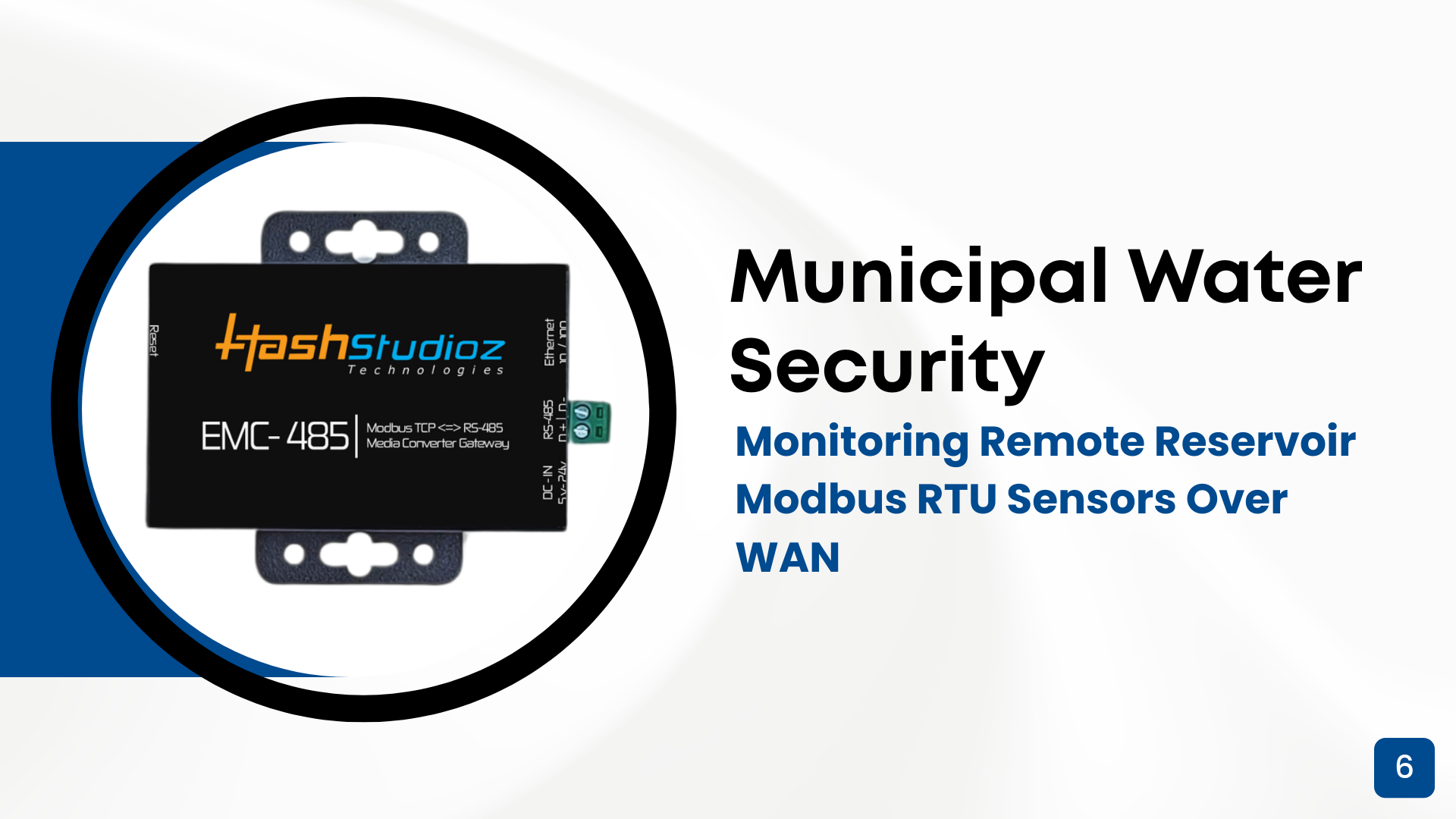
A Modbus RTU to TCP Gateway acts as an translator at the edge of the reservoir facility. The physical housing features an RS-485 serial terminal strip and an RJ45 Ethernet port.
The gateway functions as a local Modbus RTU Master. It polls the nearby level transmitters and pressure sensors over the serial bus using binary query frames.
Once the gateway receives the serial response, it converts the data payload. The internal processor wraps the raw binary register values into a standard TCP/IP packet.
This conversion process modifies the standard Modbus frame structure. The gateway strips away the serial Cyclic Redundancy Check (CRC) bytes. It then adds a six-byte Modbus Application Protocol (MBAP) header to the front of the data packet.
1. The Role of the Modbus TCP Gateway
A standard Modbus TCP Gateway handles the routing of these newly encapsulated packets across the corporate WAN. The device ensures that industrial SCADA servers can address the remote serial devices using standard IP routing rules.The gateway maps unique serial slave IDs to specific TCP port numbers or distinct IP aliases. This mapping mechanism lets a single central SCADA server query hundreds of separate remote sensors through a single WAN connection point. The system converts raw, localized voltage measurements into accessible network variables instantly.
Technical Step-by-Step Implementation Guide
Connecting a remote reservoir monitoring station to a municipal network requires a methodical installation workflow. Follow these five phases to build a highly reliable telemetry node.
Phase 1: Planning and Addressing
Begin by mapping out the IP network topology for the utility district. Assign a static IP address to the protocol gateway. Dynamic IP addresses should not be used for critical infrastructure components.Verify the electrical settings of the serial bus. Ensure all field instruments utilize the same baud rate, parity bit structure, and stop bit selection.
Phase 2: Gateway Configuration
Connect your configuration laptop to the Ethernet port of the gateway using a standard patch cable. Open a secure web browser configuration panel by entering the factory default IP address. Navigate to the serial communication configuration interface. Set the port operating mode to RS-485. Enter the exact connection speeds noted during the planning phase, such as 19200 baud, No parity, and 1 Stop bit.
Next, navigate to the network operating settings. Select Modbus TCP Server mode. This mode allows the gateway to listen for incoming tracking connections from the central SCADA center.
Phase 3: Hardware Enclosure Assembly
Mount a NEMA 4X weatherproof control enclosure inside the valve vault or pump house building at the reservoir site. This industrial enclosure protects the electronic components from humidity, dust, and freezing ambient temperatures.
Snap a heavy-duty industrial Modbus TCP Gateway onto the internal TS-35 DIN rail assembly. Install a regulated 24V DC industrial power supply next to the gateway module. Connect a dedicated electrical ground wire to the backplate of the enclosure to shield the system from unexpected lightning strikes.
Phase 4: Serial and Network Wiring
Route the shielded, twisted-pair serial wire from the field instruments into the enclosure base using liquid-tight conduit fittings. Strip the insulation back and land the data wires into the gateway RS-485 terminal blocks. Connect the positive wire to terminal A and the negative wire to terminal B.
Ground the overall cable drain shield at a single, centralized ground lug to avoid noisy ground loop interference. Next, plug an industrial-grade Cat6 network cable into the gateway RJ45 jack. Route the other end of this patch cable directly into the local WAN transceiver terminal, such as a cellular router or microwave radio unit.
Phase 5: Verification and System Commissioning
Contact the database specialists at the central corporate control center. Instruct them to build new data tags inside the master SCADA application software interface. The developers configure the tags to query the static IP address of the remote gateway using Modbus TCP port 502.
Observe the local diagnostics LEDs on the gateway faceplate. The serial transmit and receive indicators must flash rhythmically, showing active communication with the field instruments. Verify that the live sensor numbers displayed on the master SCADA screen match the physical levels observed at the reservoir tank site.
Overcoming Critical Technical Challenges
Vast open-air water environments expose sensitive networking electronics to severe operational hazards. Engineers must implement specific safeguards to preserve data integrity.
1. Mitigating Lightning and Voltage Surges
Remote water storage reservoirs typically occupy high, exposed geographic ridges. These locations face a high probability of direct lightning strikes. A nearby strike can inject thousands of volts of electricity into copper sensor lines, destroying the gateway instantly.
Engineers place heavy-duty surge protection devices on the RS-485 line directly before the gateway port inputs. These surge protectors shunt excessive voltage loops safely into the ground before the energy hits the sensitive logic board.
2. Maximizing Limited Network Bandwidth
Remote communications networks like satellite channels often utilize metered data billing structures. Querying twenty field instruments every single second can generate massive monthly network expenses. Engineers configure the Modbus RTU to TCP Gateway to operate in a data-polling cache mode to reduce this traffic payload. The gateway queries the local serial instruments continuously at high speed and saves the numbers into internal memory tables.
Essential Hardware Selection Criteria
Using commercial, office-grade routers or basic media converters in water infrastructure utilities will lead to premature failures. Engineers look for specific technical features when purchasing industrial translation units.
-
Extended Environmental Limits: Enclosures must operate reliably across a wide temperature spectrum, usually from -40°C to 85°C. This tolerance prevents components from failing during extreme weather cycles.
-
Redundant Power Terminal Blocks: The gateway hardware should feature dual DC power input jacks. This allows connection to a primary grid power supply and a secondary 12V battery backup circuit simultaneously.
-
Firmware Security Implementations: Modern infrastructure regulations require strict access rules. Choose gateways that support IP address filtering, secure HTTPS setup interfaces, and password-encrypted console access.
-
Protocol Troubleshooting Utilities: Software firmware must include real-time packet monitoring tools. These screens help technicians check for checksum errors and missing packet frames without using external diagnostic equipment.
The Next Iteration of Resource Management
The shift toward total digital oversight continues to alter the utility landscape. Market forecasts show that investments in digital water solutions are projected to grow by 6.5% annually through 2030. Water authorities recognize that data collection protects public safety while cutting operating costs. Modern communication networks allow utilities to pivot from reactive repair practices to predictive asset management models.
Future infrastructure nodes will embed advanced protocol translation capabilities natively. Next-generation gateways will include edge computing engines that process local telemetry trends directly at the reservoir site.
The gateway will watch for rapid, abnormal changes in reservoir levels locally. If a failure pattern emerges, the device can send priority alarms over the WAN instantly while logging historical statistics into local flash cards. This strategy minimizes non-revenue water losses and guarantees reliable clean water access for communities.
Conclusion
Securing municipal water networks requires connecting old field hardware to modern network architectures. Legacy Modbus RTU instruments continue to serve as highly accurate sensors for monitoring water variables. However, their physical distance limitations prevent direct connection to modern control rooms.
Deploying an industrial Modbus RTU to TCP Gateway provides an effective, reliable way to cross this operational gap. These devices translate raw serial strings into secure internet packets, allowing long-distance transmission over WAN backbones.
Using a rugged Modbus TCP Gateway helps water districts centralize their asset tracking, reduce response times, and prevent expensive water losses. This integration strategy protects past capital investments in field instrumentation while delivering the data tools needed to preserve public water security.

 English
 Arabic
 French
 Spanish
 Portuguese
 Deutsch
 Turkish
 Dutch
Dutch
 Italiano
 Romaian
 Portuguese (Brazil)
 Greek
Greek