


Extended Producer Responsibility Compliance in India
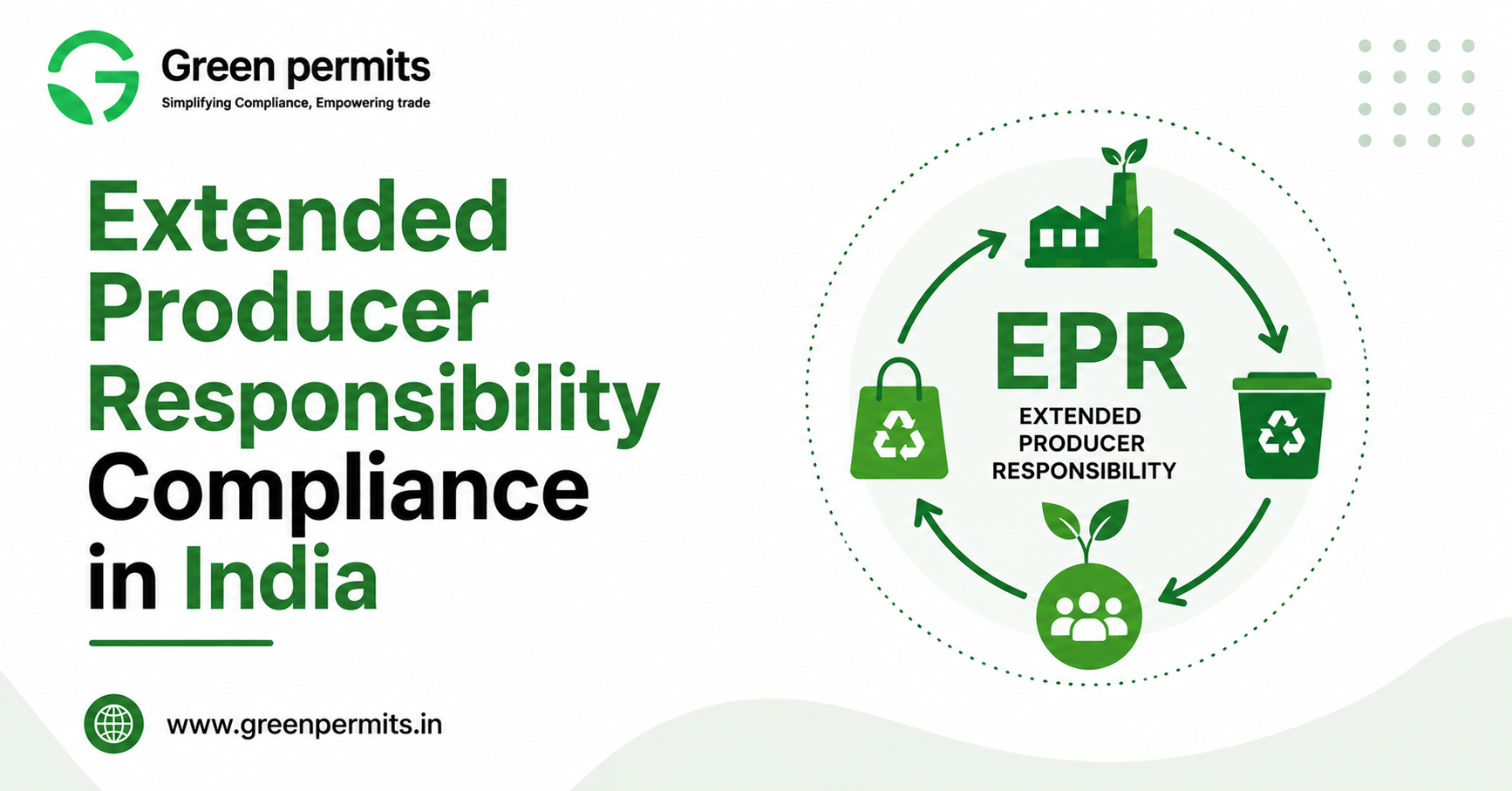
India is rapidly strengthening its environmental regulations to promote a circular economy and reduce pollution caused by waste generated from products after their useful life. One of the most significant environmental compliance frameworks introduced by the Government of India is Extended Producer Responsibility (EPR).
Under EPR regulations, businesses that manufacture, import, sell, or introduce regulated products into the Indian market are responsible for collecting, recycling, refurbishing, or ensuring environmentally sound disposal of the waste generated from those products. This responsibility extends beyond manufacturing and continues until the product reaches the end of its lifecycle.
Today, Extended Producer Responsibility Compliance is mandatory for businesses dealing with electrical and electronic equipment, plastic packaging, batteries, waste tyres, end-of-life vehicles (ELVs), and used oil. Companies covered under these rules must obtain CPCB registration, achieve annual recycling targets, purchase EPR certificates where applicable, maintain records, and submit periodic returns through CPCB portals.
Failure to comply can result in environmental compensation, cancellation of registration, penalties, and legal action by regulatory authorities.
This guide explains the complete Extended Producer Responsibility (EPR) Compliance in India, including registration, process, documents, obligations, costs, and compliance requirements.
What is Extended Producer Responsibility (EPR)
Extended Producer Responsibility (EPR) is an environmental policy that makes producers responsible for managing products after they become waste.
Instead of placing the entire responsibility on municipalities or consumers, EPR requires businesses introducing products into the market to finance or organize the collection, recycling, treatment, and environmentally sound disposal of waste.
The objective of EPR is to:
- Reduce waste generation
- Increase recycling rates
- Promote resource recovery
- Reduce landfill disposal
- Encourage sustainable product design
- Strengthen India's circular economy
Legal Framework for EPR Compliance in India
EPR compliance in India is governed by multiple environmental regulations issued by the Ministry of Environment, Forest and Climate Change (MoEF&CC) and implemented by the Central Pollution Control Board (CPCB).
Major regulations include:
- E-Waste (Management) Rules, 2022
- Plastic Waste Management Rules, 2016 (as amended)
- Battery Waste Management Rules, 2022
- Hazardous and Other Wastes (Management and Transboundary Movement) Rules, 2016
- End-of-Life Vehicle Rules, 2025
- Used Oil EPR Framework
Each regulation has separate compliance obligations depending on the product category.
Why EPR Compliance is Important
India generates enormous quantities of waste every year.
According to government estimates:
- Over 1.6 million tonnes of e-waste are generated annually.
- Plastic waste generation exceeds 4 million tonnes every year.
- Battery waste is increasing rapidly due to the growth of electric vehicles and energy storage systems.
- Millions of tyres and end-of-life vehicles require environmentally sound recycling every year.
EPR compliance helps businesses:
- Meet legal environmental obligations
- Support sustainable waste management
- Improve ESG performance
- Reduce environmental pollution
- Promote recycling industries
- Strengthen corporate sustainability
- Avoid regulatory penalties
Who Needs EPR Compliance
EPR compliance generally applies to:
- Manufacturers
- Producers
- Importers
- Brand Owners
- Battery Manufacturers
- Electronics Manufacturers
- Plastic Packaging Companies
- Vehicle Manufacturers
- Tyre Manufacturers
- Used Oil Producers
- E-commerce Companies introducing regulated products
Applicability depends on the products introduced into the Indian market.
Types of EPR Compliance in India
India currently operates multiple EPR systems.
E-Waste EPR Compliance
Applicable to producers of electrical and electronic equipment.
Businesses must:
- Obtain CPCB Registration
- Meet annual recycling targets
- Purchase EPR certificates
- File annual returns
Plastic Waste EPR Compliance
Applicable to Producers, Importers and Brand Owners (PIBOs).
Obligations include:
- Plastic packaging reporting
- Recycling targets
- Plastic waste certificate procurement
- Annual reporting
Battery Waste EPR Compliance
Applicable to battery producers, importers and manufacturers.
Businesses are required to:
- Register on the CPCB Battery Portal
- Fulfil battery recycling targets
- Purchase EPR certificates
- Maintain sales records
Waste Tyre EPR Compliance
Applicable to tyre manufacturers and importers.
Compliance includes:
- Annual collection targets
- Recycling obligations
- Certificate procurement
- Annual reporting
End-of-Life Vehicle (ELV) EPR Compliance
Applicable to vehicle manufacturers.
The framework promotes scientific dismantling and recycling of vehicles through Registered Vehicle Scrapping Facilities (RVSFs).
Used Oil EPR Compliance
Applicable to producers and importers covered under the Used Oil EPR framework.
Businesses must ensure environmentally sound recycling of waste oil through authorized recyclers.
EPR Registration Process
The registration process begins with identifying the applicable waste management rules.
The applicant prepares business information, product details, sales records, import data, and supporting documents.
Registration is completed through the relevant CPCB online portal.
The application generally includes:
- Company information
- Product category
- Manufacturing details
- Sales quantity
- Import quantity
- Supporting documents
- Compliance declarations
After verification, CPCB grants EPR Registration.
Documents Required for EPR Compliance
The documents vary depending on the applicable EPR category.
Common documents include:
- Company Incorporation Certificate
- PAN Card
- GST Registration Certificate
- Import Export Code (where applicable)
- Authorized Signatory Details
- Business Address Proof
- Product Details
- Brand Authorization Documents
- Manufacturing Information
- Sales and Import Data
- Pollution Control Board Approvals, where applicable
- EPR Action Plan
Additional documents may be required depending on the applicable rules.
Step-by-Step EPR Compliance Process
Step 1: Applicability Assessment
Determine whether the business falls under any EPR regulation.
The assessment considers:
- Product category
- Manufacturing activity
- Import activity
- Brand ownership
- Waste category
- Applicable environmental rules
Step 2: CPCB Registration
The applicant registers on the relevant CPCB portal.
Each waste category has its own registration module.
Step 3: Obtain EPR Registration
After document verification, CPCB issues the registration certificate.
The business can then legally operate under the applicable EPR framework.
Step 4: Fulfil Recycling Targets
Every registered entity must fulfil annual recycling or waste management obligations.
Targets vary depending on:
- Product category
- Sales quantity
- Import quantity
- Applicable regulations
Step 5: Procure EPR Certificates
Where applicable, businesses purchase EPR certificates generated by authorized recyclers.
These certificates demonstrate compliance with annual recycling obligations.
Step 6: File Annual Returns
Registered entities must submit annual returns and compliance reports through the CPCB portal.
Accurate reporting is essential for maintaining compliance.
Ongoing Compliance Requirements
EPR registration is not a one-time approval.
Businesses must continuously comply with:
- Annual recycling targets
- EPR certificate procurement
- Record maintenance
- Annual return filing
- Portal updates
- Regulatory reporting
- CPCB inspections, where applicable
Failure to meet these obligations may lead to regulatory action.
Cost of EPR Compliance
The cost depends on several factors, including:
- Product category
- Quantity introduced into the market
- Registration fees
- EPR certificate procurement cost
- Consultancy fees
- Annual compliance management
The total compliance cost varies depending on the size and nature of the business.
Timeline for EPR Registration
The approval timeline depends on:
- Document readiness
- Application accuracy
- CPCB review
- Product category
- Portal verification
A typical process includes:
- Applicability assessment
- Documentation preparation
- Portal registration
- Application filing
- CPCB review
- Registration approval
Businesses with complete documentation generally receive faster approvals.
Common Challenges During EPR Compliance
Many businesses struggle with compliance because of changing regulations and multiple reporting requirements.
Common challenges include:
- Incorrect product classification
- Incomplete sales data
- Wrong recycling target calculations
- Portal filing errors
- Missing supporting documents
- Delay in procuring EPR certificates
- Late annual return filing
Professional consultants help businesses avoid these issues and maintain continuous compliance.
Benefits of Hiring an EPR Compliance Consultant
An experienced consultant simplifies the complete compliance process.
Consulting services generally include:
- Applicability assessment
- CPCB registration
- Documentation preparation
- Portal filing
- Target calculation
- EPR certificate procurement
- Annual return filing
- Compliance monitoring
- Regulatory advisory
Professional guidance helps businesses reduce compliance risks while meeting all CPCB requirements.
Learn the Complete EPR Compliance Process
Planning to achieve Extended Producer Responsibility Compliance in India? Understanding CPCB registration, recycling targets, EPR certificates, annual returns, documentation, and environmental regulations is essential before starting.
Read the complete guide here:
👉 https://www.greenpermits.in/04/e-waste-epr-registration-india-cpcb-portal-guide/
📞 Get Expert Assistance for EPR Compliance
Need assistance with E-Waste EPR Registration, Plastic Waste EPR Compliance, Battery EPR Registration, Waste Tyre EPR Registration, ELV EPR Compliance, Used Oil EPR Registration, CPCB portal filing, EPR certificate procurement, annual return filing, or complete environmental compliance? The experts at Green Permits Consulting can guide you throughout the complete process.
🌐 Website: https://www.greenpermits.in/
📞 Phone: +91 78350 06182
📧 Email: wecare@greenpermits.in

 English
 Arabic
 French
 Spanish
 Portuguese
 Deutsch
 Turkish
 Dutch
Dutch
 Italiano
 Russian
 Romaian
 Greek
Greek