Substance use treatment has become an essential part of healthcare across the USA. As more people seek help for addiction and recovery, treatment centers, behavioral health clinics, and private practices must balance quality patient care with accurate financial operations. One of the biggest challenges they face is medical billing for substance abuse.
Unlike many other specialties, substance abuse treatment often involves different levels of care, changing treatment plans, strict documentation requirements, and varying insurance policies. A small billing mistake can lead to claim denials, delayed reimbursements, or compliance issues.
This guide explains how medical billing for substance abuse works, the common challenges providers face, and the best practices that help maintain healthy cash flow while supporting quality patient care.
Why Medical Billing for Substance Abuse Is Different
Behavioral health and addiction treatment billing is more complex than many traditional medical specialties. Patients often receive services over an extended period, and treatment may include multiple healthcare professionals.
Common services include:
- Initial evaluations
- Individual counseling
- Group therapy
- Family therapy
- Medication-assisted treatment (MAT)
- Detoxification services
- Intensive outpatient programs (IOP)
- Partial hospitalization programs (PHP)
- Residential treatment
- Follow-up care
Each service has its own documentation requirements, billing rules, and insurance coverage limitations. Providers must ensure that every claim accurately reflects the care delivered.
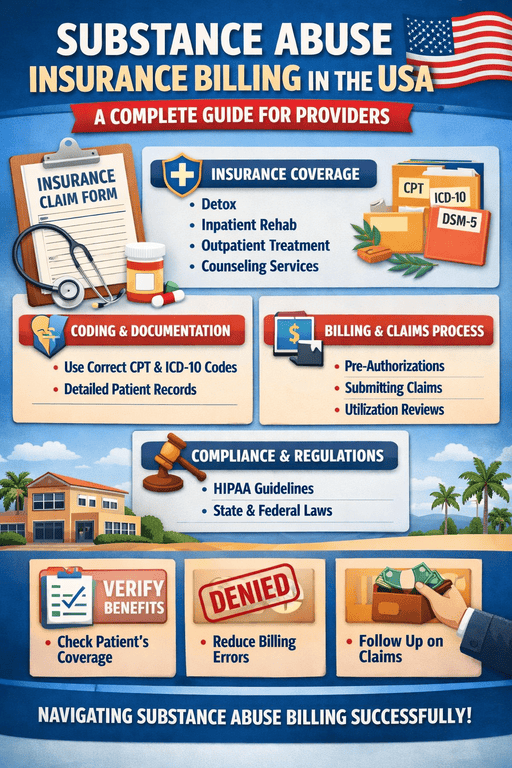
Understanding the Billing Process
A successful billing workflow starts long before a claim is submitted.
Patient Registration
Accurate patient information is the foundation of clean claims. Staff should verify:
- Personal details
- Insurance information
- Policy eligibility
- Referral requirements
- Prior authorization status
Missing or incorrect information at this stage often creates billing problems later.
Clinical Documentation
Providers must clearly document:
- Diagnosis
- Medical necessity
- Treatment goals
- Progress notes
- Time spent with patients
- Services provided
Complete documentation supports accurate coding and reduces audit risks.
Medical Coding
Proper coding converts clinical services into standardized billing codes accepted by insurance companies.
This is where professional medical coding services become valuable. Accurate coding helps ensure that claims match the documented treatment while meeting payer requirements.
Common Billing Challenges in Substance Abuse Treatment
Many addiction treatment providers encounter similar billing issues.
Insurance Verification Problems
Behavioral health benefits vary significantly between insurance plans. Some policies cover outpatient therapy but limit residential treatment or medication-assisted programs.
Without verifying benefits before treatment begins, providers may experience unexpected claim denials.
Prior Authorization Requirements
Many insurers require authorization before approving certain services.
Examples include:
- Residential treatment
- Extended therapy sessions
- Intensive outpatient care
- Partial hospitalization programs
Missing authorization deadlines can result in unpaid claims.
Frequent Coding Updates
Medical billing regulations continue to evolve. Coding updates, payer policy changes, and government regulations require billing teams to stay informed throughout the year.
Medical Necessity Reviews
Insurance companies carefully review whether treatment is medically necessary.
Strong documentation helps demonstrate why a patient requires continued care and supports reimbursement.
Best Practices for Accurate Medical Billing
A proactive billing strategy helps providers reduce denials and improve collections.
Verify Insurance Before Every Visit
Insurance coverage can change unexpectedly.
Checking eligibility before appointments helps confirm:
- Active coverage
- Copay responsibilities
- Deductibles
- Covered services
- Authorization requirements
Maintain Detailed Documentation
Documentation should always reflect:
- Patient symptoms
- Clinical assessments
- Treatment progress
- Therapy duration
- Provider signatures
- Follow-up plans
The more complete the documentation, the stronger the claim.
Submit Claims Promptly
Delays increase the risk of missed filing deadlines and slower reimbursements.
Submitting claims quickly also allows providers to identify and correct any issues sooner.
Monitor Denials
Denied claims should never be ignored.
Instead, billing teams should analyze patterns to identify recurring issues such as:
- Incorrect coding
- Missing documentation
- Insurance eligibility errors
- Duplicate claims
- Authorization problems
Finding the root cause helps reduce future denials.
The Role of Revenue Cycle Management
Billing is only one part of a larger financial process.
Effective revenue cycle management covers every step from patient scheduling through final payment collection.
A strong revenue cycle typically includes:
- Insurance verification
- Patient registration
- Charge capture
- Medical coding
- Claim submission
- Payment posting
- Denial management
- Appeals
- Patient billing
- Financial reporting
When these processes work together efficiently, providers experience fewer billing delays and healthier cash flow.
Compliance Matters More Than Ever
Substance abuse treatment providers operate within a highly regulated healthcare environment.
Compliance involves following:
- HIPAA privacy requirements
- Insurance payer guidelines
- Federal regulations
- State-specific billing requirements
- Documentation standards
Regular internal audits help identify compliance risks before they become larger problems.
Staff training is equally important because billing regulations and payer policies frequently change.
Why Credentialing Supports Successful Billing
Even perfectly prepared claims can be rejected if providers are not properly enrolled with insurance companies.
This is why credentialing is an essential part of the billing process.
Credentialing helps:
- Verify provider qualifications
- Complete payer enrollment
- Maintain active participation status
- Prevent reimbursement delays
- Reduce claim rejections
Keeping provider information updated with every insurance network helps ensure uninterrupted payments.
Technology Is Improving Behavioral Health Billing
Modern billing software has transformed the way addiction treatment providers manage claims.
Today's systems can assist with:
- Electronic claim submission
- Real-time eligibility verification
- Coding assistance
- Automated payment posting
- Claim tracking
- Denial reporting
- Performance analytics
These tools reduce manual work while improving billing accuracy.
However, technology alone is not enough. Experienced billing professionals are still needed to interpret payer requirements, review documentation, and resolve claim issues.
Should Providers Outsource Their Billing?
Some clinics manage billing internally, while others choose specialized medical billing services.
Outsourcing may offer benefits such as:
- Experienced billing professionals
- Lower administrative workload
- Faster claim processing
- Improved denial management
- Better regulatory compliance
- More predictable cash flow
The right approach depends on the size of the practice, available staff, and billing complexity.
Many behavioral health providers work with experienced partners like 247 Medical Billing Services to streamline billing operations while allowing clinicians to focus on patient care. The goal is not simply faster payments but creating a more organized and compliant billing process that supports long-term financial stability.
Tips for Reducing Claim Denials
Reducing denials begins with consistency throughout the billing process.
Helpful strategies include:
- Verify insurance benefits before treatment.
- Obtain prior authorizations when required.
- Use accurate diagnosis and procedure codes.
- Document every service thoroughly.
- Submit claims within payer deadlines.
- Monitor claim status regularly.
- Appeal denied claims with supporting documentation.
- Train billing staff on current payer policies.
Small improvements at each stage can significantly increase first-pass claim acceptance rates.
Looking Ahead
Behavioral health services continue to grow throughout the USA, and billing requirements will likely become even more detailed. Insurance companies are placing greater emphasis on documentation quality, medical necessity, and compliance.
Providers who invest in organized billing processes, ongoing staff education, accurate coding, and efficient financial workflows will be better positioned to deliver quality patient care while maintaining financial health.
Medical billing for substance abuse is not simply about submitting insurance claims. It is a structured process that supports both patient access to treatment and the long-term sustainability of healthcare organizations. By combining accurate documentation, reliable coding, proactive insurance verification, effective revenue cycle management, skilled medical coding services, proper credentialing, and dependable medical billing services, providers can reduce administrative challenges and focus more attention on helping patients achieve lasting recovery.
Frequently Asked Questions
1. What is medical billing for substance abuse?
Medical billing for substance abuse is the process of submitting insurance claims for addiction treatment services, including counseling, detoxification, medication-assisted treatment, outpatient care, and residential treatment.
2. Why are substance abuse claims often denied?
Claims are commonly denied because of missing documentation, coding errors, lack of prior authorization, insurance eligibility issues, or failure to demonstrate medical necessity.
3. Is prior authorization required for addiction treatment?
Many insurance providers require prior authorization for services such as residential treatment, intensive outpatient programs, and partial hospitalization. Requirements vary by insurance plan.
4. How does medical coding affect reimbursement?
Accurate coding ensures that healthcare services are correctly represented on insurance claims. Proper coding reduces denials, supports compliance, and improves reimbursement accuracy.
5. What is the role of revenue cycle management in behavioral health?
Revenue cycle management oversees the complete financial process from patient registration through final payment collection, helping providers improve efficiency and reduce revenue loss.
6. Why is credentialing important for substance abuse providers?
Credentialing confirms that providers are enrolled with insurance companies and eligible to receive reimbursement for covered healthcare services.
7. Can outsourcing medical billing improve practice performance?
Many providers choose specialized medical billing services to reduce administrative work, improve claim accuracy, strengthen compliance, and increase reimbursement efficiency while allowing clinical teams to focus on patient care.




 English
 Arabic
 French
 Spanish
 Portuguese
 Deutsch
 Turkish
 Dutch
Dutch
 Italiano
 Russian
 Romaian
 Portuguese (Brazil)