Mental health practices across the USA are seeing a growing demand for counseling, therapy, psychiatric care, and behavioral health services. While helping patients remains the top priority, managing insurance claims, coding requirements, and payment collections often becomes a major challenge. This is where effective billing for mental health providers plays a critical role.
A well-managed billing process does more than bring in revenue. It reduces claim denials, improves cash flow, supports compliance, and allows providers to spend more time with patients instead of handling paperwork.
This guide explains how mental health billing works, common challenges, and practical ways to improve reimbursement while maintaining compliance.
Why Mental Health Billing Is Different
Mental health billing is more complex than many other medical specialties. Unlike standard office visits, behavioral health services often involve varying session lengths, multiple therapy types, telehealth appointments, and different payer requirements.
Insurance companies may have unique rules for:
- Initial psychiatric evaluations
- Individual therapy sessions
- Family therapy
- Group counseling
- Medication management
- Telepsychiatry
- Psychological testing
Even a small mistake in coding or documentation can delay payments or result in claim denials.
Understanding the Mental Health Billing Process
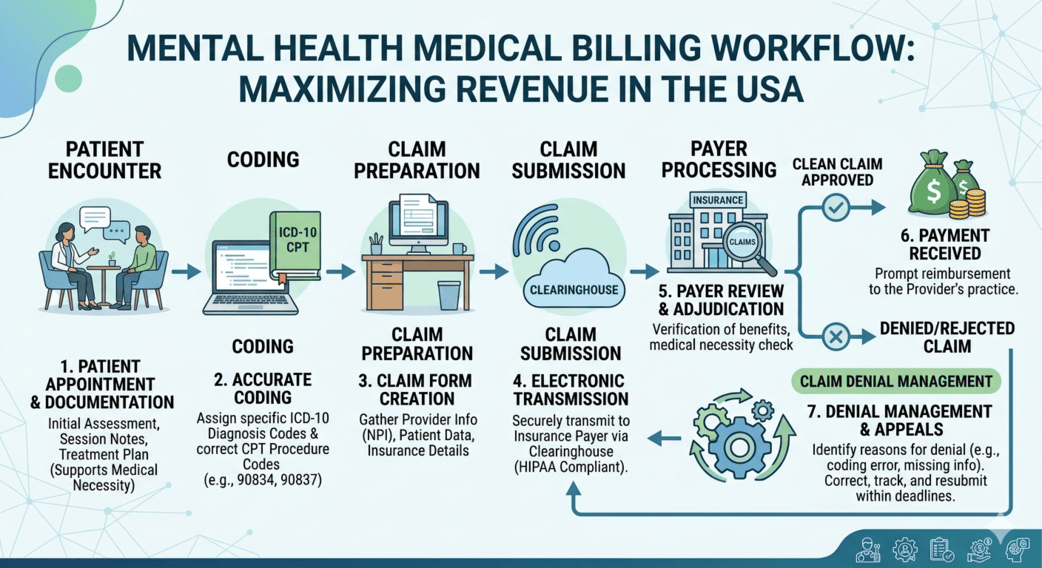
Successful billing for mental health providers follows a structured workflow. Every step contributes to timely reimbursement.
Patient Insurance Verification
Before treatment begins, verify:
- Active insurance coverage
- Copay amounts
- Deductibles
- Authorization requirements
- Covered behavioral health benefits
- Telehealth eligibility
Verifying benefits early helps prevent unexpected billing issues later.
Accurate Documentation
Complete documentation supports medical necessity and protects providers during audits.
Documentation should clearly include:
- Patient history
- Diagnosis
- Treatment goals
- Session duration
- Progress notes
- Provider signature
Clear records also improve coding accuracy.
Medical Coding
Correct coding is one of the most important parts of mental health billing.
Providers must accurately assign:
- Diagnosis codes
- Procedure codes
- Appropriate modifiers when required
Professional medical coding services help reduce coding errors and improve first-pass claim acceptance.
Claim Submission
Claims should be reviewed carefully before submission to ensure:
- Patient information is accurate
- Insurance details match payer records
- Codes are correct
- Required documentation is attached
- Authorization numbers are included if necessary
Clean claims are processed much faster.
Payment Posting and Follow-Up
Once insurers process claims, payments should be posted promptly.
If claims are:
Immediate follow-up helps recover revenue that might otherwise be lost.
Common Challenges Mental Health Providers Face
Behavioral health billing presents several obstacles that affect practice revenue.
Frequent Claim Denials
Claims may be denied because of:
- Incorrect diagnosis codes
- Missing documentation
- Expired authorizations
- Invalid modifiers
- Eligibility issues
Many of these problems are preventable with strong billing processes.
Prior Authorization Requirements
Certain services require approval before treatment begins.
Missing authorization can result in payment delays or complete claim rejection.
Practices should maintain a reliable tracking system for approvals and renewals.
Telehealth Billing Rules
Telehealth has become a standard part of behavioral healthcare.
However, billing rules vary by payer and may require:
- Specific modifiers
- Place of service codes
- Updated documentation requirements
Keeping current with payer policies is essential.
Insurance Policy Changes
Insurance companies regularly update:
- Coverage policies
- Coding guidelines
- Documentation requirements
- Reimbursement rates
Staying informed helps practices avoid costly billing mistakes.
Best Practices to Improve Mental Health Billing
Improving billing performance doesn't always require major changes. Small improvements across the workflow can produce better financial results.
Verify Insurance Before Every Visit
Insurance benefits can change frequently.
Confirming eligibility before each appointment helps avoid denied claims.
Submit Claims Quickly
Delays increase the chance of missed filing deadlines.
Submitting claims promptly improves payment speed and cash flow.
Monitor Denial Trends
Instead of correcting denials one by one, identify recurring patterns.
Examples include:
- Coding errors
- Authorization problems
- Missing documentation
- Eligibility failures
Addressing the root cause reduces future denials.
Maintain Complete Documentation
Accurate records support:
- Medical necessity
- Insurance audits
- Appeals
- Coding accuracy
Consistent documentation protects both providers and patients.
Train Staff Regularly
Billing regulations continue to evolve.
Ongoing education helps administrative teams stay updated with current payer requirements.
How Technology Supports Better Billing
Modern practice management systems simplify many billing tasks.
Useful features include:
- Electronic claim submission
- Eligibility verification
- Appointment scheduling
- Automated reminders
- Payment tracking
- Reporting dashboards
- Denial management
Automation reduces manual work while improving billing accuracy.
The Importance of Revenue Cycle Management
Strong revenue cycle management covers every financial step from patient scheduling to final payment collection.
A healthy revenue cycle includes:
- Patient registration
- Insurance verification
- Accurate coding
- Claim submission
- Payment posting
- Denial management
- Patient billing
- Financial reporting
Practices with effective revenue cycle management often experience:
- Faster reimbursements
- Lower denial rates
- Better cash flow
- Improved operational efficiency
Why Credentialing Should Never Be Overlooked
Many payment issues begin before the first patient visit.
Proper credentialing ensures providers are enrolled correctly with insurance companies.
Without completed credentialing, providers may experience:
- Delayed payments
- Rejected claims
- Network participation issues
- Revenue interruptions
Keeping provider credentials current is equally important to maintain uninterrupted billing.
When Should Mental Health Practices Consider Outsourcing Billing?
As practices grow, billing responsibilities become increasingly demanding.
Many providers choose experienced medical billing services to manage administrative work while focusing on patient care.
Outsourcing may be beneficial if a practice experiences:
- High claim denial rates
- Slow reimbursements
- Limited in-house billing expertise
- Increasing administrative workload
- Frequent payer follow-ups
- Staffing shortages
Professional billing teams typically stay current with payer policies, coding updates, and compliance requirements.
Similarly, specialized medical coding services help improve coding accuracy, reduce compliance risks, and support cleaner claim submissions.
Building a Financially Healthy Mental Health Practice
Financial stability allows providers to continue delivering quality behavioral healthcare.
Successful practices typically focus on:
- Strong documentation habits
- Accurate coding
- Regular insurance verification
- Timely claim submission
- Consistent denial follow-up
- Ongoing staff education
- Efficient revenue monitoring
Organizations such as 247 Medical Billing Services support healthcare providers by assisting with billing workflows, coding accuracy, credentialing, and revenue cycle management, allowing practices to strengthen their financial operations while maintaining their focus on patient care.
Frequently Asked Questions
1. What is billing for mental health providers?
Billing for mental health providers is the process of documenting services, assigning appropriate diagnosis and procedure codes, submitting insurance claims, posting payments, and resolving claim denials to receive reimbursement for behavioral healthcare services.
2. Why are mental health claims often denied?
Claims may be denied because of incorrect coding, incomplete documentation, insurance eligibility issues, missing authorizations, filing deadline violations, or payer-specific billing requirements.
3. How can providers reduce claim denials?
Providers can reduce denials by verifying insurance before appointments, maintaining accurate documentation, using correct diagnosis and procedure codes, submitting clean claims, and monitoring denial trends regularly.
4. Does telehealth require different billing procedures?
Yes. Many insurance companies have unique billing requirements for telehealth services, including specific modifiers, place of service codes, and documentation standards.
5. What role does credentialing play in mental health billing?
Credentialing allows providers to participate with insurance networks and receive reimbursement. Incomplete or expired credentialing can lead to rejected claims and delayed payments.
6. Why are medical coding services important for behavioral health practices?
Professional medical coding services help ensure diagnosis and procedure codes accurately reflect patient services, improving claim acceptance rates while supporting compliance with payer guidelines.
7. How does revenue cycle management improve practice performance?
Effective revenue cycle management streamlines the entire payment process, reduces billing errors, improves collections, lowers denial rates, and supports long-term financial stability for mental health practices.




 English
 Arabic
 Spanish
 Portuguese
 Deutsch
 Turkish
 Dutch
Dutch
 Italiano
 Russian
 Romaian
 Portuguese (Brazil)
 Greek
Greek