Mental health care is more important than ever, and Medicare continues to play a major role in helping millions of Americans access these services. However, billing Medicare for mental health services can be challenging. Frequent policy updates, documentation requirements, coding rules, and claim submission guidelines mean that even small mistakes can lead to claim denials or delayed payments.
Understanding how Medicare billing works helps providers receive timely reimbursement while ensuring patients continue to receive the care they need. This guide explains the essentials of billing Medicare for mental health services in the USA, common challenges, and practical ways to improve billing accuracy.
Understanding Medicare Coverage for Mental Health Services
Medicare covers a wide range of mental health services when they are considered medically necessary and provided by qualified healthcare professionals.
Some commonly covered services include:
- Psychiatric diagnostic evaluations
- Individual psychotherapy
- Group psychotherapy
- Family counseling (when appropriate)
- Medication management
- Depression screenings
- Annual wellness visits with mental health assessments
- Telehealth mental health services (subject to current Medicare guidelines)
- Partial hospitalization programs
- Intensive outpatient services in eligible settings
Coverage may vary depending on whether services fall under Medicare Part A or Medicare Part B and whether the provider meets Medicare participation requirements.
Who Can Bill Medicare for Mental Health Services?
Several licensed healthcare professionals may bill Medicare for covered mental health services, including:
- Psychiatrists
- Clinical psychologists
- Clinical social workers
- Psychiatric nurse practitioners
- Physician assistants (when applicable)
- Clinical nurse specialists
- Licensed therapists working within Medicare guidelines
Providers must meet Medicare enrollment requirements before submitting claims.
Proper credentialing is one of the first steps toward successful reimbursement. Without accurate enrollment and provider information, claims may be delayed or rejected.
Key Documentation Requirements
Strong documentation supports medical necessity and protects providers during claim reviews or audits.
A complete patient record should typically include:
Initial Assessment
The first visit should document:
- Patient history
- Mental status examination
- Diagnosis
- Risk assessment
- Treatment goals
- Clinical observations
Treatment Plan
Every patient should have a treatment plan that clearly explains:
- Diagnosis
- Planned interventions
- Therapy frequency
- Expected outcomes
- Progress measurement
Progress Notes
Each session should document:
- Date of service
- Duration of treatment
- Therapeutic interventions used
- Patient response
- Clinical progress
- Updated treatment recommendations
Incomplete or inconsistent documentation is one of the most common reasons Medicare claims are questioned.
Choosing the Right CPT and Diagnosis Codes
Accurate coding is essential when billing Medicare.
Providers must report:
- Appropriate CPT codes for the services performed
- ICD-10-CM diagnosis codes that support medical necessity
- Correct modifiers when required
- Accurate place of service codes
Even when clinical care is excellent, coding errors can lead to payment delays.
This is where experienced medical coding services become valuable. Proper coding helps ensure claims accurately reflect the care provided while reducing the risk of denials.
Common Billing Challenges
Mental health providers often experience billing issues that reduce cash flow.
Some of the most common challenges include:
Incorrect Documentation
Missing signatures, incomplete notes, or vague treatment plans can result in denied claims.
Coding Errors
Using outdated CPT codes, incorrect diagnosis codes, or missing modifiers frequently causes payment issues.
Eligibility Problems
Patient Medicare eligibility should always be verified before services are provided.
Authorization Requirements
Certain services may require additional approvals depending on payer rules or supplemental coverage.
Duplicate Claims
Submitting duplicate claims may delay payment and trigger unnecessary claim reviews.
Tips to Improve Medicare Claim Success
Improving claim acceptance starts with consistent billing practices.
Consider the following best practices:
- Verify patient eligibility before each visit.
- Review Medicare coverage updates regularly.
- Document medical necessity clearly.
- Submit claims promptly.
- Conduct routine internal billing audits.
- Train staff on coding updates.
- Monitor denied claims to identify recurring issues.
Small workflow improvements often produce significant gains in reimbursement efficiency.
The Role of Technology in Mental Health Billing
Modern practice management systems have simplified many aspects of Medicare billing.
Useful features include:
- Electronic claim submission
- Automated eligibility verification
- Coding assistance
- Documentation templates
- Claim tracking
- Denial management reports
- Payment reconciliation
These tools reduce manual work while improving billing accuracy.
However, technology works best when combined with knowledgeable billing professionals who understand Medicare regulations.
Preventing Medicare Claim Denials
Preventing denials is usually easier than appealing them later.
Healthcare organizations can reduce denials by focusing on:
Regular Staff Training
Billing teams should stay informed about Medicare policy updates and coding changes.
Internal Quality Reviews
Periodic chart audits help identify documentation gaps before claims are submitted.
Accurate Patient Information
Simple errors such as incorrect Medicare numbers or outdated demographic information can delay reimbursement.
Timely Claim Submission
Meeting Medicare filing deadlines helps avoid unnecessary payment issues.
Why Revenue Cycle Management Matters
Mental health practices rely on consistent reimbursement to maintain quality patient care.
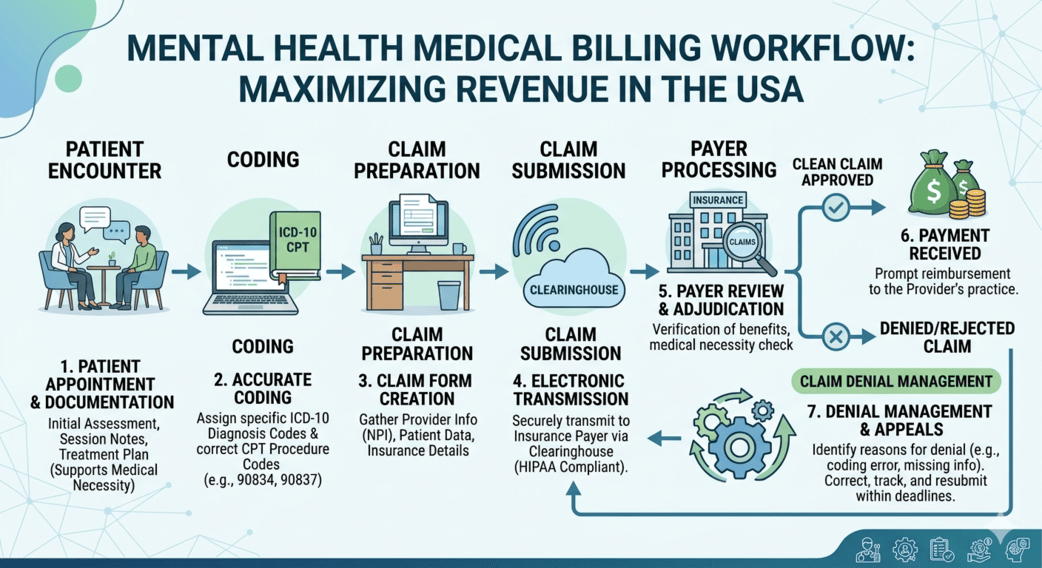
A well-organized revenue cycle management process covers every financial step, including:
- Patient registration
- Insurance verification
- Documentation review
- Coding
- Claim submission
- Payment posting
- Denial management
- Appeals
- Financial reporting
When each stage works efficiently, providers spend less time resolving billing issues and more time focusing on patient care.
When Professional Billing Support Makes Sense
As Medicare regulations continue to evolve, many behavioral health practices choose to work with specialized billing professionals.
Reliable medical billing services can help providers by:
- Improving claim accuracy
- Reducing billing errors
- Monitoring claim status
- Managing denials and appeals
- Keeping up with Medicare policy changes
- Supporting compliance efforts
Organizations like 247 Medical Billing Services support healthcare providers by combining experienced billing teams, accurate medical coding services, proper credentialing, and effective revenue cycle management processes. Rather than replacing clinical expertise, these services help practices maintain smoother financial operations while remaining focused on delivering quality patient care.
Best Practices for Long-Term Billing Success
Maintaining consistent Medicare reimbursement requires an ongoing commitment to compliance and quality.
Providers should aim to:
- Keep documentation complete and accurate.
- Verify patient eligibility before every appointment.
- Use current CPT and ICD-10 codes.
- Perform regular billing audits.
- Monitor denial trends.
- Educate staff on Medicare updates.
- Maintain organized patient records.
- Review coding changes each year.
Building these habits helps create a more efficient billing process while reducing administrative burdens.
Conclusion
Successfully billing Medicare for mental health services involves much more than submitting a claim. It requires accurate documentation, proper coding, compliance with Medicare regulations, and careful attention to every stage of the billing process.
Healthcare providers who invest in organized workflows, ongoing staff education, and reliable billing practices are better positioned to reduce claim denials and improve reimbursement. As Medicare policies continue to change, staying informed and maintaining high documentation standards remain essential for delivering quality mental health care while supporting the financial stability of the practice.
Frequently Asked Questions
1. Does Medicare cover psychotherapy services?
Yes. Medicare generally covers medically necessary psychotherapy services provided by qualified healthcare professionals who meet Medicare requirements.
2. Why are Medicare mental health claims denied?
Common reasons include incomplete documentation, coding errors, eligibility issues, missing modifiers, and insufficient evidence of medical necessity.
3. Is documentation important for Medicare reimbursement?
Absolutely. Detailed documentation demonstrates medical necessity, supports coding accuracy, and helps providers meet Medicare compliance requirements.
4. What role does credentialing play in Medicare billing?
Credentialing ensures providers are properly enrolled with Medicare, allowing them to submit claims and receive reimbursement for covered services.
5. How can providers reduce Medicare billing errors?
Regular staff training, accurate documentation, updated coding practices, eligibility verification, and periodic billing audits can significantly reduce errors.
6. Can technology improve Medicare billing for mental health practices?
Yes. Electronic health records, billing software, and automated claim management tools help improve accuracy, reduce manual work, and speed up reimbursement.
7. Why is revenue cycle management important for behavioral health providers?
Effective revenue cycle management helps providers manage claims, reduce denials, improve cash flow, and maintain a more efficient financial process while supporting quality patient care.




 English
 Arabic
 French
 Spanish
 Portuguese
 Deutsch
 Turkish
 Dutch
Dutch
 Italiano
 Russian
 Romaian
 Greek
Greek