


Mastering Event Safety and Compliance
A single unanchored stage truss, a sudden summer squall, or an overcrowded exit bottleneck can instantly turn a celebratory gathering into a logistical and legal nightmare. In live production, safety is not a secondary checkbox, it is the baseline infrastructure that allows an event to happen.
Managing compliance for large-scale gatherings requires moving away from reactive firefighting toward predictive risk management. Securing your venue, protecting your attendees, and safeguarding your organization requires a bulletproof strategy.
The Foundation of Crowd Dynamics and Risk Mitigation
Crowd management is rooted in understanding behavioral psychology and spatial design. When thousands of people occupy a shared space, physical bottlenecks present immediate physical hazards. Risk mitigation begins with a comprehensive site assessment long before the first attendee arrives.
Spatial Planning and Capacity Thresholds
Calculating safe capacity involves more than just reading the venue's maximum occupancy limit. Strategists must account for production footprints:
-
Dead space allocation: Deduct the exact square footage of staging, audio-visual tables, backstage barricades, and vendor booths from the total usable floor plan.
-
Flow rate calculation: Ensure exit widths accommodate the maximum crowd capacity, allowing full evacuation within local regulatory timeframes (typically three to five minutes).
-
High-density zones: Identify potential crunch points, such as main entrances, merchandise lines, and bar areas, and implement physical queuing systems to distribute crowd pressure.
Vendor and Contractor Compliance
An event is only as safe as the third-party crews building it. Managing temporary structures requires strict documentation loops:
-
Engineering sign-offs: Require certified structural engineering prints for all temporary stages, grandstands, and heavy rigging points.
-
Credential verification: Verify that all high-risk operators (forklift drivers, riggers, and pyrotechnicians) hold valid, current licenses and certifications.
-
Liability tracking: Collect up-to-date Certificates of Insurance (COI) from every vendor, naming your organization and the venue as additionally insured.
Designing a Special Event Operations Plan
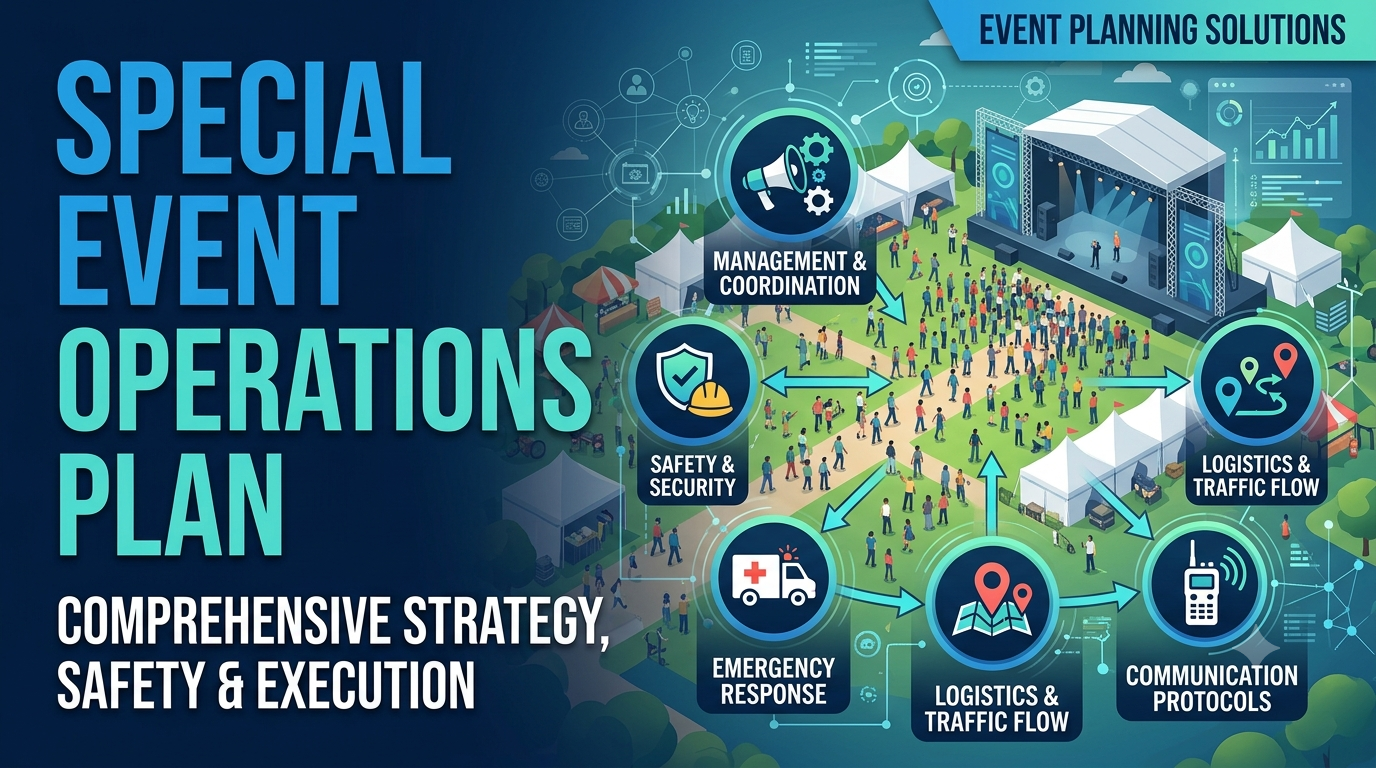
An operational strategy cannot exist purely in the minds of the production team; it must be codified. A comprehensive special event operations plan serves as the central operational guide for every department, from private security to local emergency services.
Core Components of the Operational Blueprint
This document acts as the single source of truth during build days, show days, and strikes. It must explicitly detail:
-
Chain of command: A clear, hierarchical communication chart showing exactly who holds final decision-making authority during an incident.
-
Communication protocols: Dedicated radio channels for medical, security, production, and tech teams, alongside established code words for specific emergencies to prevent crowd panic.
-
Ingress and egress schedules: Staggered load-in times for vendors and timed gate openings for attendees to prevent structural overloading and traffic congestion.
To streamline this process, production teams frequently utilize standardized templates and vetted frameworks. Relying on established resources like Safety docs allows organizers to access legally compliant, field-tested documentation structures that satisfy local municipal requirements and insurance underwriters.
Integrating Local Authorities
An operational blueprint should never be authored in isolation. True compliance requires active collaboration with local municipalities:
-
Multi-agency briefings: Host joint meetings with local police, fire marshals, and municipal traffic controllers at least 30 days prior to the event.
-
Unified command posts: Establish a physical on-site headquarters where public emergency representatives sit alongside your internal event director during show hours.
-
Permit alignment: Cross-reference your operational plan with the specific conditions laid out in your noise, structural, and occupancy permits.
Building an Event Disaster Recovery Strategy
When severe weather strikes or a critical infrastructure failure occurs, the time for brainstorming is over. A definitive event disaster recovery strategy dictates how your team protects lives, preserves assets, and manages liabilities when operations face catastrophic disruption.
Contingency Triggers and Decision Matrices
An effective recovery strategy relies on hard data points rather than subjective assessments. Establish clear, measurable thresholds for halting or canceling an operation:
-
Weather parameters: Define exact wind speed thresholds (e.g., sustained winds hitting 35 mph) that trigger the immediate evacuation of temporary structures or outdoor stages.
-
Power and infrastructure redundancy: Maintain automated backup generators for critical life-safety systems, including emergency lighting, public address systems, and medical tents.
-
Evacuation sequencing: Map out clear, unblocked routes to designated safe shelter areas, ensuring staff are trained to guide attendees systematically.
Post-Incident Preservation and Continuity
If an emergency forces a cancellation or evacuation, the focus immediately shifts to documentation and liability management:
-
Logbook preservation: Secure all written logs, recorded radio traffic, and CCTV footage from the duration of the event.
-
Incident reporting: Document every medical interaction or security intervention with precise times, witness statements, and photographic evidence.
-
Media and stakeholder management: Establish a single authorized spokesperson to handle public statements, ensuring accurate information is distributed while protecting organizational liability.
Cultivating a Culture of Active Safety
The most thoroughly drafted compliance binder is useless if the ground staff have not read it. True event safety is an active, operational culture executed by informed personnel.
-
Pre-shift briefings: Conduct mandatory safety huddles with all security, hospitality, and tech crews before gates open to review emergency protocols and weather forecasts.
-
Tabletop exercises: Run simulation drills with key department heads to walk through hypothetical crisis scenarios and test response times.
-
Visible safety assets: Ensure medical tents, security personnel, and free water stations are highly visible, well-lit, and clearly marked on all attendee maps.
Prioritizing structured planning, clear communication, and rigorous compliance infrastructure allows organizers to deliver memorable experiences while mitigating risks effectively.
Frequently Asked Questions
Q1: What is the difference between crowd management and crowd control?
Crowd management is the proactive planning of crowd movement and behavior through space design, signs, and staffing. Crowd control is the reactive, physical intervention used by security or law enforcement to handle disruptive behavior or static crushes once they occur.
Q2: How often should an event safety plan be reviewed and updated?
An event safety plan should be updated for every single project. Even for recurring annual events, factors like changing vendor personnel, structural alterations, updated local ordinances, and evolving local infrastructure require a fresh risk assessment and documentation review.
Q3: Who holds ultimate legal liability for safety compliance at a guest event?
Liability is typically shared among the event organizer, the venue owner, and primary contractors. The exact distribution of liability depends on the indemnification clauses written into the commercial contracts and the specific nature of the safety failure.
Q4: At what point should an event safety team involve local emergency services?
Local emergency services should be involved during the initial planning phase if the attendance triggers municipal thresholds, requires public road closures, or involves high-risk elements like pyrotechnics or temporary structural builds.
Q5: What are the minimum requirements for an on-site medical tent setup?
A compliant medical setup requires a clearly marked, easily accessible tent staffed by certified first responders. It must feature dedicated ingress/egress routes for ambulances, direct communication lines to event control, and automated external defibrillators (AEDs) alongside standard trauma supplies.

 English
 Arabic
 French
 Spanish
 Portuguese
 Deutsch
 Turkish
 Dutch
Dutch
 Italiano
 Russian
 Romaian
 Greek
Greek