


The Future of Connectivity: Europe Fixed Wireless Access (FWA) Market Size & Forecast (2026–2034)
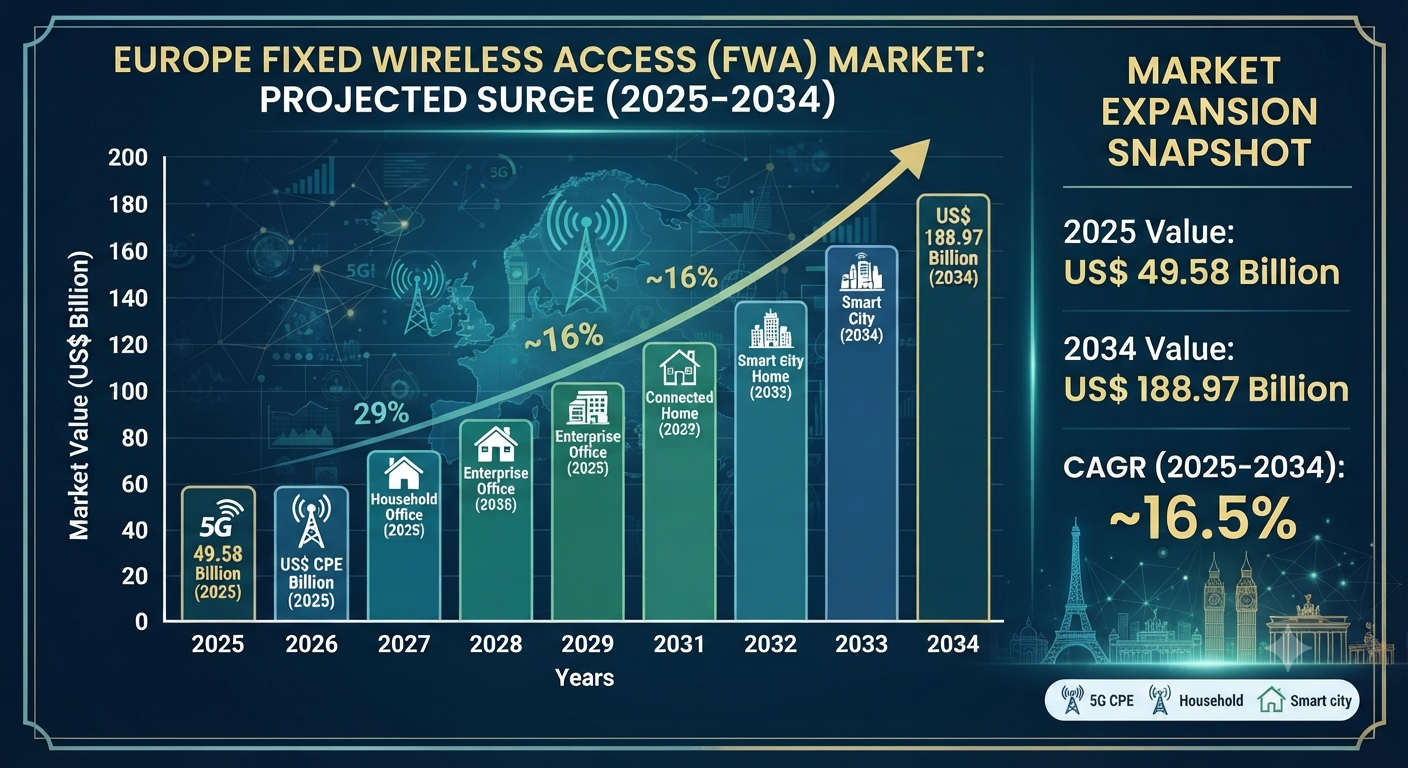
The European digital landscape is undergoing a massive transformation. As the demand for high-speed, reliable connectivity penetrates every corner of the continent, Fixed Wireless Access (FWA) has emerged as a cornerstone technology. By bypassing the physical limitations of traditional trenching and fiber deployment, FWA is rapidly bridging the digital divide between dense urban centers and underserved rural communities.
According to Renub Research, the Europe Fixed Wireless Access (FWA) market is projected to surge from US$ 49.58 Billion in 2025 to US$ 188.97 Billion by 2034. The market is expected to expand at a robust CAGR of 16.03% from 2026 to 2034. This growth is primarily fueled by the aggressive rollout of 5G infrastructure, the urgent need for scalable broadband solutions, and a strategic governmental emphasis on rural connectivity.
Download Free Sample Report: https://www.renub.com/request-sample-page.php?gturl=europe-fixed-wireless-access-market-p.php
Market Overview
Fixed Wireless Access (FWA) provides high-speed broadband to homes and businesses using radio access technology rather than copper or fiber-optic cables. Utilizing 4G, 5G, or millimeter wave (mmWave) networks, data is transmitted from base stations to customer-premises equipment (CPE).
In Europe, FWA is no longer just a "stop-gap" solution; it is a strategic necessity. With increasing reliance on cloud services, remote work, and e-education, the continent faces a pressing need for consistent, high-capacity internet. FWA offers a faster, more cost-effective alternative to laying fiber in geographically challenging regions, making it a vital tool for meeting national digital agendas.
Key Growth Drivers
1. Closing the Last-Mile Gap
Europe’s diverse geography creates significant "last-mile" challenges where fiber installation is economically unfeasible. FWA provides operators with a way to deliver high-speed broadband with significantly lower civil-works costs and a faster time-to-market. For small businesses and households in suburban and semi-rural areas, FWA acts as the primary upgrade from outdated ADSL or slow cable connections.
2. 5G NR and Multi-Gbps Capacity
The commercialization of 5G New Radio (NR) and the utilization of mid-band (3.5 GHz) and mmWave spectrum have revolutionized FWA performance. Technologies like Massive MIMO, beamforming, and carrier aggregation allow FWA to deliver speed and Quality of Service (QoS) metrics that rival traditional fiber, enabling multi-gigabit experiences for residential and enterprise users.
3. Favorable Cost Economics
For telecom operators, the capital expenditure (capex) of FWA is substantially lower than that of full-fiber rollouts. With minimal excavation and standardized CPE installation, operators can scale their networks in response to actual consumer demand. This efficiency is particularly attractive for regional ISPs and mobile network operators (MNOs) looking to maximize existing infrastructure.
Market Challenges
-
Spectrum Fragmentation: Europe’s regulatory landscape is heterogeneous. Different countries have varying licensing frameworks and channelization rules, which increases the complexity of equipment and adds to logistics costs.
-
Propagation Constraints: While high-band (mmWave) spectrum offers incredible speed, it is limited by "line-of-sight" issues. Factors such as building materials, foliage, and rain fade can impact reliability, requiring sophisticated network densification that can increase overall deployment costs.
Strategic Segmentation Insights
-
Hardware Evolution: The market is witnessing a shift toward multiband, multimode devices capable of seamless 4G/5G fallback. Vendors are prioritizing weatherproof outdoor units and O-RAN-compatible base stations to reduce vendor lock-in.
-
The Rise of Commercial FWA: Enterprises now utilize FWA for primary or redundant high-speed links. Providers are catering to this sector with specialized SLAs, managed routers, and dedicated enterprise-grade security, making it a high-margin segment.
-
Regional Trends:
-
Germany: Leveraging hybrid strategies to combine fiber in urban cores with FWA in rural/suburban areas.
-
United Kingdom: FWA is heavily utilized in rural hamlets, supported by government voucher schemes.
-
Netherlands: High population density and smart-city initiatives drive urban FWA adoption via existing street furniture and infrastructure.
-
Frequently Asked Questions (FAQs)
Q1: What is the projected market size of the Europe FWA market by 2034? Answer: According to Renub Research, the European Fixed Wireless Access market is forecast to reach US$ 188.97 Billion by 2034.
Q2: What is the expected CAGR of the European FWA market during the 2026–2034 period? Answer: The market is expected to grow at a CAGR of 16.03% from 2026 to 2034.
Q3: Why is FWA considered a superior alternative to fiber in certain European regions? Answer: FWA offers faster deployment, significantly lower civil-work costs (no trenching), and greater scalability, making it ideal for rural and semi-urban areas where fiber installation is prohibitively expensive or slow.
Q4: How does 5G influence the growth of the FWA market in Europe? Answer: 5G New Radio, combined with mid-band and mmWave spectrum, enables higher throughput and lower latency, allowing FWA to compete directly with fiber-optic broadband.
Q5: Which demography is the primary target for FWA deployments? Answer: While FWA is used in urban environments for densification, its primary growth is concentrated in semi-urban and rural areas where traditional broadband infrastructure is lacking.
Q6: What role does CPE play in the hardware segment of this market? Answer: Customer-Premises Equipment (CPE) is critical; current demand favors multi-band, software-upgradeable units that support self-installation, reducing maintenance and operational costs for operators.
Q7: How are European telecom operators monetizing FWA? Answer: Operators are bundling 5G FWA with home services, IPTV, and business SLAs, while also leveraging it to enter markets with lower incremental capex and defending against competition from cable providers.

 English
 Arabic
 French
 Spanish
 Portuguese
 Deutsch
 Dutch
Dutch
 Italiano
 Russian
 Romaian
 Portuguese (Brazil)
 Greek
Greek