


How to Use a Soft Buffer for Nails: A Complete Beginner's Guide
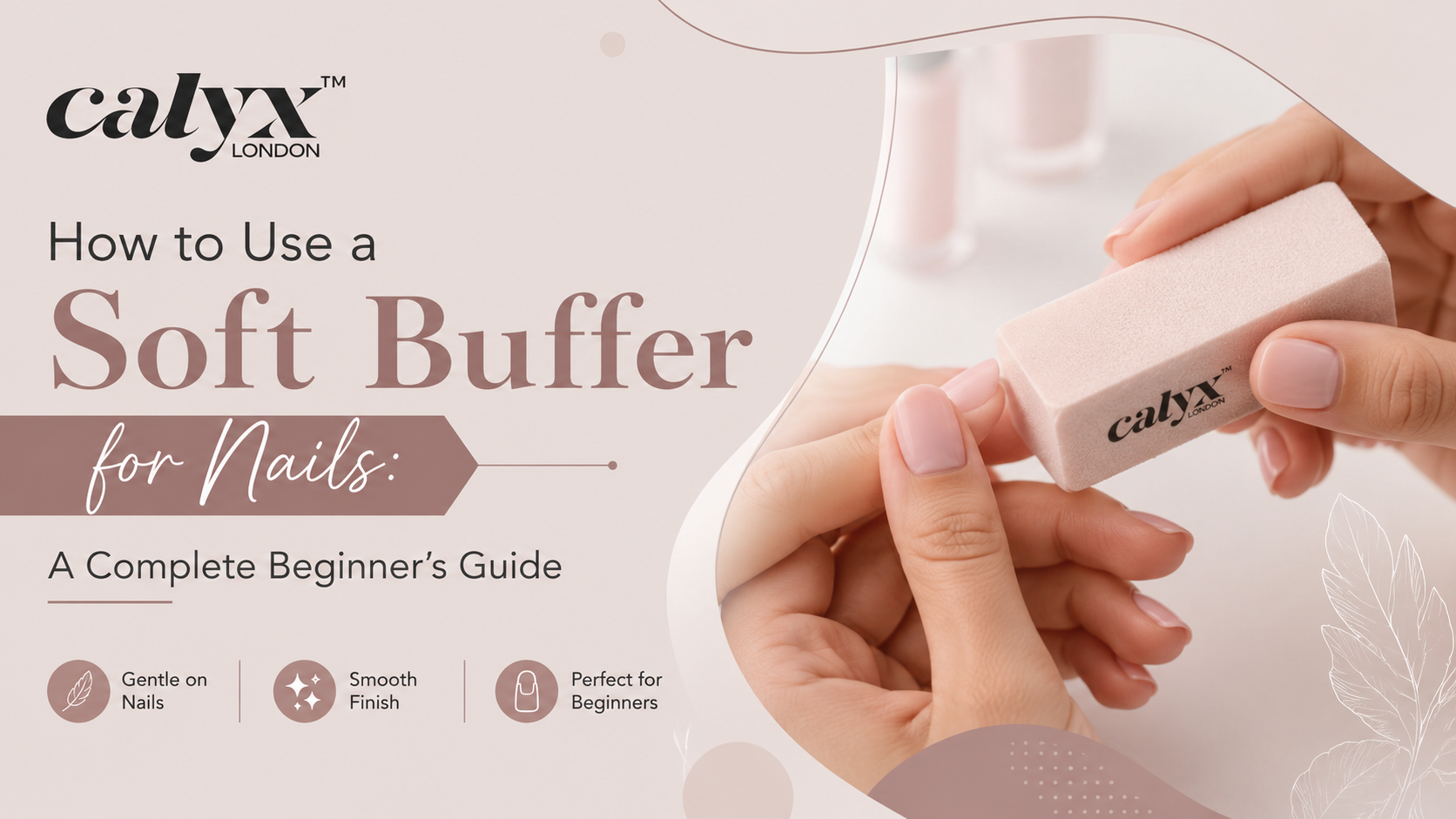
What Is a Soft Buffer for Nails
A soft buffer is an abrasive tool built on a compressible core, typically foam or sponge, rather than the rigid board used in a standard nail file. The abrasive layer sits on top of this cushioned base, so the working surface flexes slightly under pressure instead of holding a fixed, flat plane.
This construction difference matters more than it first appears. A rigid file applies uniform pressure regardless of the nail's natural curvature, which means a technician has to actively lift and adjust angle to avoid flat-spotting a curved nail bed. A soft buffer's compressible layer conforms to that curvature on contact, distributing pressure evenly across a convex surface without the technician needing to compensate as aggressively.
The practical result is self-limiting abrasion. Because the cushion absorbs some of the applied force rather than transferring all of it directly into the nail plate, a soft buffer removes material more gradually and more evenly than a rigid tool at the same grit rating. This is precisely why soft buffers are the professional standard for surface preparation and finishing work, while rigid files remain better suited to shaping and length reduction.
For salons working with Gel Nail Paint and Builder Gel systems, this distinction directly affects product performance. A surface prepared with a soft buffer at the correct grit gives a base coat consistent microscopic texture to grip, without the risk of over-thinning that comes from rigid-file pressure applied unevenly across a curved nail.
Benefits of Using a Soft Buffer in Professional Nail Services
The primary benefit of a soft buffer in a professional setting is adhesion consistency. Gel Nail Paint and Builder Gel both rely on a mechanically prepared surface to bond correctly, and a soft buffer creates that surface without the risk of removing more nail plate than necessary. This directly reduces lifting, one of the most common causes of early service failure and unplanned client callbacks.
Nail plate preservation is the second major benefit, and it compounds over time. Clients on a regular gel or extension cycle are having their nail plate lightly abraded at every appointment. A soft buffer's cushioned action removes a thinner, more even layer of surface material per pass than a rigid file at equivalent grit, which matters significantly across months of repeat services. Technicians who standardise on soft buffers for prep tend to see fewer clients present with thinned, over-processed nail plates over time.
Finish quality is the benefit clients notice directly. A soft buffer's flexible contact produces a smoother, more even surface across the curve of the nail, which shows through in the final result once Gel Nail Paint, a glossy top coat, and cuticle oil are applied. On a natural nail finishing service with no product applied at all, this same quality is what produces a professional shine without any risk of over-processing.
These three benefits work together directly toward retention. A service that holds without lifting, a nail plate that stays healthy across repeat visits, and a finish that looks considered rather than rushed are the details that separate a one-time client from a rebooking one.
Soft Buffer Grit Guide for Nail Technicians
Grit selection should be driven by the product and the stage of the service, not treated as a single fixed number across every appointment. The following breakdown reflects standard professional practice for soft buffers used within a Gel Nail Paint and Builder Gel workflow.
100-180 grit is appropriate only for debulking or reshaping existing enhancement product, such as removing a harsh line left after coarse filing on a Builder Gel overlay. This range is too aggressive for direct contact with the natural nail plate and should be reserved for enhancement material only.
180-220 grit sits at the boundary between enhancement work and natural nail prep. This is the range to reach for when blending a Builder Gel edge into the natural nail or refining a previously filed surface before moving to a finer grit.
220-240 grit is the standard for natural nail prep immediately before Gel Nail Paint application. At this grit, the soft buffer removes just enough surface shine to create adhesion texture without meaningfully reducing nail plate thickness. This is the grit range that should be used on every client, every appointment, for base coat prep.
280 grit and finer is reserved for finishing work after Builder Gel has been shaped and cured, smoothing the surface ahead of a glossy top coat, or for a standalone shine finish on natural nails with no colour product involved.
The consistent principle across every grit range is direction and restraint. A soft buffer should always be worked in one direction, following the natural growth pattern of the nail, and a single pass at the correct grit is normally sufficient. Repeated back-and-forth buffing at any grit increases material removal well beyond what the service requires.
How to Use a Soft Buffer: Professional Technique
Begin with clean, dry nails, free of oil, previous product residue, or moisture. A soft buffer performs inconsistently on a contaminated surface, and any residue left behind at this stage will compromise every layer applied afterward.
Select grit according to the stage of the service, per the guide above. For a standard natural nail prep ahead of Gel Nail Paint, move to a 220-240 grit soft buffer and work in one direction only, following the nail's natural growth pattern from cuticle to free edge. The goal is to remove surface shine evenly across the entire nail plate, not to create visible scratch patterns or flat spots.
Cover the full nail plate methodically, including the curved edges near the sidewalls where a rigid file tends to miss coverage or dig in unevenly. The soft buffer's cushioned surface should maintain consistent contact across this curvature without requiring the technician to constantly adjust angle.
Once the surface shine has been evenly removed, dust off all residue with a clean, lint-free wipe before moving to dehydration and base coat. Proceed with the Gel Nail Paint application, followed by Builder Gel where structural reinforcement is required, then a glossy top coat, and finish with cuticle oil to rehydrate the surrounding skin.
For finishing work after Builder Gel has cured and been shaped, switch to a finer grit soft buffer, again working in one direction, to smooth the surface ahead of top coat application. This step is what determines whether a glossy top coat sits flat and even or highlights underlying texture irregularities.
Soft Buffer Uses Beyond Prep
Soft buffers serve purposes beyond pre-application surface texture, and recognising these secondary uses is part of working efficiently as a technician.
A soft buffer functions as a diagnostic tool during consultation. Running a soft buffer lightly across a client's natural nail plate before starting any service reveals surface irregularities, unusual softness, or thinning that may not be visible on inspection alone. This information should inform product selection and whether a client is a suitable candidate for enhancement work at that appointment.
For clients requesting a natural nail finish with no colour product, a soft buffer at 280 grit or finer can be used as the entire service. This produces a clean, even shine directly from the nail plate, finished with cuticle oil, and represents a legitimate standalone offering for clients between enhancement cycles or during periods where a rest from product is recommended.
Soft buffers also assist with minor corrective work on existing enhancements between full rebalances, such as smoothing a small surface imperfection in cured Builder Gel without requiring a full removal and reapplication.
Common Mistakes Technicians Should Avoid
Over-buffing is the most frequent and most damaging error. Multiple passes at the same grit, or buffing back and forth rather than in one direction, remove significantly more nail plate material than a single correctly executed pass. This is the primary mechanical cause of nail plate thinning across repeat clients.
Selecting too coarse a grit for direct natural nail contact is the second common mistake. Grits intended for enhancement debulking should never touch the natural nail plate directly, as the resulting surface damage compromises both nail health and the adhesion the next service depends on.
Skipping soft buffer prep entirely, in an attempt to save time, is a false economy. An under-prepared surface leads directly to early lifting, which costs more technician time in redos and client goodwill than the thirty seconds saved at prep stage.
Neglecting soft buffer hygiene between clients is a mistake with consequences beyond the immediate service. A soft buffer's porous, cushioned surface can retain product residue and biological material if not properly managed, which creates cross-contamination risk across a busy salon day.
Manicure Soft Buffer: Salon Hygiene and Maintenance Best Practices
Soft buffers used in professional settings should follow the same single-use or properly disinfected standard applied to any other implement that contacts the nail plate. Where local regulation and salon protocol permit reusable buffers, they must be disinfected according to an EPA- or equivalent-registered hospital-grade disinfectant appropriate for porous nail tools, and inspected before each use for visible wear or residue that cannot be fully removed.
In practice, many salons standardise on single-use soft buffers precisely because the cushioned, porous construction that makes them effective is the same property that makes thorough disinfection more difficult than with a solid-surface file. This is a reasonable operational decision to build into service pricing rather than treating buffer cost as a variable to minimise.
Buffer lifespan should be tracked as a consumable, not assumed. A soft buffer that has visibly compressed, frayed at the edges, or lost abrasive grit will produce inconsistent results regardless of correct technique, and continuing to use a worn buffer is a common source of unexplained inconsistency in finish quality. Building buffer replacement into standard reordering alongside Gel Nail Paint and Builder Gel stock keeps this from becoming a recurring gap in service quality.
Conclusion
A soft buffer for nails is a precision component of professional service quality, not an interchangeable step ahead of colour application. Getting grit selection, direction, and technique right protects the nail plate, supports Gel Nail Paint and Builder Gel adhesion, and produces the finish quality clients notice and rebook for. Building correct soft buffer protocol, and the hygiene standards around it, into every technician's routine is a straightforward way to raise consistency across an entire salon.
For technicians looking to build this into a complete, structured service methodology, Calyx London Nail Academy offers professional training that covers prep technique, product system integration, and salon protocol in full.
A soft buffer is built on a compressible foam or sponge core, which flexes to follow the natural curvature of the nail plate. A rigid file holds a fixed flat plane, which makes it better suited to shaping and length reduction rather than surface prep or finishing.

 English
 Arabic
 French
 Portuguese
 Deutsch
 Turkish
 Dutch
Dutch
 Italiano
 Russian
 Romaian
 Portuguese (Brazil)
 Greek
Greek