


How Toppers Use CAT Previous Year Question Papers to Crack IIMs
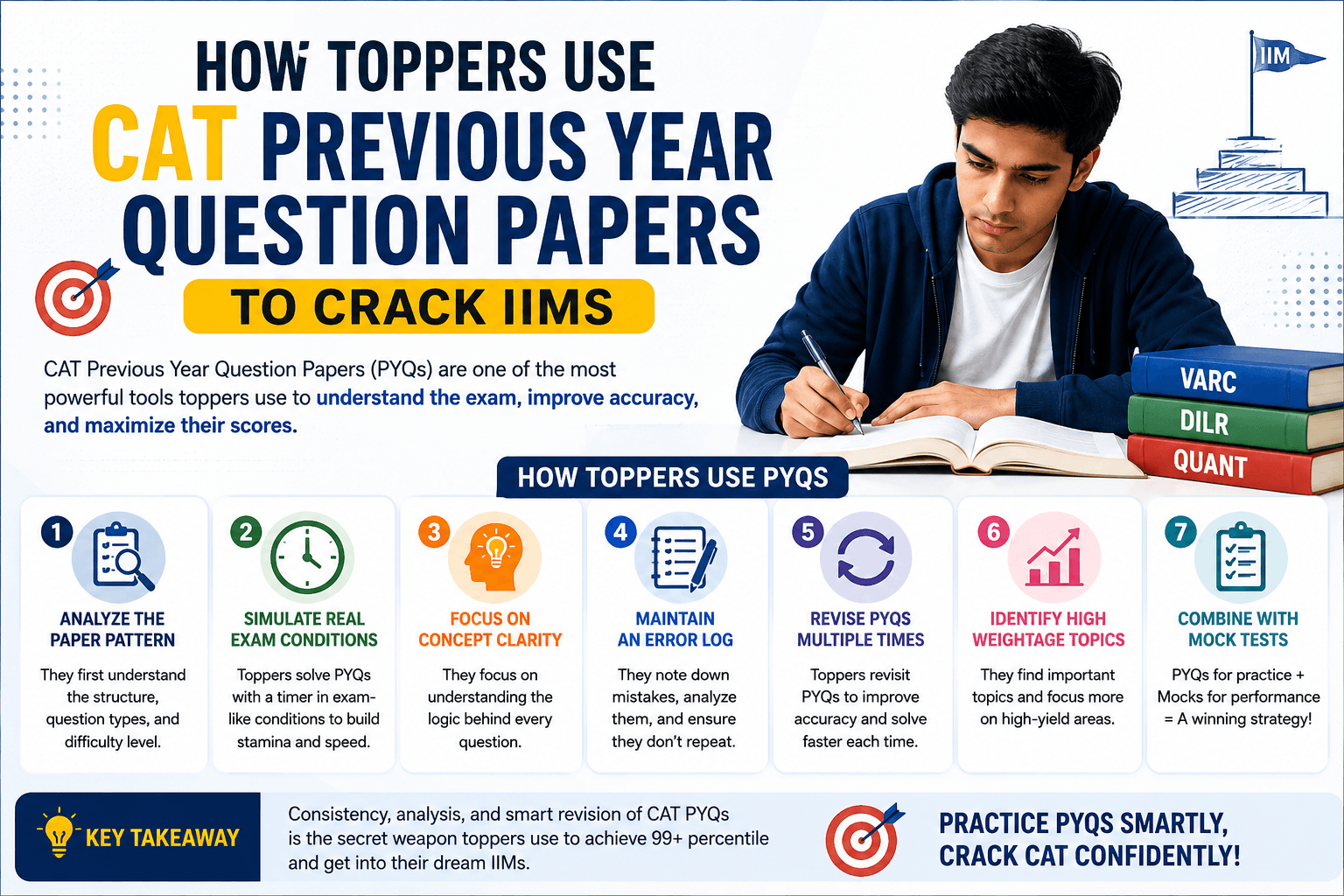
Preparing for the Common Admission Test (CAT) is not just about completing the syllabus. To score a high percentile, aspirants need to understand how questions are framed, manage time effectively, and develop the ability to select the right questions. This is why CAT Previous Year Question Papers are an important part of preparation.
Toppers use previous year papers differently from average aspirants. Instead of simply solving questions and checking answers, they analyse every paper to understand patterns, identify weaknesses, and improve their exam strategy.
Why Are CAT Previous Year Question Papers Important?
CAT PYQs provide students with practical exposure to the type of questions asked in the actual examination. They can help aspirants understand:
- CAT question types and formats
- Difficulty level of different sections
- Important concepts and topics
- Time pressure during the examination
- Common mistakes made while solving questions
- Question-selection strategies
Practising PYQs also helps students become familiar with the overall structure of the CAT examination.
How Toppers Use CAT PYQs
1. Toppers Analyse the Paper Before Solving It
Before attempting a previous year paper, toppers examine its structure. They look at the different sections and identify the types of questions included.
For example, they analyse:
- Which Quantitative Aptitude topics were tested?
- What types of Reading Comprehension passages appeared?
- Which DILR sets required more time?
- Which questions appeared relatively easier?
This initial analysis helps them understand the nature of the CAT examination.
2. They Solve PYQs in a Timed Environment
Toppers don't treat previous year papers like ordinary practice exercises.
They recreate exam conditions by:
- Setting a timer
- Solving the paper without distractions
- Avoiding unnecessary breaks
- Following sectional time limits
- Recording their performance
This helps develop the mental stamina required for the actual CAT examination.
3. They Analyse Every Incorrect Answer
One of the biggest differences between toppers and other aspirants is what happens after they finish a paper.
Instead of simply checking the answer key, toppers ask:
Why did I get this question wrong?
The reason could be:
- Lack of conceptual knowledge
- Calculation error
- Misreading the question
- Incorrect assumption
- Poor time management
- Choosing the wrong approach
Understanding the reason behind a mistake makes future preparation much more effective.
4. They Maintain an Error Log
An error log can be extremely useful during CAT preparation.
Students can record their mistakes in a simple format:
| Topic | Mistake | Reason | Correct Approach |
|---|---|---|---|
| Arithmetic | Wrong answer | Calculation error | Recheck calculations |
| Algebra | Conceptual mistake | Formula not clear | Revise concept |
| VARC | Incorrect option | Misinterpreted passage | Improve RC analysis |
| DILR | Set not completed | Poor time allocation | Practise set selection |
Toppers revisit this error log regularly to make sure they don't repeat the same mistakes.
5. They Identify Their Weak Areas
CAT PYQs can act as a diagnostic tool.
Suppose an aspirant performs well in Arithmetic but consistently struggles with Algebra. Instead of continuing to solve random questions, the student can focus specifically on Algebra.
Similarly, a student may discover that:
- Reading Comprehension accuracy is low
- DILR sets take too much time
- Calculation speed needs improvement
- Certain Quant topics are consistently difficult
This allows preparation to become targeted rather than random.
6. They Practise Question Selection
CAT is not simply a test of how many questions you can solve.
It also tests whether you can identify which questions are worth attempting.
While practising PYQs, toppers learn to differentiate between:
- Easy questions
- Moderate questions
- Difficult questions
- Time-consuming questions
They gradually develop the ability to skip questions that are likely to consume too much time.
This strategy can be particularly useful when dealing with difficult sections.
7. They Revise PYQs
Toppers don't necessarily consider a PYQ finished after solving it once.
They revisit important or difficult questions after some time.
A useful revision cycle can be:
First Attempt → Analyse → Revise Concept → Reattempt
When a student can solve a previously difficult question independently, it indicates genuine improvement.
Also Read:
Also Read: CMAT Previous Year Question Paper

 English
 Arabic
 French
 Spanish
 Portuguese
 Deutsch
 Turkish
 Dutch
Dutch
 Italiano
 Russian
 Portuguese (Brazil)
 Greek
Greek