


Telemedicine in 2026: What Providers Need to Know as Temporary Rules Head Toward a Permanent Framework
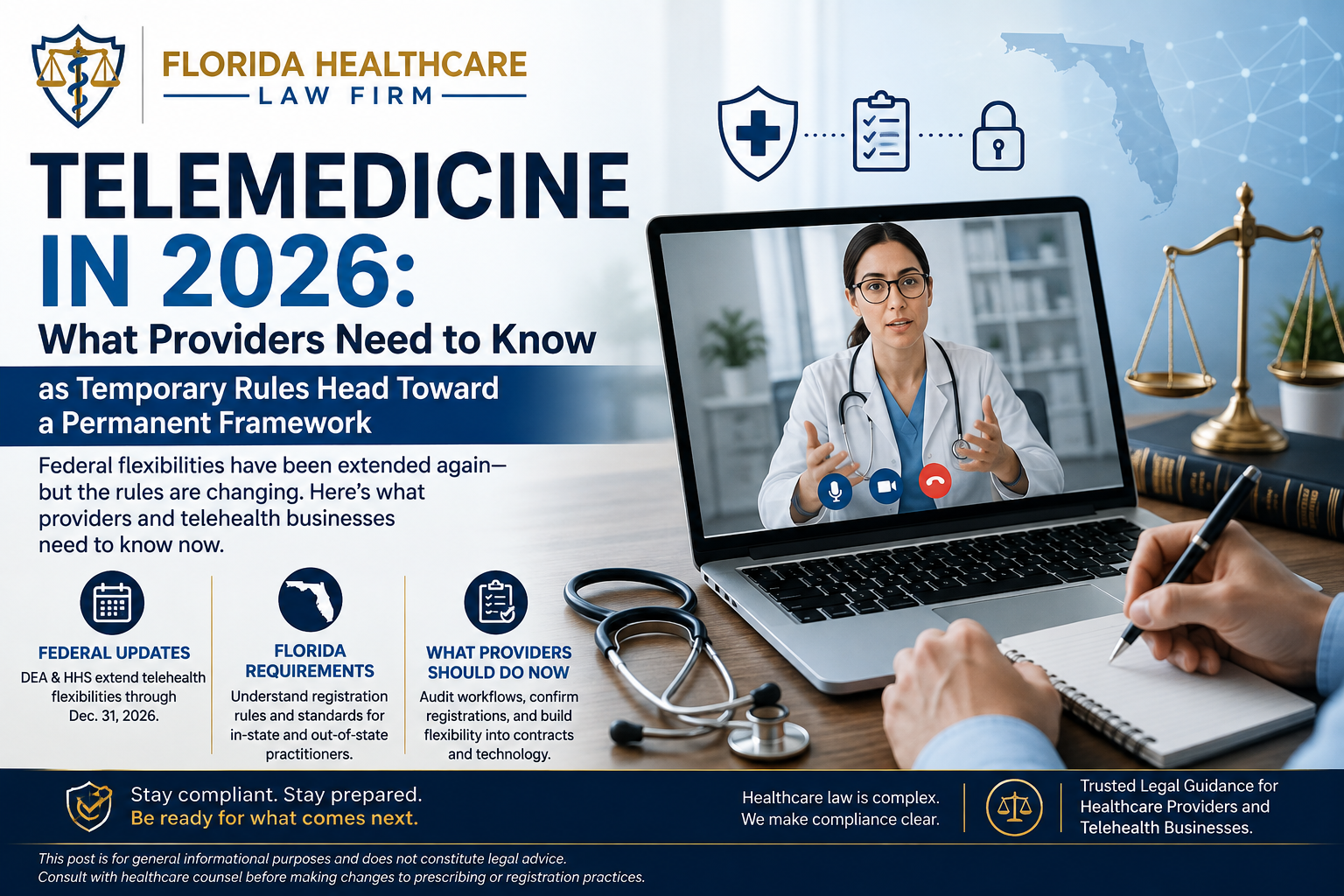
In nearly two decades advising physicians, telehealth companies, and digital health investors on regulatory compliance, one pattern has held steady: the practices that treat "temporary" federal flexibilities as permanent are the ones that get caught flat-footed when the rules finally change. That pattern is worth remembering in 2026, as telehealth regulation continues to operate on borrowed time at the federal level while Florida's own statutory framework keeps demanding careful, ongoing attention.
The Federal Picture: Another Extension, Not a Resolution
In January 2026, the DEA and HHS issued their fourth temporary extension of the COVID-era telemedicine flexibilities that allow practitioners to prescribe Schedule II–V controlled substances via telemedicine without first conducting an in-person evaluation. This latest extension runs through December 31, 2026, and also permits audio-only telehealth encounters for Schedule III–V narcotic medications used to treat opioid use disorder.
The agencies have been candid about why they keep extending rather than finalizing: they're still working through a large volume of public comment on a proposed permanent framework built around "special registrations" for telemedicine prescribers. That framework, first proposed in January 2025, would create structured pathways for telehealth practitioners to prescribe controlled substances and for online platforms to dispense them — but it would also come with new requirements around prescription drug monitoring checks, identity verification, credentialing, and recordkeeping.
The practical takeaway for providers: nothing has changed in day-to-day prescribing authority for now, but "for now" has an expiration date, and it keeps moving. Practices that have built controlled-substance telehealth prescribing into their care model should treat 2026 as a planning year — not a reason to relax. Waiting until the special registration rules are finalized to update policies, technology, and documentation practices could leave providers scrambling on short notice, the same way many did each time a prior extension deadline approached.
(Note for editors: the DEA/HHS extension referenced here runs through Dec. 31, 2026 — if this post runs after that date or after permanent rules are finalized, this section should be updated accordingly.)
The Florida Layer: Registration, Standards of Care, and Out-of-State Practitioners
Florida's own telehealth framework, codified in section 456.47 of the Florida Statutes, predates the federal pandemic flexibilities and remains the backbone of how telehealth is regulated in the state. A few points are worth reinforcing for providers and telehealth companies operating here:
- Florida-licensed practitioners do not need a separate telehealth registration to treat patients located in Florida — the existing license covers it, provided the practitioner meets the same standard of care that applies to in-person treatment.
- Out-of-state practitioners treating Florida patients must register with the Florida Department of Health (or the applicable board) as an out-of-state telehealth provider. That registration requires an active, unencumbered license substantially similar to one of the license types enumerated in the statute, a designated in-state registered agent for service of process, and proof of liability coverage or financial responsibility.
- Out-of-state registrants may not open a Florida office or provide in-person care to Florida patients — the registration is telehealth-only, and stepping outside those bounds can jeopardize the registration and expose the practitioner to unlicensed-practice risk.
- The Department of Health is also required to publish telehealth registrants' training and education history publicly, which makes accurate, complete applications more important than a routine licensing filing might otherwise warrant.
For multistate telehealth groups, this creates a patchwork problem: a compliance structure built for one state's registration and prescribing rules doesn't automatically travel. Florida's registration requirements, standard-of-care expectations, and (soon) whatever the DEA's permanent special registration framework requires will all need to be layered together — and reconciled with whatever additional states a platform operates in.
Three Things to Do Now
- Audit your controlled-substance telehealth prescribing workflows. If your practice relies on the current DEA flexibilities, document how patient identity is verified, how PDMP checks are handled, and how records are retained. These are exactly the areas the proposed special registration framework is expected to formalize — building the habits now reduces the lift later.
- Confirm registration status for every out-of-state practitioner treating Florida patients. This sounds basic, but growth-stage telehealth companies frequently onboard providers faster than their compliance teams can process registration paperwork. An unregistered out-of-state practitioner treating a Florida patient is an unlicensed-practice problem, not a paperwork technicality.
- Build flexibility into vendor and technology contracts. Whatever the DEA's final rule requires — audio-video versus audio-only distinctions, new technology standards, additional recordkeeping — your EHR, e-prescribing, and telehealth platform vendors will need to accommodate it. Contracts signed now should anticipate that a regulatory change is coming, not assume the status quo is permanent.
The Bottom Line
Telehealth regulation in 2026 is defined by borrowed time. The federal government has made clear it intends to replace the current stopgap extensions with a permanent framework, and Florida's own statutory structure continues to demand careful attention to registration and standard-of-care requirements regardless of what happens federally. Providers and telehealth businesses that use this year to tighten their compliance posture — rather than waiting for the next extension announcement — will be far better positioned when the rules finally settle.
Florida Healthcare Law Firm regularly advises physicians, telehealth platforms, and digital health companies on prescribing compliance, out-of-state registration, and telehealth business structuring. If your practice or platform needs a compliance checkup ahead of the next regulatory shift, reach out to our telehealth team for a consultation.
This post is for general informational purposes and does not constitute legal advice. Telehealth and controlled-substance prescribing regulations are changing rapidly at both the state and federal level; providers should consult with healthcare counsel before making changes to prescribing or registration practices.

 English
 Arabic
 French
 Spanish
 Portuguese
 Deutsch
 Turkish
 Italiano
 Russian
 Romaian
 Portuguese (Brazil)
 Greek
Greek