


A Practical Guide to Aviation and Navigation Antennas (ILS, DME, ADS-B)
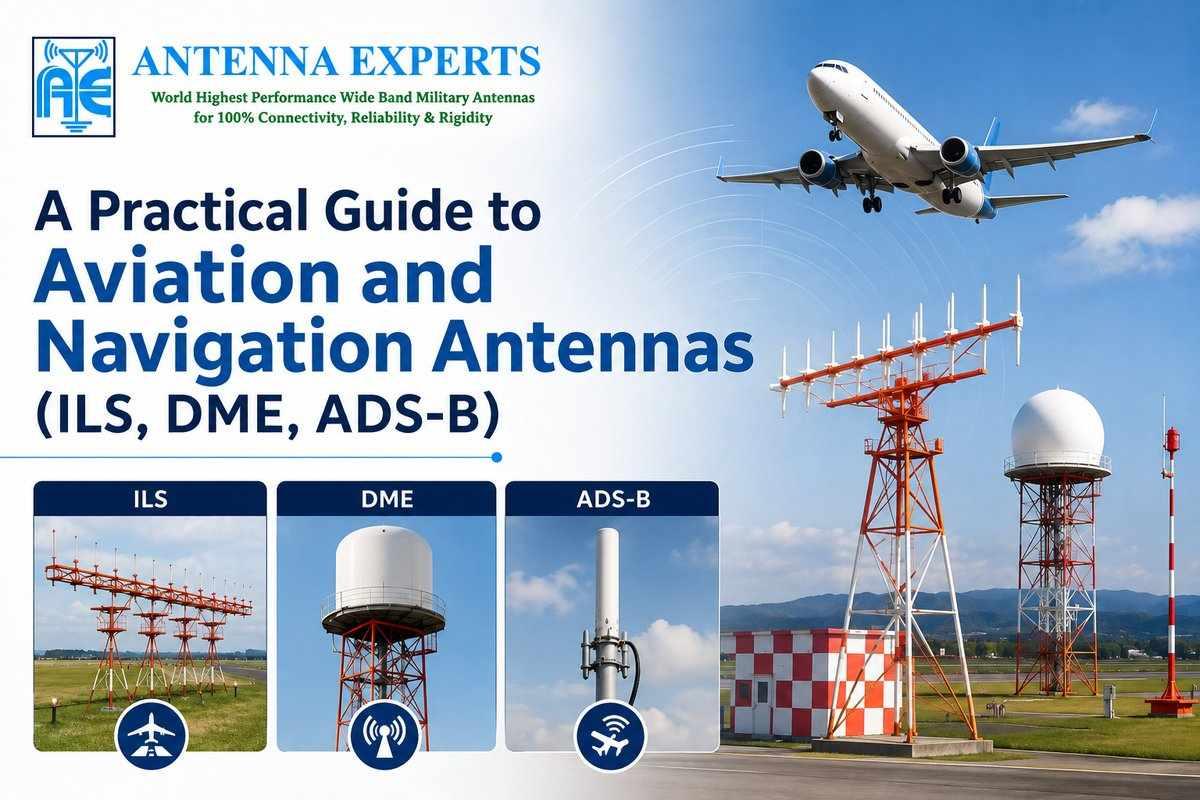
Every safe landing depends on a chain of signals working together without failure. Pilots rely on ground-based navigation systems to know exactly where the runway is, how far away it is, and how to line up correctly even in poor visibility. None of this works without properly designed antennas transmitting and receiving these signals reliably.
An ILS antenna sits right at the center of this system. It is used to work along with other key aviation antennas. That helps engineers and procurement teams make better decisions when building or upgrading airport infrastructure. This post is a dedicated practical guide to aviation and navigation antennas (ILS, DME, ADS-B).
How Ground-Based Navigation Aids Use ILS Antennas
Ground-based navigation aids depend entirely on antennas to send accurate positioning and guidance signals to aircraft. The antennas help the plane in landing, tracking, and identifying so that air traffic control can use them to seamlessly perform their job. Getting the antenna design wrong can reduce the performance and even bring some other risks. In aviation, the antenna directly affects safety, That is why these systems go through such strict testing and certification before deployment.
These antennas support safe and reliable aircraft navigation and communication. ILS antennas help aircraft align with the runway during landing. DME antennas are very helpful in measuring the aircraft’s distance from ground stations. On the other hand, ADS B antennas transmit and receive aircraft location and identification data. That helps air traffic controllers monitor aircraft accurately.
Coverage And Pattern Requirements At Airports
Airport antennas need very specific coverage patterns to work correctly. It can vary by application. Typical systems may cover 360 degrees for omnidirectional antennas or focused sectors of about 30-120 degrees for directional antennas. A signal that is too narrow might miss aircraft approaching from certain angles. ILS antennas are designed perfectly for this application. They provide signals from all directions. And they ensure the pilot can check the status of the aircraft from everywhere.
A pattern that is too wide can cause interference with other systems nearby. Engineers designing airport navigation infrastructure have to balance coverage range, signal strength, and pattern shape carefully. Even small deviations can affect how reliably aircraft receive guidance signals during approach. Connecting with a trusted antenna manufacturer can help you to build and design antennas that are specific to your application. They save your time and energy and let you get high performance and accurate wireless solutions.
Instrument Landing System: Localizer And Glide Slope
The Instrument Landing System or ILS helps pilots align with the runway both horizontally and vertically. When the condition is harsh and there is low visibility that is the time when the antennas help the most. This system relies on two main components working together.
The localizer antenna handles horizontal guidance. It keeps the aircraft aligned with the center of the runway. The glide slope antenna manages vertical guidance. It tells the pilot whether they are too high, too low or correctly positioned for a safe descent angle. Together these two systems form the backbone of instrument landing procedures.
Without a properly functioning ILS antenna setup, pilots would lose one of their most reliable tools for landing safely. Lack of these antennas can make the safe landing a hard nut to crack when the visibility is low due to fog, rain, or darkness. ILS performance depends on accurately installed and maintained antennas. Small alignments or single issues can affect landing guidance. The system is particularly valuable at airports where aircraft frequently operate in changing weather conditions. That is why regular inspection, testing, and maintenance of ILS antennas are required for better results. It ensures stable guidance signals and supports safer approaches for arriving aircraft.
DME, ADS-B And ATC Antennas Explained
Beyond landing guidance several other antenna systems keep aviation running smoothly on a day to day basis.
-
DME (Distance Measuring Equipment): A high gain DME antenna helps aircraft determine their exact distance from a ground station. It supports navigation throughout the flight not just during landing
-
ADS-B (Automatic Dependent Surveillance-Broadcast): A high gain ADS-B antenna allows aircraft to broadcast their position speed and altitude. Air traffic control and other aircraft use for tracking and collision avoidance
-
ATC (Air Traffic Control): A high gain ATC antenna supports voice and data communication between controllers and pilots. That ensures instructions are received clearly even at longer ranges
These systems work continuously throughout a flight. It is not like just during takeoff or landing. That is why reliability and consistent performance matter so much for this category of airport navigation antenna infrastructure.
Safety-Critical Antennas: IFF, ELT And FTS
Some aviation antennas exist purely for safety and identification rather than everyday navigation.
An IFF antenna stands for Identify Friend or Foe and is used primarily in military and controlled airspace settings to confirm whether an aircraft is friendly before any action is taken. Performance here is critical since a delayed or inaccurate identification can lead to serious consequences in sensitive airspace.
An ELT antenna supports Emergency Locator Transmitters which activate automatically during a crash or emergency to broadcast a location signal for search and rescue teams. This antenna often needs to survive impact conditions that would destroy standard equipment which makes its build quality especially important.
An FTS antenna relates to Flight Termination Systems typically used in test and range operations to safely end a flight if something goes wrong. Given the safety implications tied to all three of these systems, reliability testing standards are far stricter than for general communication antennas.
Why Choose Antenna Experts
Antenna Experts is a trusted antenna manufacturer and supplier in India. We bring deep experience designing and manufacturing antennas for aviation defence and navigation applications including ILS, DME, ADS-B and safety critical systems like IFF and ELT. Every product is built to meet strict environmental and reliability standards. And it is required for aviation infrastructure to ensure consistent performance under demanding conditions.
Our engineering team works closely with airport operators and defence teams. And it helps to make sure new installations integrate smoothly with existing navigation systems without causing interference. From coverage pattern design to long term support, Antenna Experts help aviation infrastructure teams source antennas they can depend on when safety is on the line.
Frequently Asked Questions
-
What antennas are used in an ILS system?
An ILS system uses a localizer antenna for horizontal guidance and a glide slope antenna for vertical guidance working together to help pilots align safely with the runway during approach.
-
What is the difference between DME and ADS-B antennas?
A DME antenna measures an aircraft's distance from a ground station, while an ADS-B antenna transmits the aircraft's position, speed and altitude information to air traffic control and other aircraft.
-
Why is IFF antenna performance critical?
IFF antennas confirm whether an aircraft is friendly in controlled or sensitive airspace and any delay or inaccuracy in this identification can lead to serious safety consequences.

 English
 French
 Spanish
 Portuguese
 Deutsch
 Turkish
 Dutch
Dutch
 Italiano
 Russian
 Romaian
 Portuguese (Brazil)
 Greek
Greek