


Why Solar Panel Coatings Are Becoming Essential to Protect PV Performance
The Economics of Keeping Solar Panels Productive
A solar panel can generate electricity for years, but its financial performance depends on more than the photovoltaic cells inside it. The surface must continue transmitting light, resisting contamination and surviving outdoor exposure. That operational reality is creating a new role for Solar Panel Coating Technologies.
The market stood at USD 5.13 billion in 2024 and reached USD 6.5 billion in 2025. By 2035, it is projected to reach USD 69.3 billion, growing at a CAGR of 26.7% from 2025 to 2035. The central commercial issue is not simply coating demand; it is the growing effort to protect the economic output of increasingly valuable solar assets.
For solar developers, every maintenance decision involves a trade-off. Cleaning improves surface conditions but requires labor, water, equipment and sometimes downtime. Leaving panels contaminated avoids those costs but can reduce performance. Coatings are entering this equation as a way to change the balance.
What Creates the Demand for Better Panel Surfaces
Solar deployment is expanding across environments that are far from uniform. Panels can be installed in dry regions with heavy dust, coastal locations with moisture and salt exposure, agricultural areas with airborne particles, or dense urban settings where pollution can accumulate.
The result is a shift in how module performance is viewed. A solar panel is no longer simply an electrical product; it is an outdoor asset whose operating environment directly affects output.
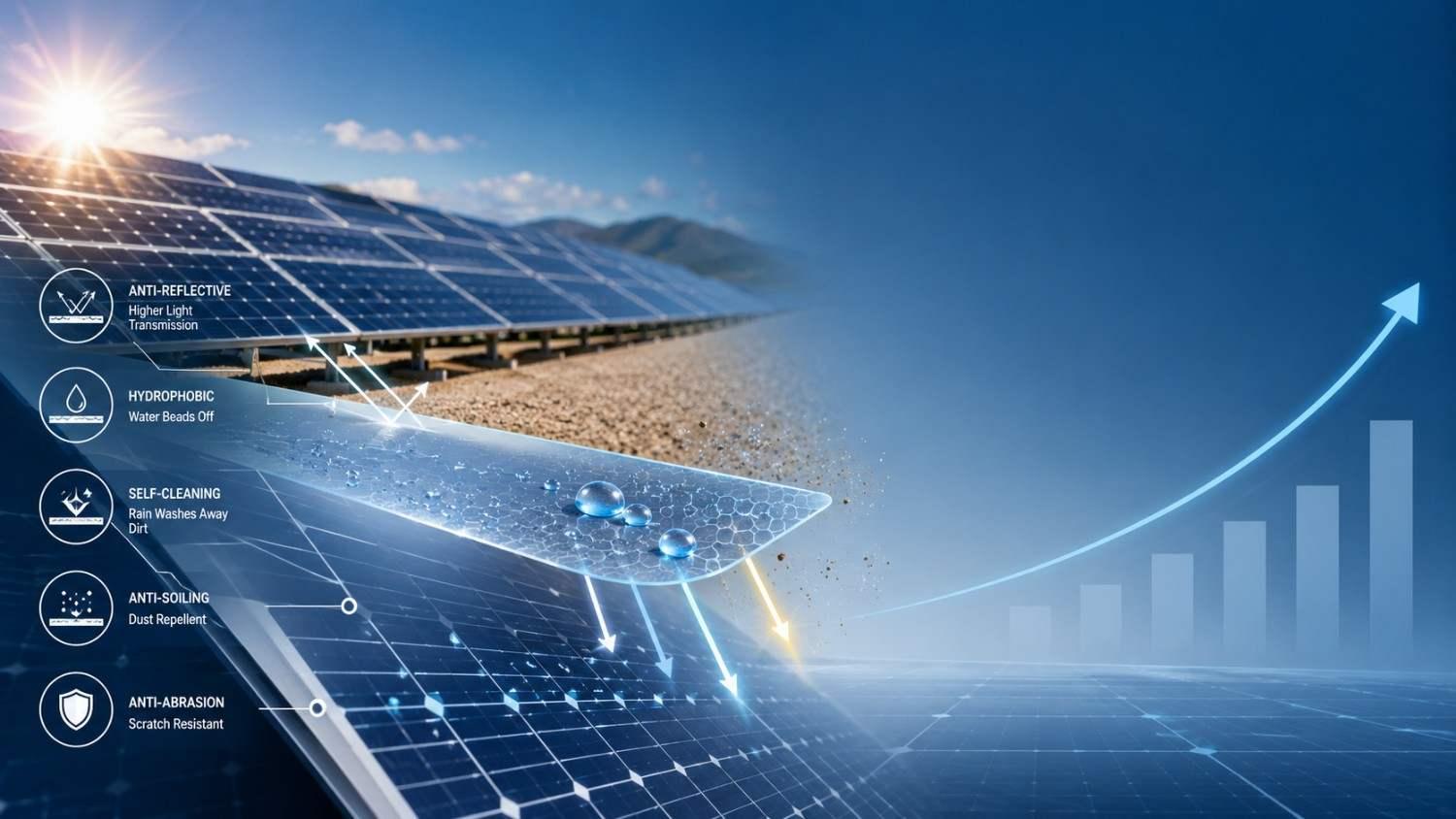
Anti-soiling coatings are relevant because contamination can reduce the amount of light reaching the active photovoltaic surface. Self-cleaning formulations attempt to reduce the attachment or persistence of contaminants. Hydrophobic coatings approach the problem through water-surface interaction, while anti-reflective treatments address the optical side of the equation.
These functions can become particularly valuable for installations where cleaning is difficult. Large solar farms may contain vast numbers of modules, while rooftop installations can be physically challenging to access. In both cases, reducing the frequency or intensity of maintenance can have economic value.
The Application Mix Is Becoming More Sophisticated
The residential market illustrates how coating demand can be connected to convenience. Homeowners generally want solar systems that require limited intervention. A coating that helps panels remain cleaner for longer can therefore become part of a broader low-maintenance proposition.
Commercial and industrial installations have a different economic rationale. Businesses installing solar on factories, warehouses and commercial buildings are often concerned with predictable energy production and operating costs. Reduced contamination and better surface durability can contribute to that objective.
Energy applications, particularly large-scale solar projects, create another dimension. At utility scale, a seemingly modest improvement in panel performance can become meaningful when multiplied across an enormous installed base. This is one reason coating performance needs to be measured at the system level rather than only in laboratory conditions.
Agriculture also offers a relevant application environment. Dust and organic material can be persistent problems around agricultural operations, making surface-management technologies potentially valuable.
Automotive applications could eventually create a more specialized opportunity as solar-integrated vehicles place additional demands on transparent, durable surfaces.
Why Coating Economics Matter as Much as Chemistry
A technically impressive coating will not automatically become commercially successful. Solar manufacturers operate within a cost-sensitive industry, and every additional material or manufacturing step must justify itself.
That means the economic value of a coating should be evaluated through its lifecycle contribution. If a coating costs more but reduces cleaning frequency, preserves optical performance or protects the panel surface for longer, the additional cost may be justified.
The challenge is demonstrating those benefits consistently.
Solar projects have long operating horizons, while coating degradation can depend on climate, module design and maintenance practices. A technology that performs strongly during initial deployment but loses its properties after prolonged ultraviolet exposure may provide limited long-term value.
Manufacturing integration is another issue. Coatings must be compatible with module production processes and capable of being applied consistently across large surface areas. A solution that requires complex handling may struggle against simpler alternatives even if its laboratory performance is stronger.
Sustainability Is Becoming a Technical Question
The sustainability discussion around coatings needs to go beyond calling a formulation environmentally friendly.
The more useful question is what the coating changes across the lifecycle of the solar module. If it reduces cleaning requirements, for example, it could lower water consumption and maintenance activity. If it extends surface durability, it could potentially support longer equipment life.
At the same time, coating formulations have their own environmental footprint. Raw materials, manufacturing processes, application methods and end-of-life considerations all matter.
This creates a competitive opening for suppliers capable of improving performance without introducing unnecessary environmental burdens. Sustainable chemistry may increasingly become a product-development criterion rather than simply a marketing message.
Regional Markets Will Solve Different Problems
The regional opportunity is closely connected to both solar deployment and operating conditions.
Asia-Pacific is particularly important because it combines major photovoltaic manufacturing activity with expanding solar installations. Coating suppliers operating close to module manufacturing ecosystems can benefit from opportunities to integrate formulations into production rather than treating coatings as an aftermarket product.
North America offers opportunities associated with large-scale solar development and distributed installations. Here, lifecycle performance can become a significant consideration as asset owners seek predictable generation over extended operating periods.
Europe presents a different combination of drivers. Renewable-energy deployment, efficiency objectives and sustainability considerations create demand for technologies that can improve solar performance while aligning with broader environmental priorities.
In other regions, climate may be the dominant factor. High dust loads, extreme heat or water constraints can increase the value of anti-soiling and self-cleaning technologies.
Competition Is About More Than Selling a Coating
Saint-Gobain, 3M, Dow, BASF, Henkel and Solvay are among the companies associated with the competitive landscape. Their capabilities span materials science, industrial chemistry, formulation and large-scale manufacturing.
The strategic question for suppliers is how specifically they can serve photovoltaic applications. General-purpose coating expertise is useful, but solar manufacturers require solutions that preserve transparency, adhere reliably to module surfaces and maintain performance under prolonged outdoor exposure.
This creates room for specialization. Suppliers may compete by developing coatings optimized for particular climates, panel technologies or maintenance strategies.
Partnerships between materials suppliers and photovoltaic manufacturers could also become important because coating performance depends partly on how the material interacts with the complete module architecture.
Where the Strongest Opportunities Could Develop
Government incentives and renewable-energy policies remain important because they influence the pace at which new solar capacity is installed. Every additional panel expands the potential market for surface-performance technologies.
Yet the largest opportunity may come from improving existing installations rather than relying only on new panel production. As the global solar fleet expands, operators will increasingly look for ways to maintain performance throughout the asset lifecycle.
Smart monitoring can reinforce this trend. If operators can measure surface contamination, weather conditions and changes in output, coating performance can be evaluated against real operating data. This could help turn coatings from a relatively passive material into part of a broader asset-performance strategy.
Another opportunity is multifunctionality. A single treatment capable of combining anti-reflective, hydrophobic, anti-soiling and protective characteristics could simplify the value proposition, provided those functions do not compromise one another.
Risks That Could Slow Adoption
The biggest risk is a gap between laboratory claims and field performance. Solar panels operate under variable conditions, so long-term testing is essential.
Another challenge is commoditization. If coatings become easy to formulate and manufacture, pricing pressure could reduce supplier margins. Differentiation would then depend increasingly on durability, application expertise and documented lifecycle benefits.
Compatibility with future photovoltaic technologies is also uncertain. As module designs change, coating requirements may change with them. Suppliers need enough flexibility to adapt formulations without making existing production systems obsolete.
Finally, solar developers may prioritize improvements inside the module over surface treatments if they perceive greater returns elsewhere. Coatings therefore need to demonstrate that they complement rather than compete with other efficiency investments.
The Next Decade Will Be About Lifecycle Performance
The market's projected increase to USD 69.3 billion by 2035 suggests that panel coatings are moving into a much larger industrial opportunity. But the long-term winners will likely be determined less by market size than by measurable performance.
The most valuable coating technologies will help solar operators answer practical questions: How often does a panel need cleaning? How much output is preserved? How long does the coating remain effective? Can it be applied economically at scale? What happens to the material at the end of the module's life?
Those questions shift the industry away from coating as an accessory and toward coating as an element of solar asset management.
The Market Outlook Is Tied to Solar's Next Efficiency Frontier
The solar industry's next gains will not come exclusively from photovoltaic cell improvements. As installed capacity expands, incremental performance losses caused by surface contamination, reflection and environmental wear become more commercially visible.
That gives coating suppliers a distinctive role. Their opportunity is to solve an operational problem that sits between materials science and energy economics.
If manufacturers can combine optical performance, durability, contamination resistance and sustainable chemistry at an acceptable cost, solar panel coatings could become a standard part of module performance engineering rather than an optional enhancement.

 English
 Arabic
 French
 Spanish
 Portuguese
 Deutsch
 Turkish
 Dutch
Dutch
 Italiano
 Russian
 Portuguese (Brazil)
 Greek
Greek