


Crumb Rubber Market Forecast to 2035: Devulcanization and Recycled-Rubber Demand Reshape the Industry
The Economics Behind the Next Phase of Tire Recycling
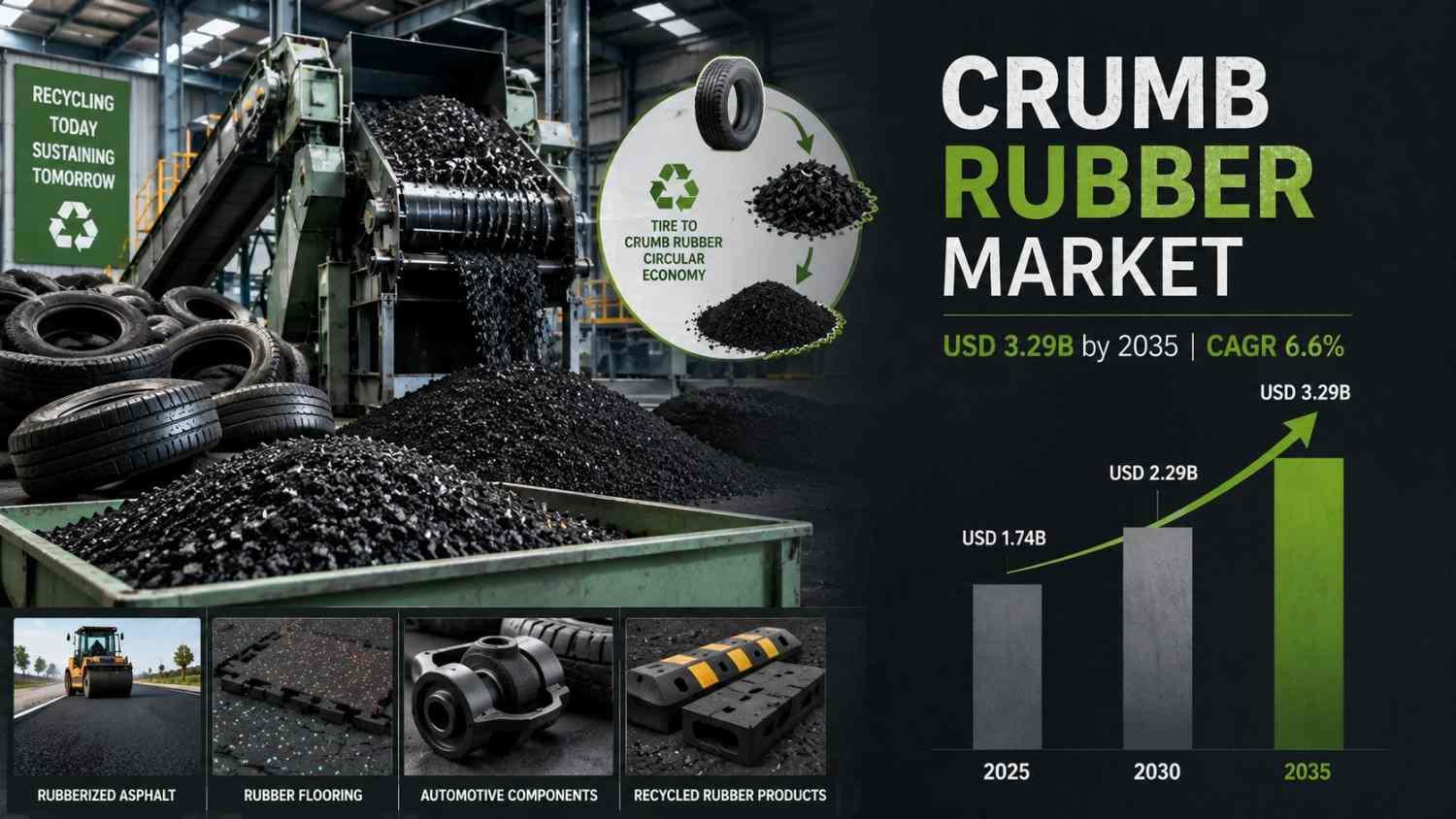
The economics of discarded tires are changing as manufacturers, infrastructure developers and recycling companies look for ways to turn a difficult waste stream into a usable industrial material. That shift is reshaping the Crumb Rubber Market Analysis, which is projected to expand from USD 1.74 billion in 2025 to USD 3.29 billion by 2035 at a CAGR of 6.6%. The forecast period of 2026–2035 captures a market being influenced by three connected forces: stronger producer responsibility, pressure on virgin-rubber costs and advances that can improve the performance of recycled rubber.
The important issue for businesses is not simply whether more tires will be recycled. It is whether recovered rubber can become predictable enough, affordable enough and versatile enough to compete for a broader range of industrial applications.
What Is Creating New Demand
The first demand mechanism begins with the tire itself. Every vehicle eventually produces an end-of-life tire, and increasing attention to waste management is making disposal less attractive. EPR mandates are pushing responsibility further into the product value chain, encouraging systems that connect tire collection with recycling and reuse.
That policy pressure changes the economics for recyclers. A tire that once represented a disposal liability can become feedstock with measurable value if it reaches a processor capable of recovering rubber efficiently.
A second driver is the cost relationship between recycled and virgin materials. Recycled rubber will not automatically replace virgin rubber, particularly in applications with demanding performance specifications. But when buyers need to manage material costs while meeting sustainability objectives, crumb rubber can become an attractive component.
A third driver is infrastructure. Road construction, flooring and molded products create applications capable of consuming recovered rubber at meaningful volumes. This is especially relevant because a recycling industry needs dependable outlets for material to remain financially viable.
Applications Are Expanding Beyond Basic Tire Recovery
The market's application mix reveals why crumb rubber has become more than a waste-processing niche.
Automotive and aircraft tire-related applications remain important, but their relationship with recycled rubber is nuanced. Material recovery can support the broader tire value chain while also supplying rubber for applications where recovered content is technically suitable.
Construction presents a different opportunity. Rubberized asphalt can create a direct connection between tire recycling and infrastructure development. Instead of treating used tires as an isolated waste issue, road programs can create a downstream market for processed rubber.
Flooring is another promising outlet. Recycled rubber can provide cushioning and wear resistance in selected commercial, industrial and recreational environments. Acoustic flooring and green-building applications can strengthen this opportunity when buyers place value on recycled content.
Molded goods and industrial products add further diversity. The ability to tailor particle size and material characteristics allows processors to serve different formulations rather than relying on a single commodity-grade product.
The Technology Battle Is About Quality, Not Just Capacity
Recycling capacity alone does not guarantee market expansion. The bigger technological challenge is producing material with consistent characteristics.
Mechanical processing remains an established route because it can convert tires into usable rubber particles while separating steel and fiber. The resulting crumb can be specified according to particle size and application.
Devulcanization introduces a more ambitious proposition. By modifying the cross-linked structure of vulcanized rubber, processors seek to create recovered material that can be integrated more effectively into new rubber formulations.
The opportunity is substantial, but the process must balance performance with cost. Energy requirements, treatment precision, throughput and consistency all affect commercial viability.
This means technology providers and recyclers are likely to compete on process economics as much as on nominal output capacity. A system that produces superior material but requires excessive energy or complex treatment may struggle against a simpler process with better operating economics.
The Supply Chain Determines Whether the Model Works
A tire-recycling business begins with collection, not processing equipment.
End-of-life tires are bulky and expensive to transport before shredding. That makes regional collection networks and plant location important factors in profitability. Facilities close to large vehicle populations or established waste-management networks can potentially reduce inbound logistics costs.
Sorting also matters. Tire composition varies according to application and manufacturer, while contaminants and reinforcing materials can affect recovered output. Efficient separation of steel and fiber is therefore part of the quality equation.
Downstream contracts are equally important. Recyclers need customers willing to purchase material consistently, while manufacturers need confidence that recycled rubber will meet formulation requirements.
This creates a classic industrial scaling problem: supply must become reliable before large buyers commit, but strong buyer commitments are often needed before recycling infrastructure receives sufficient investment.
Sustainability Is Becoming an Economic Variable
Sustainability is influencing the market, but its commercial effect is more complex than simply labeling crumb rubber as an environmentally preferable material.
The environmental benefit depends on the complete processing chain. Collection, transportation, shredding and further treatment consume energy. The value of recycling therefore increases when recovered material replaces higher-impact alternatives or avoids disposal pathways.
EPR mandates can help internalize some of these costs by making producers and supply-chain participants responsible for end-of-life management. Green-building certification can provide another demand mechanism where recycled content contributes to project objectives.
The strongest business models are likely to connect environmental benefits with measurable material performance and competitive pricing. Sustainability creates demand, but technical reliability keeps that demand commercially durable.
Regional Growth Will Follow Infrastructure and Waste Systems
North America benefits from a substantial automotive base and established recycling activity, supporting the development of collection and processing networks. Europe has additional momentum from circular-economy policies and producer-responsibility systems, which can make tire recovery an integral part of industrial waste management.
Asia-Pacific presents a potentially important long-term opportunity because large vehicle populations and construction activity can generate both feedstock and end-use demand. However, market development depends on the organization of collection networks and investment in processing infrastructure.
In emerging markets, the availability of tires alone is not enough. Formalized recovery channels, stable regulation and downstream applications must develop together.
Competitive Dynamics Are Moving Toward Specialization
Companies such as Liberty Tire Recycling LLC, Genan Holding A/S, Lehigh Technologies, GRP Ltd., J. Allcock & Sons Ltd. and Emanuel Tire LLC operate in an environment where specialization can matter as much as scale.
A recycler with strong collection infrastructure may have an advantage in feedstock security. Another company may differentiate through processing technology or specialized material grades. Others can compete by developing relationships with construction, automotive, flooring or industrial customers.
This suggests that the industry is unlikely to be defined by a single business model. Integrated recycling operations, specialized material processors and application-focused suppliers can all occupy different positions in the value chain.
Emerging Opportunities Are Moving Up the Value Chain
The clearest opportunity is to convert more recovered rubber into higher-value materials.
Devulcanization is central to this possibility because improved recovered-rubber performance could increase the range of applications available to recyclers. Specialty grades for industrial and molded products could provide better margins than undifferentiated commodity material.
Rubberized asphalt offers a different kind of opportunity: scale. Road projects can potentially absorb significant quantities of processed tire rubber, giving recyclers a route toward large-volume demand.
Green construction is another area to watch. Flooring and acoustic products containing recycled rubber can combine functional performance with circular-material objectives.
Emerging markets could eventually add another layer of growth as vehicle ownership, road construction and formal waste-management systems expand together.
Risks That Could Slow Adoption
The market still faces several structural barriers.
One is inconsistent material quality. Manufacturers cannot broadly substitute recovered rubber if its properties vary significantly from batch to batch.
Another is collection economics. Where tires are dispersed across large geographic areas, transportation and sorting costs can reduce recycling margins.
Technology risk also remains relevant. Devulcanization must achieve commercial scale without making recovered rubber prohibitively expensive.
Finally, downstream acceptance matters. Some applications have strict material specifications, meaning recycled content can expand only where technical performance and regulatory requirements align.
What the Next Decade Could Look Like
The next decade is likely to shift the competitive discussion from recycling volume toward material value. A larger supply of tires will support the market, but supply alone will not determine success.
The more important development will be the emergence of integrated systems in which EPR programs secure feedstock, recycling facilities produce consistent grades, technology improves material performance and construction or manufacturing industries create dependable demand.
If those pieces connect effectively, crumb rubber can move from being primarily a waste-derived commodity toward becoming a strategic circular material. That transition would give the market significance well beyond the recycling sector.
Another Trending Topics
Industrial Ovens Market
Industrial Residential Heating Market
Industrial Solvent Separation Membranes Market

 English
 French
 Spanish
 Portuguese
 Deutsch
 Turkish
 Dutch
Dutch
 Italiano
 Russian
 Romaian
 Portuguese (Brazil)
 Greek
Greek