


Magnet Wire Market Forecast to 2035: Electric Motors Become a Major Growth Engine
The Hidden Material Behind the Electrification Economy
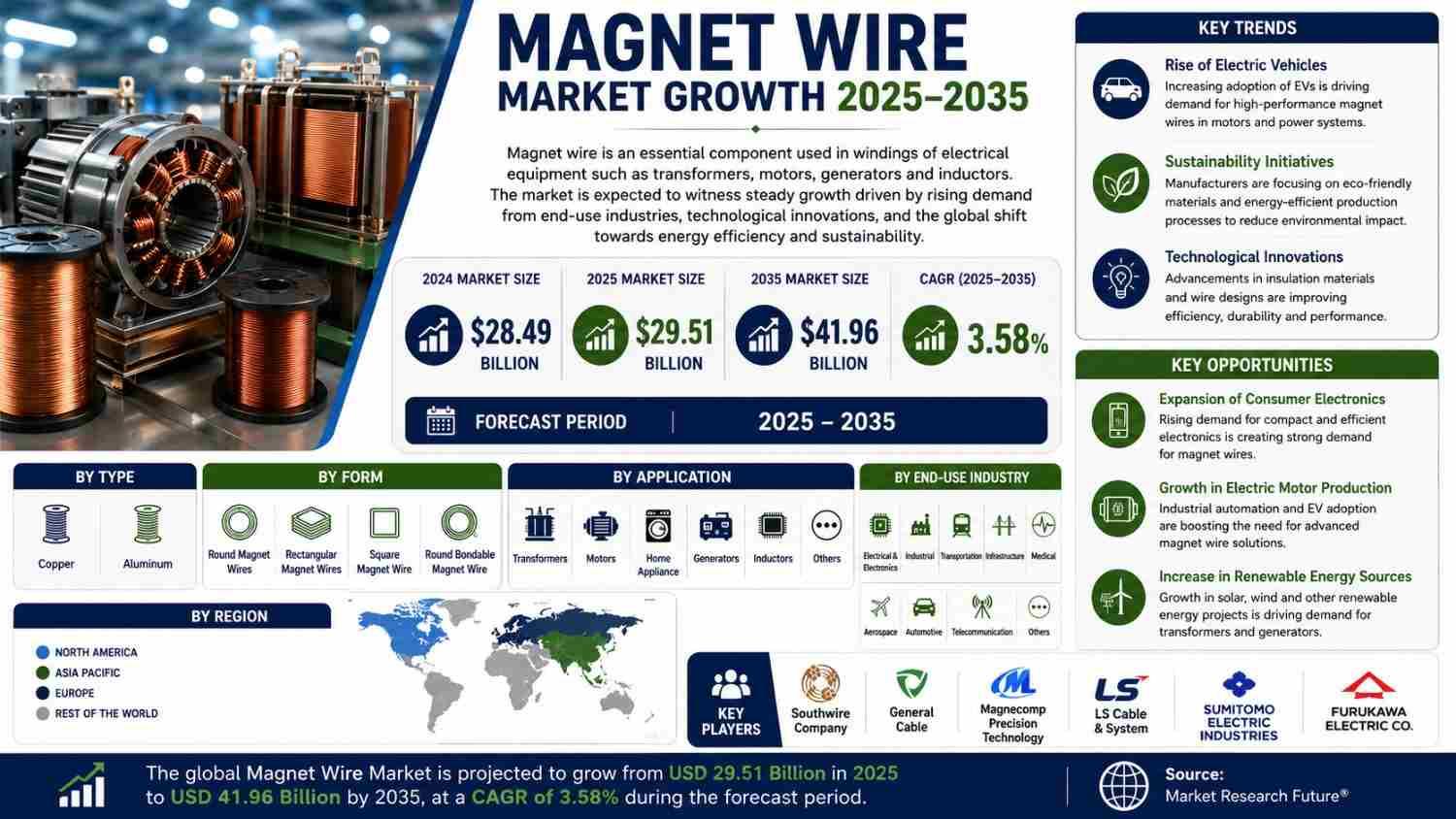
When an electric motor becomes smaller, a transformer becomes more efficient or an appliance consumes less electricity, the engineering changes often extend down to the materials used inside its electromagnetic components. The Magnet Wire Industry was worth USD 28.49 billion in 2024 and reached USD 29.51 billion in 2025. It is forecast to reach USD 41.96 billion by 2035 at a CAGR of 3.58% between 2025 and 2035. Behind these numbers is a structural shift: transportation, industry, appliances and energy infrastructure are relying on increasingly sophisticated electric machines.
Demand Is Being Rewritten by Efficiency Requirements
The traditional argument for magnet wire has been straightforward: electrical machines need conductors.
The newer argument is more demanding. Electrical machines increasingly need to deliver more output from less space while managing heat and minimizing energy losses. This changes what buyers expect from winding materials.
The conductor has to fit the winding architecture, withstand operating temperatures and remain reliably insulated. In some applications, the wire must also tolerate demanding manufacturing processes and long operating cycles.
That shift benefits suppliers that can provide consistency and application-specific solutions. It also makes magnet wire an important part of the broader push toward energy efficiency.
Electric Motors Connect Several Major Industries
The motor segment provides one of the clearest explanations for the market's development.
Automobiles, industrial machinery, household appliances, pumps, compressors, HVAC systems and countless other products depend on electric motors. Electrification is increasing the number of motor-driven applications while simultaneously raising performance expectations.
Electric vehicles are particularly important because propulsion motors must combine efficiency, compact dimensions and high power output. The winding system influences the overall motor architecture, making conductor geometry and insulation performance important design considerations.
Industrial motors create another layer of demand. Factories are increasingly dependent on automated machinery, variable-speed drives and electrically powered systems. Even where production itself is not electrified from end to end, individual machine systems increasingly depend on efficient motors.
This makes the magnet-wire market less dependent on one industry than it may initially appear.
Transformers and Generators Bring a Different Set of Requirements
Motors are only one part of the equation. Transformers, generators and inductors also depend on winding conductors.
Grid modernization and renewable-energy deployment increase the need for electrical equipment capable of moving and managing power efficiently. Wind generation, solar power systems, backup generation and industrial power networks all rely on electromagnetic equipment.
The rise of distributed energy systems is particularly relevant. Electricity is no longer produced exclusively in large centralized facilities. Solar farms, wind installations, storage systems and localized generation create additional points where power must be converted and managed.
That infrastructure indirectly expands the addressable market for magnet wire.
Why Wire Shape Matters More Than It Appears
The market's segmentation by form illustrates an important engineering trend.
Round wire remains widely used because of its established manufacturing processes and broad application base. But rectangular and square wire can provide advantages where manufacturers want to increase conductor packing efficiency.
In a compact motor, unused space inside a winding can affect the overall design. Changing conductor geometry can help engineers use available space more efficiently, although the choice also introduces manufacturing considerations.
Bondable round magnet wire provides another specialized option where winding integrity and component design require particular characteristics.
This creates a market where product differentiation can occur at the geometry and application level rather than simply through copper or aluminum volume.
Copper and Aluminum Reflect Different Design Choices
The copper-versus-aluminum decision illustrates the economic and engineering trade-offs facing manufacturers.
Copper provides excellent electrical conductivity and is familiar to electrical-equipment manufacturers worldwide. It is particularly attractive where compact design and electrical performance are priorities.
Aluminum has lower density and can provide weight advantages in suitable designs. It can become attractive where designers can balance conductivity, size, thermal performance and manufacturing considerations.
Neither material is universally superior. The appropriate choice depends on the electrical machine, operating conditions, available space, cost objectives and manufacturing process.
This reinforces the importance of technical collaboration between wire suppliers and equipment manufacturers.
The Sustainability Question Is Becoming More Complex
Electrification is frequently associated with sustainability, but the material supply chain still has environmental considerations.
Copper and aluminum require energy-intensive extraction and processing. Manufacturing magnet wire also involves conductor preparation, insulation coating and controlled production processes.
The sustainability question therefore extends beyond the energy savings delivered by the final electric machine. Manufacturers must consider material sourcing, production efficiency, scrap recovery and end-of-life recycling.
For wire producers, improving yield can have a meaningful impact because manufacturing waste represents both an economic and environmental cost. Recycling recovered conductor material can also become increasingly important as electrical equipment volumes rise.
The industry is therefore likely to see sustainability shift from a broad corporate objective toward measurable manufacturing practices.
The Supply Chain Matters as Much as the Finished Product
Magnet wire manufacturers operate within a chain influenced by copper and aluminum availability, energy costs, transportation and regional electrical-equipment production.
Commodity-price movements can affect the economics of wire production. Manufacturers must therefore manage procurement carefully while maintaining product consistency.
Geographic diversification can also become important. Electrical-equipment customers need reliable delivery because a shortage of a relatively small component can interrupt production of motors, transformers or generators.
This makes manufacturing footprint, quality control and supply reliability important competitive factors.
Asia-Pacific Has a Structural Advantage
Asia-Pacific's importance is closely connected to its manufacturing ecosystem. The region hosts extensive electrical-equipment, electronics, appliance and automotive production, creating a substantial downstream customer base.
The continued expansion of electric mobility strengthens this position. Motor manufacturing, battery-related infrastructure and electronics production all interact with the wider electrical-component supply chain.
North America presents a different opportunity profile, with demand linked to industrial equipment, transportation electrification, renewable-energy infrastructure and electrical-grid investment.
Europe combines advanced automotive manufacturing with energy-efficiency priorities and renewable-energy development. The region's emphasis on efficient products can encourage demand for technically advanced winding solutions.
These regional differences mean that manufacturers need more than a global production strategy; they need to understand the specific industrial ecosystem of each market.
Competitive Advantage Is Moving Toward Specialization
Southwire Company, General Cable, Magnecomp Precision Technology, LS Cable & System, Sumitomo Electric Industries and Furukawa Electric Co. represent major participants in a competitive environment shaped by product capability, manufacturing reliability and geographic reach.
The strategic question for suppliers is increasingly how to serve specialized electrical applications rather than simply how much wire can be produced.
Automotive customers may prioritize performance and compact winding solutions. Transformer manufacturers may emphasize reliability and insulation performance. Industrial customers may place greater weight on durability, supply consistency and cost.
A supplier capable of responding to these different requirements can compete through engineering depth as well as manufacturing scale.
Emerging Opportunities Are Tied to New Electrical Architectures
The next opportunity cycle is likely to come from the continued expansion of electric motors, renewable power and sophisticated electronics.
Electric vehicles are an obvious application, but the larger opportunity lies in the electrification of multiple sectors simultaneously. Industrial equipment, commercial transportation, appliances and infrastructure all require motors or electromagnetic components.
Renewable-energy expansion can create demand for generators and transformers, while consumer electronics can support smaller-scale applications.
The industry should also watch improvements in winding technology. Changes in conductor geometry, insulation systems and manufacturing processes can alter how much wire is required and what specifications buyers need.
What Could Limit Market Expansion?
The market is not immune to constraints.
High material prices can pressure manufacturers and customers. Supply disruptions can create production bottlenecks. Technology changes can also shift demand between product types.
There is another important issue: greater motor efficiency may reduce material intensity per unit. If a new motor design achieves the same output using less conductor, wire demand per machine may fall even as the total number of machines increases.
This creates a nuanced growth environment. Volume growth and material efficiency can move in opposite directions.
The Next Decade Will Be Defined by Electrical Efficiency
The magnet-wire market's future will be determined less by the visibility of the product and more by the scale of the systems that depend on it.
Electric vehicles, industrial automation, renewable generation, appliances and electrical infrastructure are all pushing manufacturers toward more efficient electromagnetic equipment. That creates sustained demand while also forcing wire suppliers to improve precision, material efficiency and application specialization.
The most important development to watch is not simply how many kilometers of wire are produced. It is how electrical-machine design changes the specifications, shapes and materials required by manufacturers.
That distinction will separate volume-driven demand from higher-value opportunities through 2035.

 English
 Arabic
 French
 Spanish
 Portuguese
 Deutsch
 Turkish
 Italiano
 Russian
 Romaian
 Portuguese (Brazil)
 Greek
Greek