


Stealth Coating Market Outlook 2035: Aerospace, Defense and Material Science Drive New Demand
Why Stealth Coatings Are Becoming a Platform-Level Engineering Priority
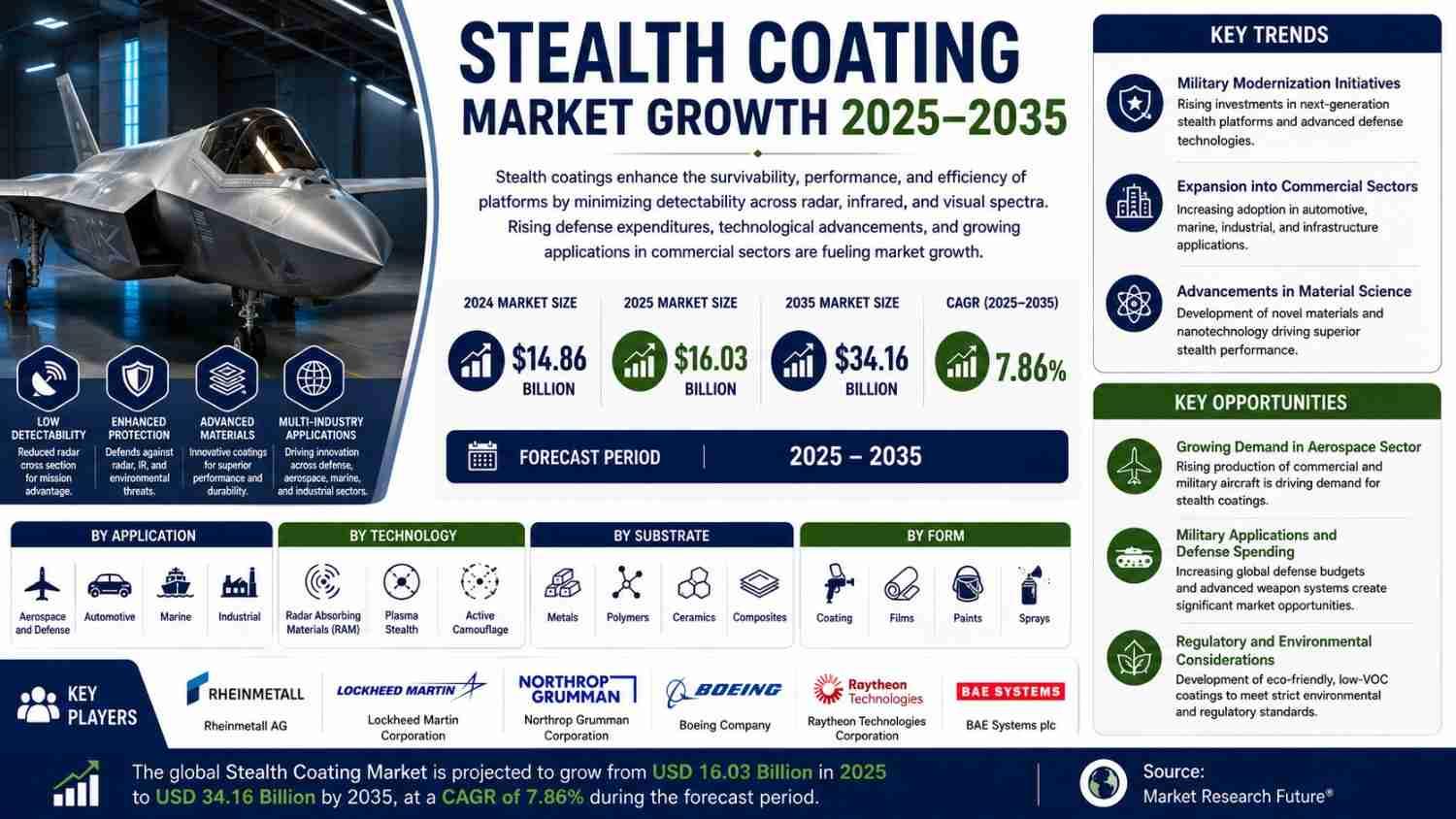
The value of a stealth coating is no longer limited to making a surface less conspicuous; it is increasingly tied to how an entire platform manages detection, durability and performance. The Stealth Coating Market was valued at USD 14.86 billion in 2024 and reached USD 16.03 billion in 2025. It is projected to reach USD 34.16 billion by 2035, expanding at a CAGR of 7.86% during 2025–2035. Military modernization, aerospace requirements, advances in material science and the gradual expansion of stealth-related technologies into commercial applications are shaping demand.
The more important development is that coatings are increasingly being considered alongside structural materials, electronics and platform design. That shift is making formulation, substrate compatibility and manufacturing consistency commercially important.
The Demand Story Starts With Modern Military Platforms
Defense modernization is providing the industry's strongest demand base.
New aircraft, naval platforms and other military assets require increasingly sophisticated approaches to signature management. At the same time, modernization programs create opportunities to upgrade existing platforms without replacing every component.
This gives stealth coating suppliers two routes to demand: new platform production and retrofit or maintenance requirements.
The technology also fits a broader defense objective. Reducing detectability can contribute to platform survivability, which makes advanced surface materials relevant to system-level engineering rather than simply cosmetic or protective treatment.
Radar Absorbing Materials Remain the Core Technology
Radar absorbing materials, or RAM, represent the largest technology segment in the supplied market structure. Their importance comes from their ability to interact with electromagnetic energy and reduce radar reflections from treated surfaces.
The engineering challenge is considerable.
A material must deliver the required electromagnetic behavior while remaining sufficiently durable, lightweight and compatible with the platform. Temperature variation, vibration, moisture and physical wear can all affect coating performance.
This is why material development increasingly involves combinations of polymers, advanced fillers, multilayer structures and other engineered components.
Active camouflage is also gaining attention as an emerging technology. Its development points toward a broader definition of stealth in which surfaces can potentially respond to changing environmental conditions rather than relying solely on passive absorption.
Lightweight Materials Are Changing Substrate Selection
Metals remain the dominant substrate, reflecting their extensive use across aerospace and defense structures. Polymers are emerging as a faster-growing category because their low weight and flexibility can support increasingly complex platform designs.
The distinction matters commercially.
A coating designed for a metal surface may require different preparation, adhesion characteristics and thermal considerations than one applied to a polymer or composite.
Composites add another dimension because they are already important to lightweight aerospace structures. As platform designers use more combinations of materials, coating developers must create systems that perform consistently across different surfaces.
This encourages customization rather than a one-formulation-fits-all model.
Aerospace Is Raising the Performance Bar
Aerospace and defense currently represent the dominant application area.
Aircraft place unusually demanding requirements on surface materials. Weight must be controlled, durability must be maintained and coatings must withstand environmental stress without compromising the underlying structure.
That makes aerospace a useful proving ground for advanced formulations.
The market opportunity is not simply related to the number of aircraft being produced. It is also connected to the increasing complexity of aircraft and the need to integrate multiple performance requirements into limited surface areas.
A successful coating therefore needs to solve several engineering problems simultaneously.
Automotive Could Broaden the Addressable Market
Automotive is identified as an emerging application with faster demand growth than the dominant aerospace and defense segment.
The commercial logic is different.
Automotive manufacturers operate under far greater cost pressure and much larger production volumes. A specialized coating therefore needs a clear functional or manufacturing benefit before it can achieve broad adoption.
The emergence of automotive applications nevertheless matters because it indicates that advanced electromagnetic and multifunctional coatings may eventually find uses outside military platforms.
The transition will depend on whether material developers can reduce complexity and integrate advanced coating processes into high-volume production.
Marine Applications Highlight the Importance of Durability
Marine platforms create another distinct requirement: prolonged exposure to moisture, salt and mechanical stress.
A coating used on a naval platform must therefore preserve its functional characteristics while resisting environmental degradation.
This makes maintenance a central economic consideration.
If a sophisticated coating requires frequent removal or reapplication, its initial technical advantage may be offset by lifecycle costs.
Developers therefore have an incentive to improve adhesion, environmental resistance and repairability alongside electromagnetic performance.
Product Form Can Determine Manufacturing Fit
The market covers coatings, films, paints and sprays.
These forms are not interchangeable from a manufacturing perspective.
Spray-based systems can be attractive where large or complex surfaces need to be treated efficiently. Films can offer controlled thickness and potentially consistent application. Conventional coating and paint formats can benefit from established industrial processes.
The fastest-growing form identified in the market is sprays, reflecting interest in convenient and adaptable application methods.
For customers, the practical question is not simply which formulation performs best in controlled testing. It is which product can be applied consistently at the required scale.
Material Science Is Creating the Next Competitive Frontier
Advances in nanotechnology, polymers and multilayer materials are influencing the industry's development.
The objective is increasingly to combine properties.
A future coating may need electromagnetic absorption, corrosion resistance, thermal stability and mechanical durability in one system.
This creates opportunities for suppliers with expertise across chemistry and materials engineering.
It also increases development complexity. Improving one characteristic can sometimes create trade-offs elsewhere, particularly around cost, weight, processing requirements or environmental compatibility.
The most commercially useful innovations will therefore be those that improve several performance dimensions without making manufacturing impractical.
Sustainability Is Becoming a Product-Development Issue
Stealth coatings are not automatically sustainable.
Their production can involve specialized chemical inputs, energy-intensive processing and waste generated during application or maintenance.
Environmental regulations can therefore influence formulation choices.
Manufacturers may need to develop systems that reduce hazardous inputs and emissions while preserving the functional characteristics required by aerospace and defense customers.
This creates a difficult balance. Environmental improvements cannot come at the expense of reliability on mission-critical platforms.
The sustainability opportunity is consequently tied to materials innovation rather than simply changing packaging or production claims.
Regional Demand Reflects Defense Capability
North America remains the largest regional market, supported by substantial defense activity, aerospace capabilities and military modernization. Europe also represents an important market, while Asia-Pacific is emerging as the fastest-growing region as defense and aerospace investment increases.
North America's advantage is reinforced by an established ecosystem connecting defense contractors, aerospace manufacturers and advanced-material suppliers.
Europe benefits from major aerospace and defense companies and collaborative defense initiatives.
Asia-Pacific has a different growth profile. Increasing investment in indigenous defense capabilities and aerospace technologies can create new demand for specialized materials.
The regional opportunity is therefore closely tied to industrial capability as well as defense spending.
Competition Is Built Around Technology and Platform Integration
The competitive field includes Rheinmetall AG, Lockheed Martin Corporation, Northrop Grumman Corporation, Boeing Company, Raytheon Technologies Corporation and BAE Systems plc.
These companies are relevant because stealth coatings are closely connected to larger defense and aerospace platforms.
Competition consequently extends beyond formulation.
Companies need materials expertise, platform knowledge, manufacturing capability and the ability to meet demanding qualification requirements.
The market is also moving toward collaboration, with advanced materials development increasingly requiring expertise from multiple parts of the technology chain.
The Biggest Opportunities Are Multifunctional Materials
The strongest long-term opportunity may come from coatings that solve several platform problems at once.
A material that combines signature management with durability or environmental resistance can offer greater value than a coating optimized for a single characteristic.
The aerospace sector provides the clearest opportunity, while military modernization creates a stable foundation.
Commercial applications offer additional upside if manufacturers can demonstrate economic value at higher production volumes.
What Could Restrict Market Expansion
The market faces technical and commercial barriers.
Advanced formulations can be expensive to develop, qualify and manufacture. Application consistency can be difficult across complex geometries. Long testing and procurement cycles can delay commercialization.
Environmental requirements may also force reformulation.
Another challenge is that performance cannot be evaluated solely at the point of application. Customers need confidence that the coating will retain its characteristics throughout the intended service life.
These factors favor suppliers with strong research, manufacturing and integration capabilities.
What to Watch Through 2035
The next decade will be shaped by continued military modernization, aerospace demand and materials innovation.
RAM is likely to remain central, while active camouflage and other advanced approaches could broaden the technology base.
Polymers and composites deserve attention because lightweight structures are becoming increasingly important.
Commercial adoption, particularly in automotive applications, will also indicate whether stealth-related materials can move from specialized defense systems into larger-volume industries.
Environmental requirements will be another important filter for future formulations.
Market Outlook
The projected increase from USD 16.03 billion in 2025 to USD 34.16 billion by 2035 reflects more than rising demand for a specialized coating category.
It signals a broader shift in how advanced surfaces are engineered.
Stealth coatings are increasingly being developed as functional components of sophisticated platforms, where electromagnetic behavior must coexist with durability, weight control, manufacturability and environmental requirements.
That makes the industry's future less about producing a better coating in isolation and more about creating materials that work reliably within complex systems.

 English
 Arabic
 French
 Spanish
 Portuguese
 Deutsch
 Turkish
 Dutch
Dutch
 Russian
 Romaian
 Portuguese (Brazil)
 Greek
Greek