


How to Read and Understand Cross Currency Rates
Currency exchange is an important part of the global economy. Businesses purchase products from overseas suppliers, travelers spend money in foreign countries, freelancers work with international clients, and investors follow markets around the world. All of these activities require some understanding of how currencies are valued against one another.
For beginners, currency rates can look confusing at first. Symbols, currency codes, numbers, and changing prices can make it difficult to understand what an exchange rate actually means. However, the basic idea is quite simple once you understand how currency pairs and cross currency rates work.
A free currency converter can also make the process easier by calculating the approximate value of one currency against another. By learning how to read currency rates and use conversion tools correctly, individuals and businesses can make better decisions when dealing with international transactions.
What Are Cross Currency Rates?
The Basic Meaning
A cross currency rate shows the exchange value between two different currencies. It tells you how much of one currency is needed to equal a certain amount of another currency.
For example, if you want to compare the euro with the British pound, the relevant exchange rate tells you the approximate value of one currency in terms of the other.
Cross currency rates are useful when the currencies involved are different from the user's domestic currency. They allow people and businesses to compare international prices and calculate foreign payments.
Why Cross Currency Rates Matter
Currency values are constantly changing. A business that needs to pay a supplier in another country may find that the payment costs more or less in its local currency depending on the current exchange rate.
Understanding cross currency rates helps businesses estimate costs, manage budgets, and make more informed international financial decisions.
Understanding Currency Codes
What Are Currency Codes?
Currencies are commonly represented using three-letter codes. These codes make it easier to identify currencies when looking at exchange rates or using financial platforms.
Some common examples include:
-
USD for US Dollar
-
EUR for Euro
-
GBP for British Pound
-
JPY for Japanese Yen
-
CAD for Canadian Dollar
-
AUD for Australian Dollar
-
CHF for Swiss Franc
-
PKR for Pakistani Rupee
Learning these codes is useful because many currency converters and financial websites use them instead of writing the full currency name.
Why Currency Codes Are Important
Using standardized codes reduces confusion. For example, a currency symbol such as "$" can represent several currencies. The code USD specifically identifies the US dollar.
When reading cross currency rates, checking the currency codes first helps you understand exactly which currencies are being compared.
How to Read a Currency Pair
Understanding the Base Currency
Currency pairs normally contain two currencies. The first currency is called the base currency.
For example, in USD/EUR, USD is the base currency and EUR is the quote currency.
The rate tells you how much of the quote currency is needed to equal one unit of the base currency.
If the rate is shown as 0.90, it means one US dollar is worth approximately 0.90 euros at that particular rate.
Understanding the Quote Currency
The second currency in a pair is the quote currency.
In USD/EUR, EUR is the quote currency. The exchange rate tells you the value of one unit of USD in EUR.
This basic structure is important because reversing the currency pair changes the calculation.
For example, USD/EUR and EUR/USD represent the same currencies but express the relationship in opposite directions.
How a Free Currency Converter Helps
Enter the Amount
A free currency converter allows users to enter the amount they want to convert.
For example, if you have $500 and want to know its approximate value in euros, you enter 500 as the amount.
Select the Source Currency
Next, select the currency you currently have. In this example, the source currency would be USD.
Select the Target Currency
Then choose the currency you want to convert into. If you want the euro value, select EUR.
The converter uses an exchange rate to calculate the estimated value.
Check the Result
The final result shows the approximate value of the original amount in the target currency.
This makes currency conversion much easier than performing the calculation manually.
Why Currency Rates Change
Interest Rates
Interest rates can have a significant influence on currency markets. Central banks may change interest rates depending on economic conditions.
Changes in interest rates can affect investor demand for a country's currency and may influence exchange rates.
Inflation
Inflation can also affect currency values. Changes in purchasing power and economic expectations can influence how investors view a currency.
Countries with changing inflation conditions may experience changes in currency demand.
Economic Data
Employment reports, economic growth figures, trade data, and other economic indicators can influence currency markets.
When important economic information is released, traders and investors may adjust their expectations, causing currency prices to move.
Political and Global Events
Political developments and global events can also influence exchange rates. Elections, trade policies, geopolitical tensions, and other major events can create uncertainty in financial markets.
This is why cross currency rates can change even when an individual business has not changed its own prices.
Understanding Bid and Ask Prices
What Is the Bid Price?
In financial markets, the bid price generally represents the price at which a market participant is willing to buy a currency.
What Is the Ask Price?
The ask price generally represents the price at which a market participant is willing to sell a currency.
The difference between these prices is known as the spread.
For basic currency conversion, users may not need to focus heavily on bid and ask prices. However, understanding the concept becomes more important when studying forex markets or making larger transactions.
Common Mistakes When Reading Currency Rates
Confusing the Currency Pair Direction
One of the most common mistakes beginners make is reading a currency pair in the wrong direction.
Remember that the first currency is the base currency and the second is the quote currency.
Always check the order before making a calculation.
Ignoring Rate Updates
Currency rates can change frequently. Using an old exchange rate can produce an inaccurate estimate.
When dealing with an important transaction, check for recently updated market information.
Forgetting Transaction Fees
A currency converter may show a market-based exchange rate, but the actual rate offered by a bank or payment service may be different.
Banks and payment providers can charge fees or add a margin to the exchange rate.
Therefore, users should consider the total cost rather than relying only on the displayed conversion rate.
Using Cross Currency Rates for International Business
Managing Supplier Payments
Businesses often need to pay suppliers in foreign currencies. Understanding the relevant exchange rate allows them to estimate the cost in their local currency.
For example, a company that receives an invoice in euros can convert the amount into its preferred currency before making the payment.
Comparing International Prices
Cross currency rates also make it easier to compare prices from different countries.
A business can convert multiple supplier quotes into one currency and then compare the costs.
This can support better purchasing decisions.
Planning Revenue
International companies may receive revenue in several currencies. Converting these amounts into a common currency can make financial reporting and planning easier.
Exchange rate changes should also be considered because they can affect the final value of international revenue.
Using Market Data to Understand Currency Movements
Look Beyond the Exchange Rate
A currency rate tells you the current relationship between two currencies, but it does not explain why the rate is moving.
Users who want to understand currency movements can also look at economic news, market charts, interest rate decisions, and other financial indicators.
Follow Global Financial Markets
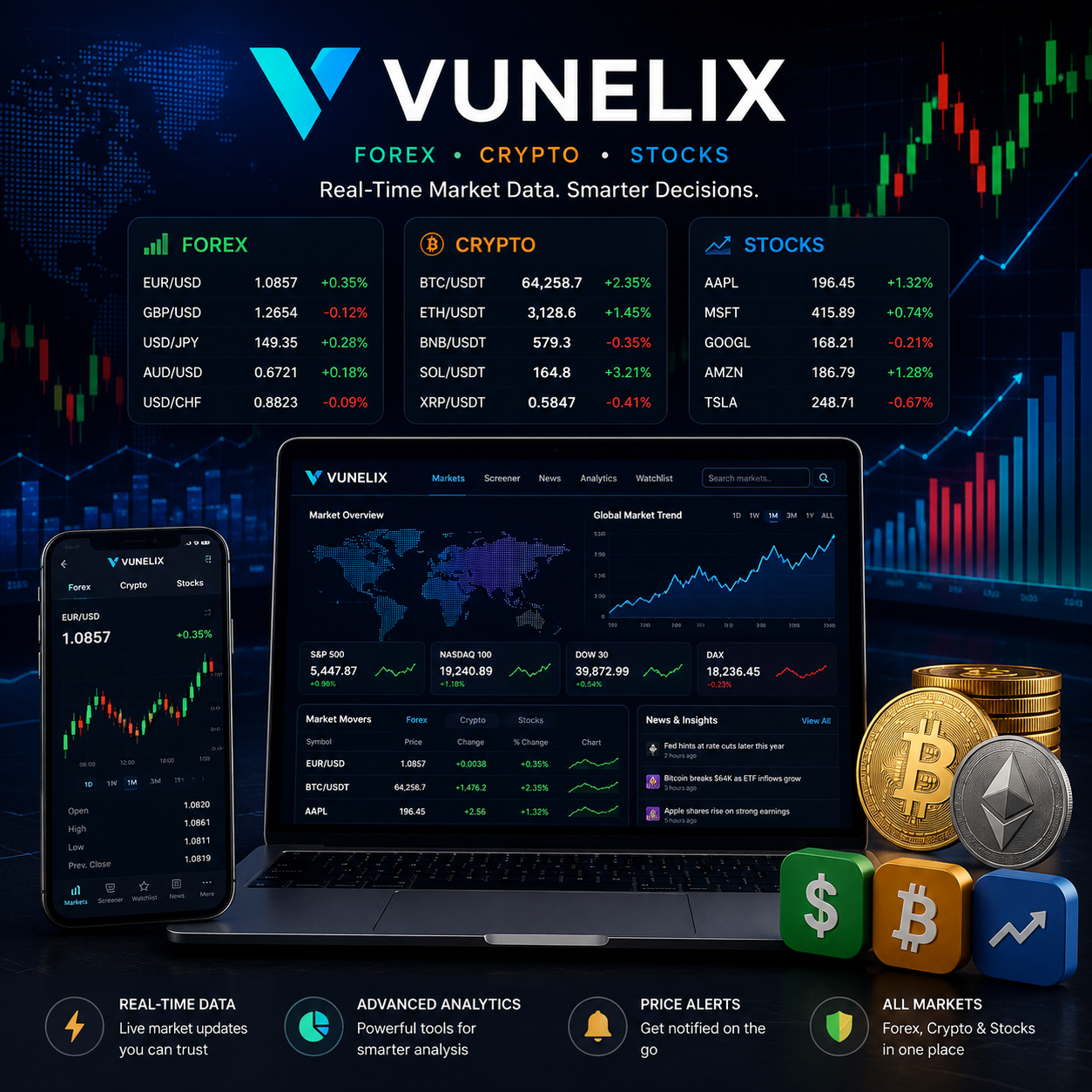
Vunelix provides real-time market data, news, and analysis covering global financial markets. The platform includes information about forex, cryptocurrencies, stocks, commodities, ETFs, and indices.
Its charts and economic updates can help users follow market trends and understand developments that may influence financial markets.
Using a free currency converter for quick calculations alongside broader market information can give users a more complete view of currency values.
Practical Example of Reading a Cross Currency Rate
Imagine you see a USD/EUR exchange rate of 0.90.
The first currency is USD, so the US dollar is the base currency. The second currency is EUR, so the euro is the quote currency.
A rate of 0.90 means one US dollar is approximately equal to 0.90 euros based on that exchange rate.
If you want to estimate the value of $1,000, you can multiply the amount by the exchange rate:
$1,000 × 0.90 = €900
A currency converter can perform this calculation automatically.
The actual amount received in a real transaction may be different because the exchange rate can change and financial institutions may charge fees.
Final Thoughts
Learning how to read cross currency rates is easier than it may initially appear. The most important concepts are understanding currency codes, identifying the base and quote currencies, and recognizing that exchange rates change over time.
A free currency converter can simplify calculations by quickly showing the estimated value of one currency in another. This is useful for travelers, businesses, freelancers, online shoppers, and anyone involved in international transactions.

 English
 Arabic
 French
 Spanish
 Deutsch
 Turkish
 Dutch
Dutch
 Italiano
 Russian
 Romaian
 Portuguese (Brazil)
 Greek
Greek