


Understanding ServiceNow Workflow and Its Benefits
What is ServiceNow Workflow?
In today’s fast-paced digital landscape, organizations are constantly seeking ways to improve efficiency, reduce manual effort, and streamline operations. One of the most effective solutions to achieve these goals is workflow automation. ServiceNow provides a powerful workflow engine that enables businesses to automate and manage their processes seamlessly across departments.
Understanding ServiceNow Workflow
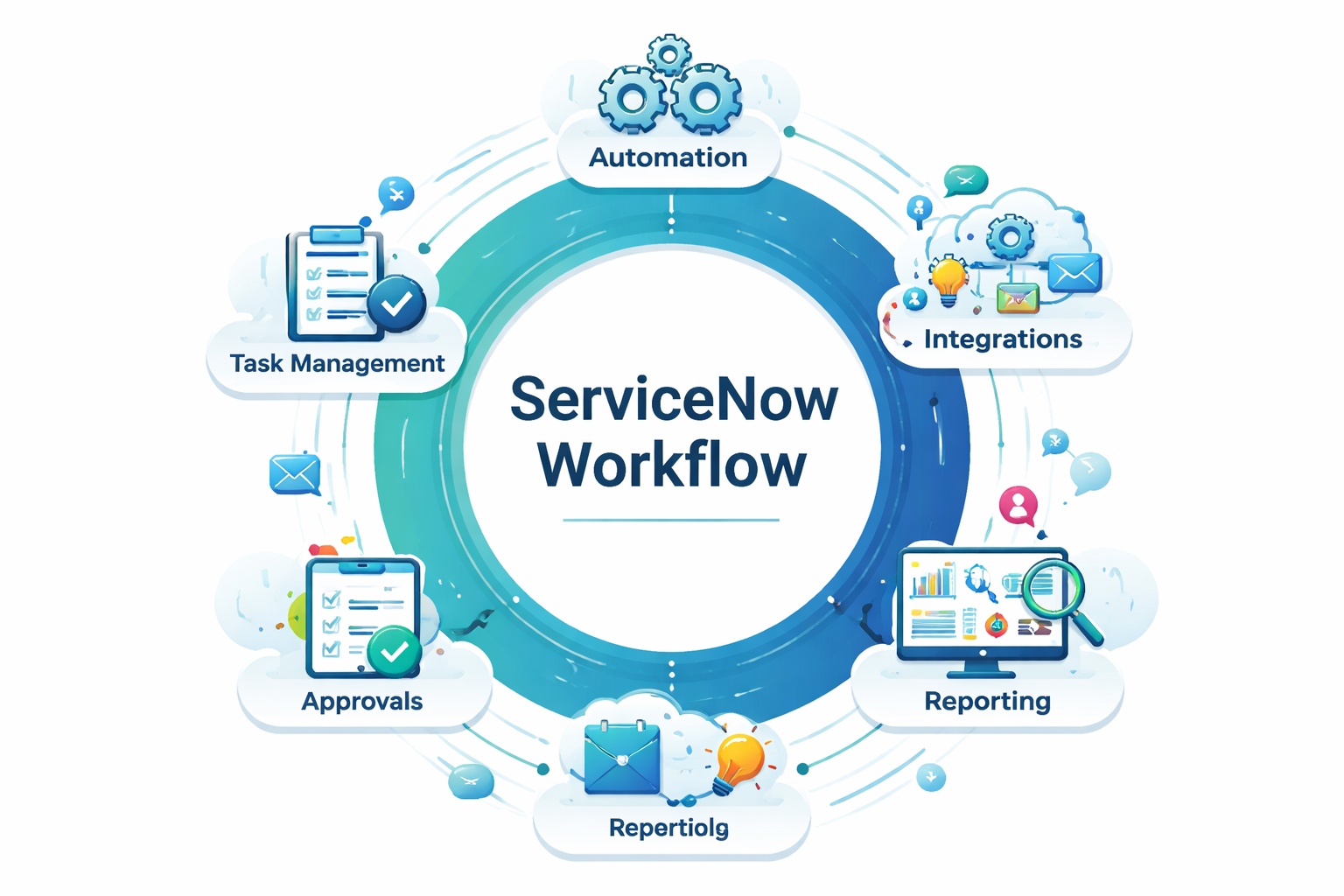
ServiceNow Workflow refers to the automation of business processes using the ServiceNow platform. It allows organizations to design, execute, and monitor workflows that connect people, systems, and data in a unified environment. Instead of relying on manual tasks, emails, or disconnected tools, workflows ensure that tasks are completed in a structured and efficient manner.
A workflow typically consists of a series of steps or activities that are triggered by specific events. These steps can include approvals, task assignments, notifications, data updates, and integrations with other systems. ServiceNow makes it easy to create these workflows using a visual interface, allowing both technical and non-technical users to design processes.
Key Components of ServiceNow Workflow
ServiceNow workflows are built using several core components that help automate and manage tasks effectively.
Triggers:
Triggers initiate a workflow based on specific conditions, such as creating a ticket, submitting a request, or updating a record.
Activities:
Activities are the individual steps within a workflow. These may include sending notifications, assigning tasks, or requesting approvals.
Conditions:
Conditions define the logic that determines how a workflow progresses. For example, a workflow may follow different paths based on approval status or priority level.
Approvals:
Approval steps allow managers or stakeholders to review and approve requests before proceeding.
Notifications:
Automated notifications keep users informed about task updates, approvals, or changes in status.
How ServiceNow Workflow Works
ServiceNow Workflow operates by automating processes from start to finish. When a trigger event occurs, the workflow engine initiates a sequence of predefined actions. Each step is executed automatically, ensuring consistency and reducing delays.
For example, in an IT service management scenario, when an employee submits a request for software access, the workflow is triggered. The system assigns the request to the appropriate team, sends approval notifications, and once approved, grants access automatically. Throughout the process, the system tracks progress and updates all stakeholders.
The platform also supports integration with third-party systems, allowing workflows to extend beyond ServiceNow. This means organizations can automate processes that involve multiple applications and data sources.
Benefits of ServiceNow Workflow
Implementing ServiceNow Workflow provides numerous benefits to organizations across industries.
Improved Efficiency:
Automation reduces the need for manual intervention, enabling faster completion of tasks and processes.
Enhanced Productivity:
Employees can focus on strategic and high-value activities instead of repetitive tasks.
Consistency and Accuracy:
Workflows follow predefined rules, minimizing errors and ensuring consistent outcomes.
Better Visibility:
Real-time tracking and reporting provide insights into process performance and bottlenecks.
Scalability:
Workflows can easily handle increased workloads as the organization grows.
Use Cases of ServiceNow Workflow
ServiceNow Workflow can be applied across various business functions to streamline operations.
IT Service Management (ITSM):
Automates incident management, change requests, and service requests, improving response times and service quality.
Human Resources:
Simplifies employee onboarding, leave management, and HR service delivery.
Customer Service:
Enhances case management by automating customer interactions and support processes.
Finance Operations:
Automates invoice processing, approvals, and financial reporting tasks.
Security Operations:
Manages incident response, threat detection, and compliance processes efficiently.
ServiceNow Workflow vs Traditional Processes
Traditional business processes often rely on emails, spreadsheets, and manual coordination. These methods are time-consuming, error-prone, and difficult to scale. In contrast, ServiceNow Workflow provides a centralized and automated approach to process management.
With automation, tasks are completed faster, approvals are tracked systematically, and communication is streamlined. This leads to improved operational efficiency and better overall performance.
Integration with Modern Technologies
ServiceNow Workflow is not limited to basic automation. It integrates with advanced technologies such as artificial intelligence, machine learning, and robotic process automation (RPA). These integrations enable intelligent workflows that can analyze data, predict outcomes, and make decisions automatically.
For example, AI-powered workflows can prioritize incidents based on urgency, recommend solutions, and even resolve issues without human intervention. This level of automation significantly enhances the efficiency of business operations.
The Future of ServiceNow Workflow
As digital transformation continues to evolve, workflows are becoming more intelligent and autonomous. ServiceNow is investing heavily in AI-driven automation, enabling organizations to create smarter workflows that adapt to changing business needs.
Future developments may include predictive workflows, advanced analytics, and agentic AI capabilities that allow systems to operate independently. These innovations will further enhance the ability of organizations to automate complex processes and improve decision-making.
Conclusion
ServiceNow Workflow is a powerful tool that enables organizations to automate and optimize their business processes. By connecting people, systems, and data in a unified platform, it helps businesses improve efficiency, reduce costs, and deliver better services.
As organizations continue to embrace digital transformation, ServiceNow Workflow will play a crucial role in driving automation and innovation across industries. Its ability to integrate with modern technologies and support scalable operations makes it an essential component of any enterprise automation strategy.

 English
 Arabic
 French
 Spanish
 Portuguese
 Turkish
 Dutch
Dutch
 Italiano
 Russian
 Romaian
 Portuguese (Brazil)
 Greek
Greek