


Hidden City Ticketing for India Flights: Legal Gray Area or Smart Hack?
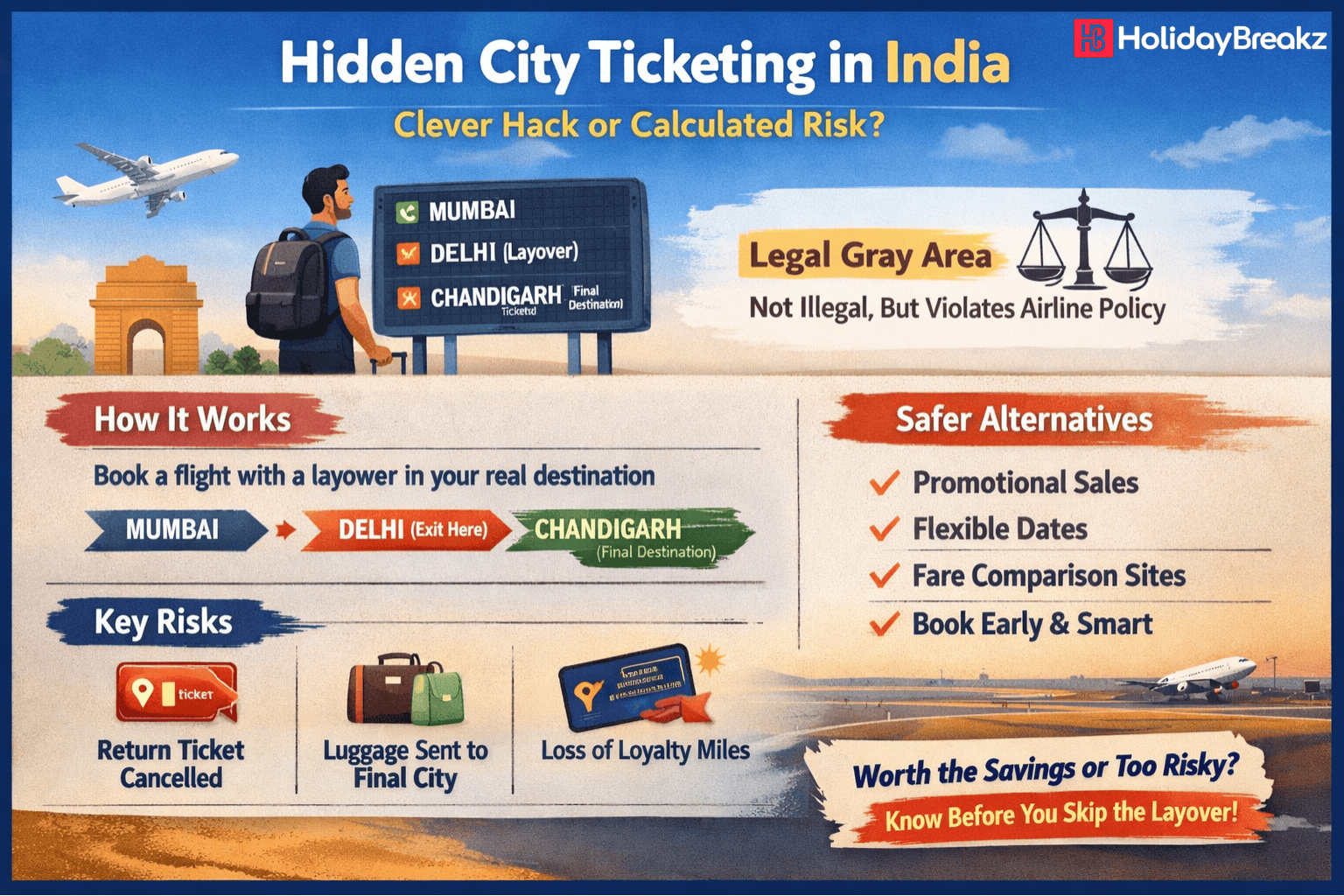
Frequent flyers are always on the hunt for a cheaper fare. And somewhere along the way, some travellers stumbled upon a quirk in airline pricing logic so counterintuitive that it sounds like it cannot possibly be real: a flight with a stopover can sometimes cost less than a direct flight to that same stopover city.
This loophole — known as hidden city ticketing — has been discussed in travel circles for years. Some call it a clever travel hack. Airlines call it a violation of their terms and conditions. The truth, as with most things in travel, sits somewhere in the middle.
This guide covers everything Indian travellers need to know about hidden city ticketing: what it is, how it works, why it exists, what the real risks are, and whether it is ever worth attempting.
What Is Hidden City Ticketing?
Hidden city ticketing — also called skiplagging — is a booking strategy where a traveller purchases a ticket to a destination beyond where they actually intend to go, and simply gets off at the stopover city instead of continuing to the final destination on the ticket.
Here is a straightforward example. Suppose you want to fly from Mumbai to Delhi. A direct ticket costs ₹8,500. But a flight from Mumbai to Chandigarh, with a stopover in Delhi, costs only ₹5,200. A hidden city traveller would book the Mumbai–Chandigarh ticket, board the flight, and disembark in Delhi — never taking the second leg of the journey.
The final destination on the ticket — Chandigarh in this case — is the "hidden city." The traveller never intended to go there. They just used it as a pricing mechanism to access a cheaper fare to their real destination.
This is not a glitch or a booking error. It is a deliberate strategy that exploits inconsistencies in how airlines construct their fare structures.
Why Does This Pricing Anomaly Even Exist?
To understand hidden city ticketing, you first need to understand how airline pricing actually works — because it is far from logical.
Airlines do not simply price each route based on distance or operating cost. Pricing is driven by competition, demand, hub strategy, and revenue management algorithms that adjust fares dynamically based on dozens of variables.
The hub-and-spoke model is the biggest contributor to this anomaly. Most major airlines route passengers through central hub airports. A flight from a smaller city to a major destination may be priced higher than a connecting itinerary through that same major destination, simply because the airline faces more competition on the longer connecting route or because it is trying to fill seats on a less popular leg.
Yield management systems compound this. Airlines use sophisticated software to fill aircraft as profitably as possible. This sometimes results in a two-leg connecting itinerary being priced below a single direct leg on the same route — not because the airline made a mistake, but because the demand and competitive dynamics on those two markets are completely different.
The result is that Mumbai–Delhi can cost more than Mumbai–Delhi–Chandigarh. It makes no intuitive sense, but it is a predictable outcome of how airline revenue management works.
How Do Travellers Find Hidden City Fares?
Identifying hidden city opportunities requires looking at connecting itineraries that route through your actual destination.
Some travellers do this manually by searching for flights from their origin city to various destinations and checking whether any connections pass through where they actually want to go. This is time-consuming but occasionally produces results.
A website called Skiplagged was built specifically to surface these opportunities — it searches for itineraries where the layover city matches a traveller's real destination. The site became controversial enough that United Airlines and Orbitz filed a lawsuit against it in 2014, though the case was eventually dismissed.
In India, the dynamics are slightly different. The domestic aviation market here is dominated by a smaller number of carriers, and the route network is not as hub-dependent as the American or European systems. Hidden city opportunities do exist, but they are less frequent and the savings can vary more unpredictably.
Is Hidden City Ticketing Legal in India?
This is the question most travellers want answered first, and the honest answer is: it is not illegal, but it almost certainly violates your airline's contract of carriage.
There is no Indian law that makes hidden city ticketing a criminal offence. The Directorate General of Civil Aviation (DGCA) does not classify it as fraud, and no traveller in India has faced criminal charges for getting off at a connecting city.
However, airlines have their own terms and conditions — the contract you agree to when you purchase a ticket. Almost every major carrier operating in India, including IndiGo, Air India, Vistara (now merged with Air India), SpiceJet, and Akasa Air, has clauses in their fare rules that prohibit this practice. These terms typically state that passengers must fly all legs of a booked itinerary in sequence, and that the airline reserves the right to cancel remaining segments, revoke frequent flyer miles, or take other action if a passenger is found to have engaged in hidden city ticketing.
So where does that leave you legally? In a gray area. You are not breaking the law. But you are potentially in breach of a private contract, which carries its own set of consequences.
What Are the Real Risks of Hidden City Ticketing?
This is where the "smart hack" narrative gets considerably more complicated. The risks are real, and for many travellers, they outweigh the savings.
Your Return Ticket May Be Cancelled
This is the most significant and commonly overlooked risk. If you book a round-trip ticket and skip the second leg of the outbound journey, the airline's system may automatically cancel your entire return booking. You could arrive at the airport expecting to fly home and find that your return ticket no longer exists.
Airlines flag incomplete itineraries in their systems, and automated processes can cancel subsequent bookings without warning. By the time you discover this, rebooking may be expensive — especially if it is close to your return date.
Checked Baggage Cannot Be Reclaimed Mid-Journey
If you check any luggage, it will be tagged to your final ticketed destination — not your actual stop. If you are flying Mumbai–Delhi–Chandigarh and you check a bag, that bag will be loaded for Chandigarh. You cannot retrieve it in Delhi. This means hidden city ticketing only works if you are travelling with cabin baggage only.
Frequent Flyer Miles May Be Forfeited
Airlines monitor for patterns of hidden city ticketing among frequent flyer members. If detected, the airline may cancel accrued miles, downgrade loyalty status, or in some cases close the loyalty account entirely. For regular flyers who have accumulated significant points, this is a meaningful risk.
You Could Be Denied Boarding on Future Flights
Some airlines, particularly in the United States, have been known to flag repeat hidden city travellers and deny them boarding or restrict their ability to purchase certain fare types. While this is more common in Western markets, the principle applies wherever airlines share passenger behaviour data.
The Price Gap May Not Be Worth It
After factoring in the cabin-bag-only restriction, the risk to your return ticket, and the loyalty programme implications, the actual saving from a hidden city fare may not be as significant as it first appears. In India's domestic market especially, where low-cost carriers frequently run promotional fares, you can often find a competitive direct fare without any of the associated risk.
Hidden City Ticketing vs. Other Flight Hacks: How Does It Compare?
Hidden city ticketing is one of several unconventional booking strategies that experienced travellers use. It is worth placing it in context alongside the others.
Throwaway ticketing is a related practice where a traveller books a connecting itinerary but only uses part of it — typically the first leg. It carries similar risks to hidden city ticketing.
Fuel dumping involves exploiting fare codes to remove fuel surcharges from international tickets. It is more technical, requires specific knowledge of airline fare structures, and is also a violation of airline terms.
Positioning flights are a legitimate and widely used strategy where travellers fly to a different city to catch a cheaper international departure. This is completely above board — you use every leg of every ticket you purchase.
Error fares are genuine pricing mistakes by airlines or booking systems that result in unusually low fares. Booking an error fare is generally legal, and many airlines honour them, though not all are obligated to.
Of these strategies, positioning flights and monitoring for error fares carry no risk and are perfectly legitimate. Hidden city ticketing and throwaway ticketing sit in breach-of-contract territory and carry the risks described above.
Is Hidden City Ticketing More or Less Risky on Indian Routes?
India's domestic aviation market has some specific characteristics that affect how hidden city ticketing plays out here.
Fewer hub-and-spoke anomalies. Indian domestic routes are more point-to-point than the major American carriers. IndiGo, the largest domestic carrier, does route through Delhi and Mumbai as de facto hubs, but the pricing anomalies that make hidden city ticketing common in the US are less frequent here.
Smaller loyalty programmes. India's frequent flyer programmes — IndiGo BluChip, Air India Flying Returns — are smaller and less integrated with global alliances than programmes like Star Alliance or oneworld. This slightly reduces the loyalty account risk, though it does not eliminate it.
Dynamic low-cost fares. India's domestic market is one of the most competitive in the world for low-cost travel. IndiGo, SpiceJet, and Akasa Air regularly offer promotional fares at prices that make hidden city savings look marginal by comparison. On many routes, searching for and booking a direct promotional fare during a sale period will produce a better outcome than any hidden city itinerary.
International routes are higher risk. Hidden city ticketing on international routes from India — say, booking Mumbai–London–Amsterdam to get to London more cheaply — carries substantially greater risk than on domestic routes. Return ticket cancellation on an international booking is a much more serious and expensive problem.
What Do Airlines Actually Do When They Catch You?
The short answer is: usually not much, for a one-time incident. Airlines are primarily concerned with frequent and systematic hidden city ticketing, not the occasional passenger who gets off at a layover.
That said, here is what airlines can and do reserve the right to do:
- Cancel remaining segments of the current itinerary automatically.
- Cancel future bookings linked to the same passenger profile, including return tickets.
- Revoke frequent flyer miles earned on the affected itinerary.
- Close loyalty accounts for repeat offenders.
- Charge the fare difference between what was paid and the market price for the journey actually flown — this has happened in documented cases in Europe.
- Ban passengers from purchasing certain discounted fare classes in the future.
In India, airline enforcement of this kind is less aggressive than in some Western markets, but the risk is not zero — and it is growing as airline data systems become more sophisticated.
The Ethical Dimension: Is It Actually Fair?
Beyond legality, some travellers think about whether hidden city ticketing is ethically defensible. Perspectives vary.
The case for it: Airlines engage in opaque, inconsistent, and sometimes arbitrary pricing. Passengers who cannot afford business class are regularly penalised for booking flexibility or choosing direct routes. Using the airline's own pricing structure to find savings is no different from using a promotional code or booking during a sale.
The case against it: When a traveller skips a flight leg, they leave a seat empty on the second leg that could have been sold to another passenger. If many travellers do this, airlines respond by raising prices or reducing routes — outcomes that affect everyone. There is also an argument that agreeing to terms and conditions creates an obligation to honour them.
Most travel experts land somewhere in the middle: hidden city ticketing is not morally equivalent to fraud, but it is not a consequence-free strategy either. The risks are real, and the ethical calculation is personal.
Practical Alternatives That Achieve Similar Savings Without the Risk
If the goal is to pay less for flights in India, there are legitimate strategies that work consistently and carry no risk whatsoever.
Book early, but watch for fare drops. Indian domestic fares often drop in the 6–8 week window before departure, particularly on competitive routes. Setting fare alerts on booking platforms allows you to catch these drops without monitoring manually.
Be flexible with travel dates. Mid-week flights — particularly Tuesday, Wednesday, and early Thursday — are consistently cheaper than weekend travel on most Indian domestic routes.
Use connecting itineraries legitimately. Sometimes a genuine connecting itinerary is cheaper than a direct flight, and you actually fly the whole route. This is a completely legitimate way to save money, no rules violated.
Book during airline sale seasons. Indian carriers run periodic sales — often around Independence Day, Republic Day, and festive seasons — where fares on major routes drop significantly. Planning travel around these windows produces reliable savings.
Compare total fares including baggage. A headline fare that looks cheaper may cost more once checked baggage is added. Comparing total prices across carriers using a platform like HolidayBreakz India — which displays fare conditions and baggage policies together — gives you a more accurate picture of what you will actually pay.
Frequently Asked Questions About Hidden City Ticketing
Is hidden city ticketing illegal in India?
No, it is not a criminal offence under Indian law. However, it violates the terms and conditions of most airline contracts, which can result in the airline cancelling your remaining ticket, revoking miles, or taking other action against your booking.
Can I use hidden city ticketing with checked baggage?
No. If you check luggage, it will be sent to the final destination on your ticket, not the city where you disembark. Hidden city ticketing only works if you travel with cabin baggage only.
Will the airline find out?
Airlines monitor for this behaviour, particularly among frequent flyers. A single instance may go unnoticed, but repeat use — especially by loyalty programme members — is more likely to be flagged.
Does hidden city ticketing work on international flights from India?
It can, but the risks are significantly higher. Cancellation of return tickets on international routes is a much more costly problem than on domestic bookings. The potential savings rarely justify the risk on long-haul international itineraries.
What happens if my return ticket gets cancelled?
You would need to rebook at the current market price, which could be substantially higher than your original fare — particularly if the cancellation is discovered close to your return date. This is the most financially damaging risk of hidden city ticketing.
Are there legitimate ways to find cheap flights without hidden city ticketing?
Yes. Flexible travel dates, early booking, watching for promotional fares, and using a reliable fare comparison platform consistently deliver savings without any of the risks associated with hidden city ticketing.
Has any Indian traveller been sued for hidden city ticketing?
There are no publicly known cases of an Indian airline suing a domestic passenger for hidden city ticketing. However, civil action is theoretically possible under contract law if an airline chose to pursue it, particularly for significant or repeated violations.
What is skiplagging?
Skiplagging is the American term for hidden city ticketing, popularised by the website Skiplagged.com. The terms are interchangeable.
The Verdict: Clever Hack or Calculated Risk?
Hidden city ticketing occupies a genuinely uncomfortable space in travel strategy. It is not illegal. It is not fraud. But it is a breach of contract that carries real, tangible risks — most seriously, the potential cancellation of your return ticket and the loss of loyalty account benefits.
In India's domestic market, where competition between low-cost carriers keeps fares relatively accessible and promotional sales are frequent, the practical case for hidden city ticketing is weaker than in markets where it is more commonly discussed. The savings are often smaller, the risks are the same, and there are legitimate alternatives that produce comparable results without any of the downside.
If you are a casual traveller flying occasionally, the risk is low but not zero. If you are a frequent flyer with accumulated miles and a loyalty status worth protecting, the risk is much harder to justify.
The smarter approach — for most Indian travellers, most of the time — is to become a better fare hunter through legitimate means: setting alerts, booking strategically, comparing total costs clearly, and using trusted platforms to make informed decisions. That path may not have the same "hack" appeal, but it reliably delivers savings without the anxiety of wondering whether your return ticket still exists.
Travel smart. Fly confidently. And always read what you are agreeing to when you book.

 English
 Arabic
 French
 Spanish
 Portuguese
 Deutsch
 Dutch
Dutch
 Italiano
 Russian
 Romaian
 Portuguese (Brazil)
 Greek
Greek